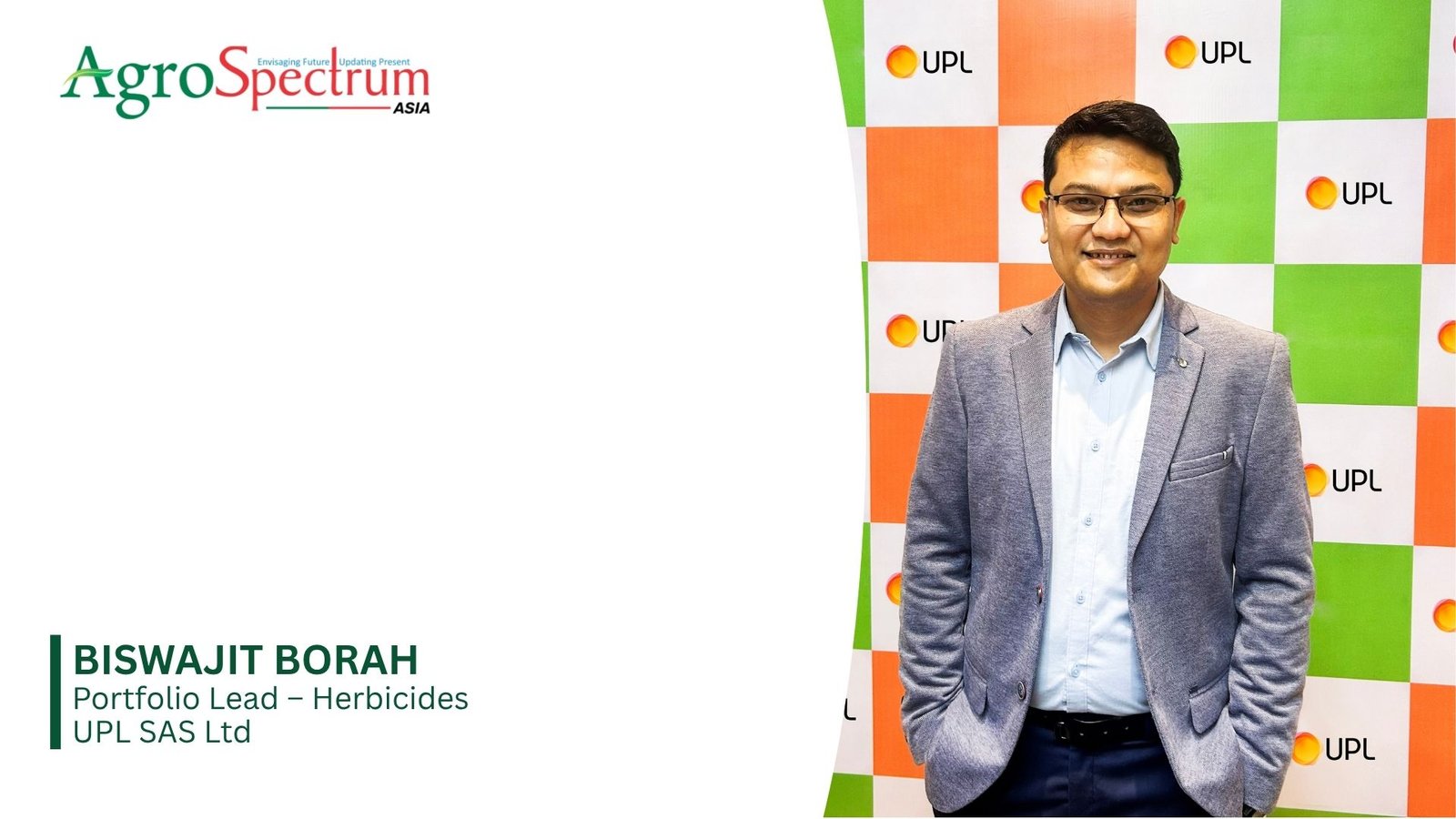
India's rice farmers are navigating one of the most significant transitions in modern agriculture. Rising labour costs, unpredictable weather and growing herbicide resistance are forcing a rethink of how weeds are managed, making innovation as much about strategy as chemistry. In this exclusive AgroSpectrum interview, Biswajit Borah, Herbicide Portfolio Lead, UPL SAS Ltd, explains why the industry's next breakthrough will come from changing farmer behaviour rather than simply introducing new molecules. He discusses the role of early intervention, integrated crop management and stewardship in building more resilient and profitable rice production systems. The conversation also explores the future of Wet Direct Seeded Rice (Wet DSR), the growing importance of digital agronomy and UPL's long-term vision for sustainable crop protection.
Ricebeaux enters a rice herbicide market that is already crowded with post-emergence products. Beyond broad-spectrum weed control, what structural gap in India's weed management ecosystem does this product aim to address, and how does it fundamentally change farmers' weed control strategies?
Let me be direct — India's rice herbicide market does not need one more molecule. It needs a paradigm shift from reactive spraying to planned, effective weed management. That is the gap Ricebeaux is built to close.
Today's farmer sprays when weeds are visible, then compensates with tank mixes, repeat applications or higher doses — a cycle driven by erratic monsoons, labour scarcity and increasingly tough weeds like Echinochloa crusgalli and Cyperus difformis. Ricebeaux, a pre-mix of Propanil 35.1% + Penoxsulam 0.9% SC, is our answer — application at the 2–3 leaf stage of weeds, broad-spectrum control across grasses, sedges and broadleaf weeds, and uncompromised crop safety. This is not a product story. This is a behavioural shift — from firefighting to foresight.
Herbicide resistance is emerging as a growing concern in rice ecosystems worldwide, particularly with repeated use of the same chemistry. Ricebeaux combines two active ingredients with different modes of action. How significant is this approach in delaying resistance, and what stewardship practices will be necessary to preserve its long-term efficacy?
Resistance is the single biggest threat to the long-term viability of chemical weed management in Indian rice. Repeated, single-site use of similar mode of action active ingredients like ALS and ACCase has already produced tolerance in Echinochloa spp. and Cyperus difformis across major geographies.
Our position is unambiguous: the future belongs to multi-mode chemistry, applied with discipline. Ricebeaux combines Propanil (PS II inhibitor) with Penoxsulam (ALS inhibitor) — two independent biochemical pathways acting together, which actually slows resistance build-up. But chemistry alone is not stewardship. We are institutionalising four non-negotiables with our channel partners and farmers — apply at the correct 2–3 leaf weed stage, restrict use to Transplanted and Wet DSR (not Dry DSR), follow the label dose of 1200 ml/acre, and re-flood the field 24 hours after application for at least 10 days.
Climate variability is altering weed emergence patterns, while labour shortages continue to reshape crop management practices. How are these two structural trends influencing herbicide innovation, and do you expect early post-emergence solutions to gradually replace traditional weed management practices in Indian rice cultivation?
These are not passing headwinds — they are the new baseline of Indian agriculture, and any herbicide innovation that does not begin here will not survive the next decade.
Erratic monsoons are compressing the weed-control window and triggering multiple flushes; labour cost and availability have made manual weeding economically unviable across most of India. That reality is pulling the entire industry towards fewer sprays, wider spectrum, multi mode-of-action pre-mixes and safer early post-emergence chemistry — precisely the space where the segment is growing at ~4 per cent CAGR.
My conviction is clear: early post-emergence solutions like Ricebeaux will progressively replace late, multi-spray practices — especially in labour-scarce, high-rainfall belts of South and East India.
Wet Direct Seeded Rice (Wet DSR) is gaining policy attention because of its potential to reduce water use and labour requirements. How critical will specialised crop protection solutions be in accelerating DSR adoption, and what role do you see Ricebeaux playing in supporting this transition?
Wet DSR will not scale on policy intent alone. It will scale when we solve for the farmer's biggest fear — losing the crop to weeds in the first 25 days after sowing. In Wet DSR, weed pressure peaks at 0–25 DAS with a complex mix of Echinochloa, Cyperus iria, Fimbristylis, Monochoria and Ludwigia spp., and yield losses of 20–40 per cent are the norm when management fails. This is the barrier that has held DSR back for years.
Ricebeaux is registered for both Transplanted Rice and Wet DSR, applied at 10–15 DAS at the 2–3 leaf stage of weeds — a single, broad-spectrum, crop-safe intervention purpose-built for this system. In our view, Ricebeaux is one of the tools that will make water-saving, labour-light rice cultivation commercially viable at scale in India.
India's rice cultivation is becoming increasingly input-intensive, even as policymakers emphasise sustainable and precision agriculture. How is UPL balancing the need for higher field productivity with the growing expectation for responsible herbicide use, resistance management and environmental stewardship?
I do not accept the framing that yield and sustainability are in tension. In a country producing rice on 45+ million hectares, they are the same conversation. UPL's approach rests on three deliberate pillars:
Fewer, smarter interventions: Early post-emergence pre-mixes like Ricebeaux replace two or three sprays with one — reducing active ingredient load, spray drift and cost.
Resistance-proofing by design: Dual mode of action combined with disciplined rotation across our pre-emergence brands — Saathi, Eros, Eros Gold — builds durability into the portfolio.
Non-negotiable application discipline: Saturated soil at application, re-flooding after 24 hours, correct weed stage — enforced through channel training and farmer engagement.
This is what sustainable intensification looks like in practice — more yield per acre, per drop, per spray.
Farmers increasingly evaluate crop protection products on overall return on investment rather than efficacy alone. Based on your field evaluations, how does Ricebeaux influence yield protection, labour savings and cost efficiency compared with conventional herbicide programmes involving multiple sprays or tank mixes?
Farmers are the sharpest ROI analysts I know, and they should be. Our field evaluations across major rice geographies, benchmarked against farmer practices market standards— consistently show Ricebeaux performing on-par to superior on the weeds that actually matter: Echinochloa, Leptochloa chinensis, Fimbristylis, Scirpus and Cyperus difformis.
The ROI translates into three tangible gains for the farmer:
Yield protected in the critical window: Uncontrolled weeds cost 20–60 per cent of yield in the first 30 DAS.
Labour and time reclaimed: application at right time - instead of multiple tank-mix experimentation.
Cost efficiency: no tank-mix errors, no crop shock. Value for money delivered as net yield per rupee spent.
Rice remains one of India's most strategically important crops for both domestic food security and exports. As production systems modernise, what are the next major technological gaps in rice crop protection that still require innovation, and where does UPL intend to focus its R&D investments over the next decade?
Rice is India's most strategic crop — for food security, farmer incomes and export revenue. The innovation agenda for the next decade must reflect that stakes-level. As I see it, the real technological gaps are: Sustainable cultivation, profitable farmers. The next wave of innovation must make rice cultivation gentler on soil, water and the environment — while ensuring the farmer earns more, not less. Water-saving systems like Wet DSR, resistance-managed chemistry and reduced-load formulations are central to this shift, and Ricebeaux is a clear step in that direction.
Integrated pest management, tailored to India's diversity. India is not one rice market — it is many. Weed flora, water availability, labour dynamics and farmer practices vary sharply from Punjab to Chhattisgarh to the Cauvery delta. The real innovation is not one more molecule; it is region-specific IPM programmes that blend chemistry, biologicals and digital advisory into solutions that fit each geography. From sustenance to dominance — more output, fewer resources. India must move beyond producing enough rice to producing better rice — higher yields per acre, per drop of water and per unit of input. That calls for smarter chemistry, precision application, resistance-proof portfolios and season-long crop programmes rather than isolated sprays.
The Indian crop protection industry is rapidly shifting towards integrated solutions that combine chemistry, biologicals and digital advisory platforms. How does Ricebeaux fit into UPL's broader strategy of offering integrated crop management solutions rather thanstandalone products, and how do you see this model evolving for rice farmers in the coming years?
Selling standalone products is the industry's past. Selling a crop programme is its future — and that is exactly how we have designed our rice portfolio. Ricebeaux is one node in an integrated, season-long rice solution: Saathi and Eros/Eros Gold at pre-emergence, Ricebeaux at early post-emergence, and Kevuka and Zevigo for stem borer management, Saaf, Tridium of comprehensive disease management & crop excellence, through the vegetative and reproductive stages.
Around this chemistry sits our digital and engagement layer — the Farmily platform for retailer and farmer connect via nurture.farm, WhatsApp advisories, farmer training on water management and application discipline, and demonstration-led adoption. The direction is clear- UPL is going to lead that transition, not follow it.
-- Suchetana Choudhury (suchetana.choudhuri@agrospectrumindia.com)