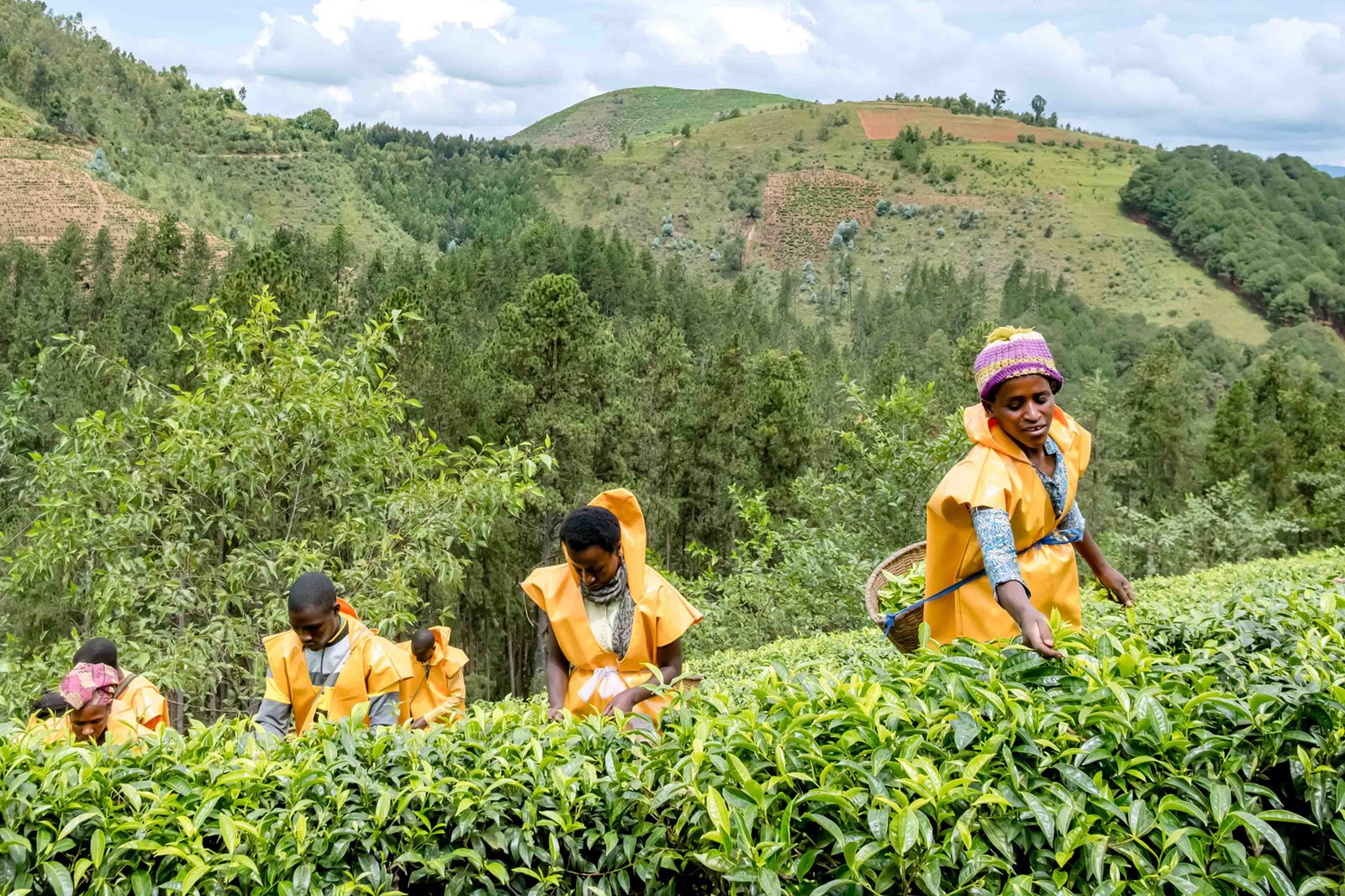
Photo courtesy: FAO/Jean Nkurunziza
How Rwanda is maximising its hilly landscape and boosting up small-scale farmers for quality tea production
Dawn breaks over the lush, green fields of the country of 1000 hills. As the sun rises, the ethereal mists shrouding the hilltops begin to lift, signaling another day for Rwanda’s agricultural workers.
Tea leaves shimmer in the rising sun as tea pluckers don their colourful yellow protective gear, safeguarding them from scratches as they plunge into verdant rows of tea plants. A wicker basket is strapped to their backs, ready to collect the leaves they expertly pluck. This wave of yellow-clad tea harvesters works swiftly and methodically through the rows as birdsongs fill the air. Their daily efforts have helped cement tea as Rwanda’s second largest export after coffee.
Rwanda’s agriculture sector is the backbone of this landlocked East African nation, employing an estimated 64.5 percent of the population and accounting for 27 percent of gross domestic product (GDP).
And tea has changed the lives of many rural communities in Rwanda.
Over 83 percent of Rwanda’s agricultural production is carried out by smallholder farmers, including in the tea producing region of Nyaruguru in southern Rwanda.
“I am proud to be a tea farm owner. I used to work for other people, but now I provide work for others,” says Bertride Nyiranzigiye, a 65-year-old woman farmer who began producing tea on her plot of just under one hectare in 2018, when the Government was working with local farmers to expand tea production in the region.
“Nyaruguru, once it was identified for expansion of tea production, now attracts people from other districts who come to work and earn money from tea harvesting.”
Ndagijimana Jean Marie Vianney, a 39-year-old fellow tea farmer in Nyaruguru and father of four children, recalls, “I was living in extreme poverty, and my family was struggling. I saw other tea farmers doing well, so I decided to start tea farming myself. I wanted to improve my livelihood.”
Jean took part in the Government’s specialised training programme and then decided to clear his sweet potato fields to grow tea instead.
“When I started harvesting tea, it helped me to lift my family from the poverty we were all living before. Now, I can get clothes and health insurance for my family. I can also afford school fees for my children. We’ve improved our nutrition too. This is all the result of tea farming.” He believes the perennial nature of the tea crop will also allow his children to continue production in the future.
Tea was first introduced to Rwanda in the 1950s, but the sector has grown rapidly in recent decades. Rwanda’s climate, with its mix of abundant rainfall and sunshine, gently rolling hills and mineral-rich volcanic soils boast an ideal environment for tea production.
The Food and Agriculture Organization of the United Nations (FAO) has been working with the Rwandan Government to develop a national tea strategy, aimed at improving quality and helping the country to meet international standards and access the best markets.
The strategy identifies several areas for improvement, including bolstering research and innovation, developing infrastructure, providing continuous training for farmers, and attracting youth to the sector. Its success rests heavily on partnering with farmers to create high-quality, niche market teas.
Sandrine Urujeni, Chief Operations Officer at National Agriculture Export Development Board of Rwanda (NAEB), explains more about the strategy, “Rwandan tea is high quality tea, but it requires handpicking and making sure that farmers select good leaves.”
According to Urujeni, strong links between small-scale farmers, cooperatives and post-harvesting facilities are key to growing the sector.
“Tea farmers are happy that tea is now vertically integrated, meaning that our farmers benefit from the tea industry. Our farmers receive 50 percent of the revenues from tea. That goes back to the farmer. So, for instance, if exporters are selling their teas, either through direct sales or through auction, we make sure that the farmers behind that good quality tea are rewarded. In that way, they are able to reinvest back in tea production.”
These small-scale tea producers are at the heart of the Rwandan tea sector, with women playing a leading role. A growing number of Rwandan tea farm owners are women, and women also make up a larger segment of the tea harvesters and factory workers. With plans to expand value added activities and related sectors like agritourism, those numbers are destined to grow.
According to Mohamed AwDahir, the FAO Representative in Rwanda, Rwandan women farmers like Bertride Nyiranzigiye are who we are celebrating in this International Year of the Woman Farmer: “In Rwanda, women are the key drivers of agricultural production, with women heavily involved in production, farm management, and processing. Importantly, the government is fully determined to ensuring women farmers are empowered, and FAO is part of that process.”
Women and men working side-by-side in the fields of the Nyaruguru and numerous other regions throughout Rwanda are harvesting only the tenderest and freshest top tea leaves by hand. These leaves are destined for higher quality teas that fetch better prices and help build vibrant rural communities across the country.
To read more, click: https://www.fao.org/newsroom/story/hilltops-and-teacups/en