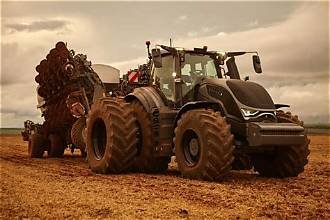
Precision agriculture is moving closer to the tractor itself. Valtra Unlimited has partnered with Danish agricultural technology company PerPlant to integrate its AI-powered crop sensor into new Valtra tractors, making plant recognition and precision application capabilities available as a factory-fitted option.
The technology will be offered across Valtra A105 and A115, G, N, T, Q and S Series models through Valtra Unlimited in selected European markets. Availability in additional markets will be considered upon request. Sales began in October 2026, coinciding with the introduction of Valtra's sixth-generation T Series.
The integration marks a shift in how precision farming technologies are delivered to growers. Rather than sourcing and installing sensing equipment separately, farmers can configure their tractors with AI-powered crop recognition technology before the machines leave the factory. For Valtra, the partnership strengthens its customised tractor offering by bringing intelligent crop sensing into its existing precision farming ecosystem. For PerPlant, factory integration with an established tractor manufacturer provides a route to expand the reach of its technology among commercial farmers.
Precision farming, built into the tractor
Valtra Unlimited specialises in configuring tractors around individual customer requirements, integrating equipment and technologies before delivery. The addition of the PerPlant Sensor extends this approach to AI-based crop intelligence. Farmers purchasing eligible models can select the sensor through Valtra's Customise and Quote tool, where it is listed as 'UNL PerPlant Crop Sensor' under option code 64352800.
The factory-fitted arrangement is intended to eliminate the need for separate hardware procurement and installation, allowing farmers to access crop-sensing capabilities from the outset. The sensor consists of a single AI processing unit equipped with two cameras, mounted on the tractor roof. As the tractor moves through a field, the cameras continuously scan vegetation and process visual information to identify plants and generate actionable field data.
The technology is designed to translate crop-level observations into precision application decisions, reducing the dependence on uniform input distribution across entire fields.
From plant recognition to precision application
The PerPlant system supports three principal applications: targeted spraying, variable-rate input application and field mapping. For weed management, its AI-powered recognition capabilities enable spot spraying across different vegetation backgrounds, including green-on-green applications, such as identifying broadleaf weeds in grass, as well as green-on-brown and green-on-yellow scenarios.
This capability is particularly relevant where farmers need to distinguish unwanted plants from desirable vegetation, a task that conventional blanket spraying systems cannot perform with the same level of selectivity. The sensor also supports variable-rate application of fertilisers, fungicides and plant growth regulators, during both daytime and nighttime operations.
Beyond application control, the system generates maps and documentation covering biomass, weed distribution and potential risk zones throughout the growing season. The resulting information can be uploaded to farm management systems, helping farmers build a more detailed picture of field conditions over time.
Connecting AI with existing farm machinery
An important feature of the integration is its compatibility with existing farm machinery and digital systems. The PerPlant Sensor works with ISOBUS-compatible sprayers, spreaders and seeders, integrating with the tractor's existing ISOBUS architecture. This allows the sensing technology to work alongside compatible implements rather than requiring an entirely separate machinery ecosystem.
The solution also complements Valtra's existing precision farming portfolio and can operate alongside other technologies within its wider ecosystem, including solutions from PTx. This interoperability is significant as farmers increasingly seek to combine machinery, sensing equipment and farm management platforms without creating fragmented technology systems.
The broader objective is to make precision agriculture more accessible by reducing the technical complexity associated with adopting individual digital tools.
Input savings make the commercial case
The economic proposition centres on reducing unnecessary input application through more targeted field operations. According to PerPlant, farmers using the technology have achieved input savings ranging from 40 per cent to 87 per cent, depending on the implement and application. The company estimates an average operating cost of approximately €4 per hectare for a 200-hectare farm.
The reported savings highlight the potential financial benefits of precision application, particularly as fertiliser and crop protection costs remain important considerations in farm profitability. However, actual savings will depend on crop type, weed pressure, field conditions, application practices and the machinery being used. For farmers, the investment case will ultimately rest on whether the reduction in input expenditure outweighs equipment and operating costs while maintaining effective crop management.
Industry collaboration brings AI closer to farmers
Tomi Siljander, manager of Product Engineering Unlimited at Valtra, said the partnership responds to increasing demand for technologies that enable more precise and profitable farming. He noted that PerPlant's technology fits within the Valtra Unlimited offering and gives farmers across Europe access to precision application capabilities directly through their new tractors.
Rasmus Emil Hansen, CEO and co-founder of PerPlant, said the collaboration addresses a major barrier to precision farming adoption: the cost and complexity associated with acquiring and installing additional technology. By integrating AI crop sensing at the factory, the companies aim to make plant-level intelligence a more accessible component of everyday farm operations.
The partnership also reflects a broader development in agricultural machinery, where the value proposition of tractors is increasingly extending beyond horsepower, engine efficiency and mechanical performance to include connectivity, automation and data-driven decision-making. As agricultural input costs, labour constraints and sustainability requirements reshape farm economics, the ability to identify crop conditions and apply inputs selectively is becoming an increasingly important competitive consideration.
With AI-powered crop sensing now entering Valtra's factory configuration process, the partnership positions intelligent machinery integration as another step towards making precision agriculture part of standard farm operations.