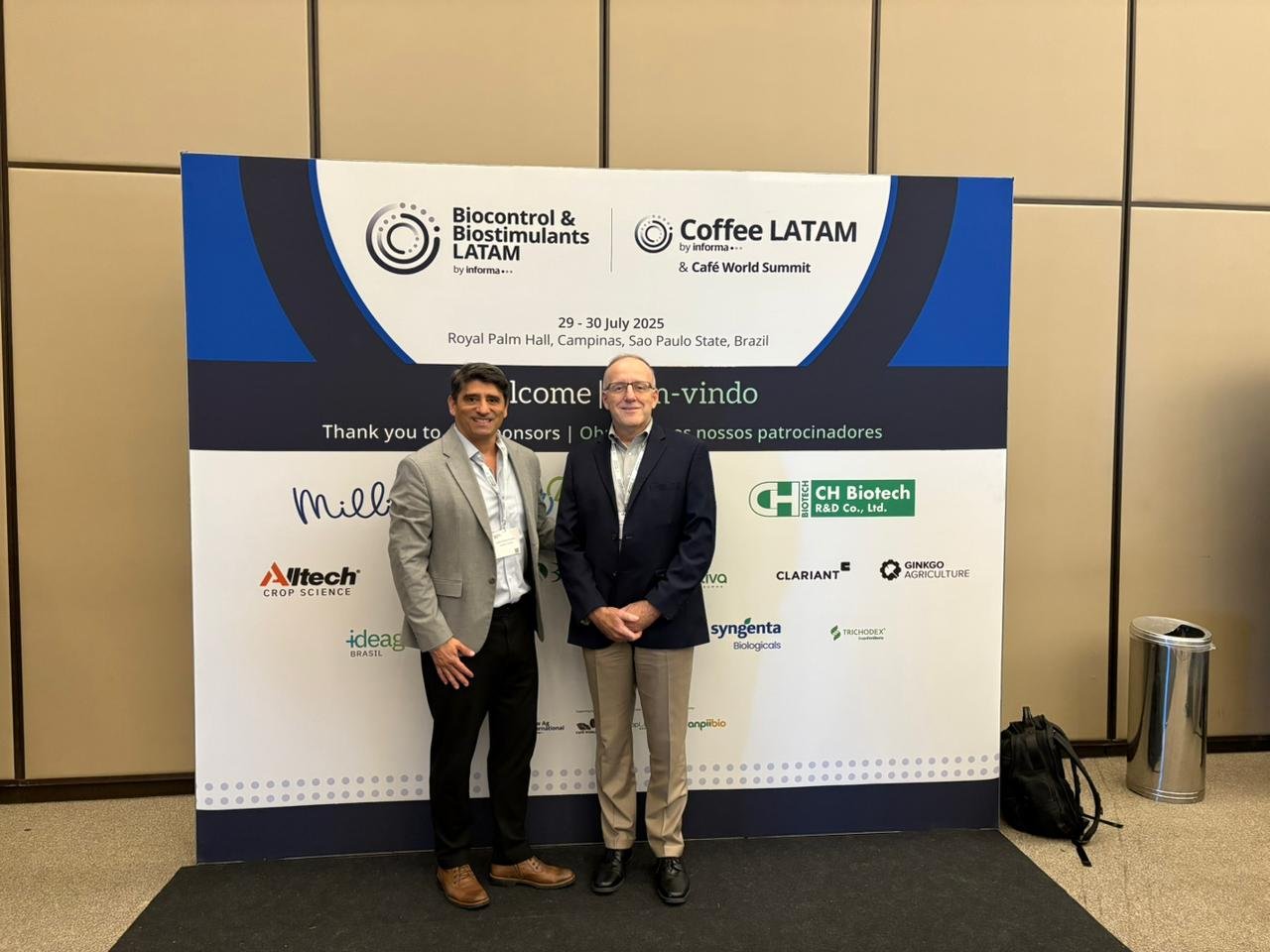
According to the latest Biological Market Overview & Future Trends, the industry's next winners will be determined less by market momentum and more by their ability to differentiate products, integrate biologicals into existing production systems, and execute commercially. The information will be presented by the president and founder of DunhamTrimmer, Mark Trimmer, in the Biocontrol LATAM 2026, held in Campinas, Brazil, next week.
"The question is no longer whether the market is growing," Mark Trimmer points out. "The question is who will capture that growth." The message reflects a structural transformation taking place across Latin America's biologicals sector. While demand continues to expand, increasing competition, pricing pressure and market consolidation are fundamentally changing how companies compete.
Brazil remains dominant—but competition is reshaping the market
Brazil continues to represent Latin America's largest biocontrol market, driven by rapid adoption across major row crops. However, the entrance of hundreds of new products and companies has dramatically intensified competition. According to DunhamTrimmer, Brazil currently has 859 active biopesticide registrations, including 826 microbial products. More than half of all microbial registrations have been approved since 2022, with 175 new microbial products registered during 2025 alone.
That rapid expansion has transformed the competitive landscape.
While treated hectares continue to increase at double-digit rates, market value growth has slowed to single digits as aggressive pricing pressures emerge across bioinsecticides, biofungicides and bionematicides. DunhamTrimmer notes that industry headlines have shifted noticeably since late 2025—from celebrating explosive market growth to discussing price competition, profitability and sustainable business models.
Faster growth emerging beyond Brazil
Although Brazil will continue to account for the largest share of Latin America's biologicals market, other countries are beginning to grow at considerably faster rates. Peru has emerged as the region's fastest-growing biocontrol market, fueled by expanding export-oriented fruit production and increasing pressure to reduce pesticide residues. Biocontrol products were used on more than 200,000 hectares during 2025, with the market projected to expand at nearly 10 per cent CAGR.
Colombia is also gaining momentum through widespread adoption in tropical crops and ornamentals. DunhamTrimmer projects annual growth exceeding 8 per cent, with market value expected to surpass $100 million by 2032. Meanwhile, Latin America continues to lead global expansion in biostimulants, with annual growth approaching 12 per cent. Brazil accounts for more than half of regional demand, while Peru, Colombia and Ecuador continue expanding rapidly through high-value export agriculture.
Integration replaces novelty
Perhaps the report's strongest message is that innovation alone is no longer sufficient. According to DunhamTrimmer, biological products must consistently deliver field performance while fitting seamlessly into increasingly complex production systems.
Modern growers are managing what the consultancy describes as an "interconnected operational stack," where biologicals, crop protection products, fertilizers, seed technologies and digital tools must work together rather than independently. In this environment, compatibility, operational simplicity, local validation and technical support become as important as biological efficacy itself. "The grower does not farm categories. The grower farms the stack," the founder of DunhamTrimmer states.
Likewise, the consultancy argues that the products achieving commercial success will not necessarily be those with the strongest scientific claims, but those that integrate most effectively into growers' existing production systems.
External pressures add complexity
The report also highlights several macroeconomic forces likely to influence investment decisions over the coming years, including geopolitical tensions, trade disputes, elevated fertilizer costs, restricted distributor credit and the possibility of a strong El Niño event later in 2026. Against that backdrop, manufacturers will increasingly need to tailor products to local agronomic conditions, strengthen relationships with distribution partners and position biologicals as complementary components of integrated crop management programs rather than replacements for conventional inputs.
Industry leaders to debate the next phase
These market dynamics will form the basis of discussions during Biocontrol LATAM 2026, where DunhamTrimmer executives will examine how companies can remain competitive in an increasingly mature biologicals market.
On July 28, Vice President of Business Development LATAM, Ignacio Moyano, will moderate a panel featuring executives from Simbiose, BioConsortia, Koppert Brasil, Veganic and Invasive Species Corporation to discuss differentiation, innovation, resilience, consolidation and profitability. The firm's conclusion is unequivocal: Latin America will remain one of the world's most attractive biologicals markets. However, future success will depend far less on the sector's natural growth trajectory and far more on companies' ability to build differentiated, integrated and economically sustainable solutions.
As the report ultimately concludes, growth remains abundant—but the industry's defining question has changed. The challenge is no longer whether the market will continue expanding, but which companies will be best positioned to capture that expansion.