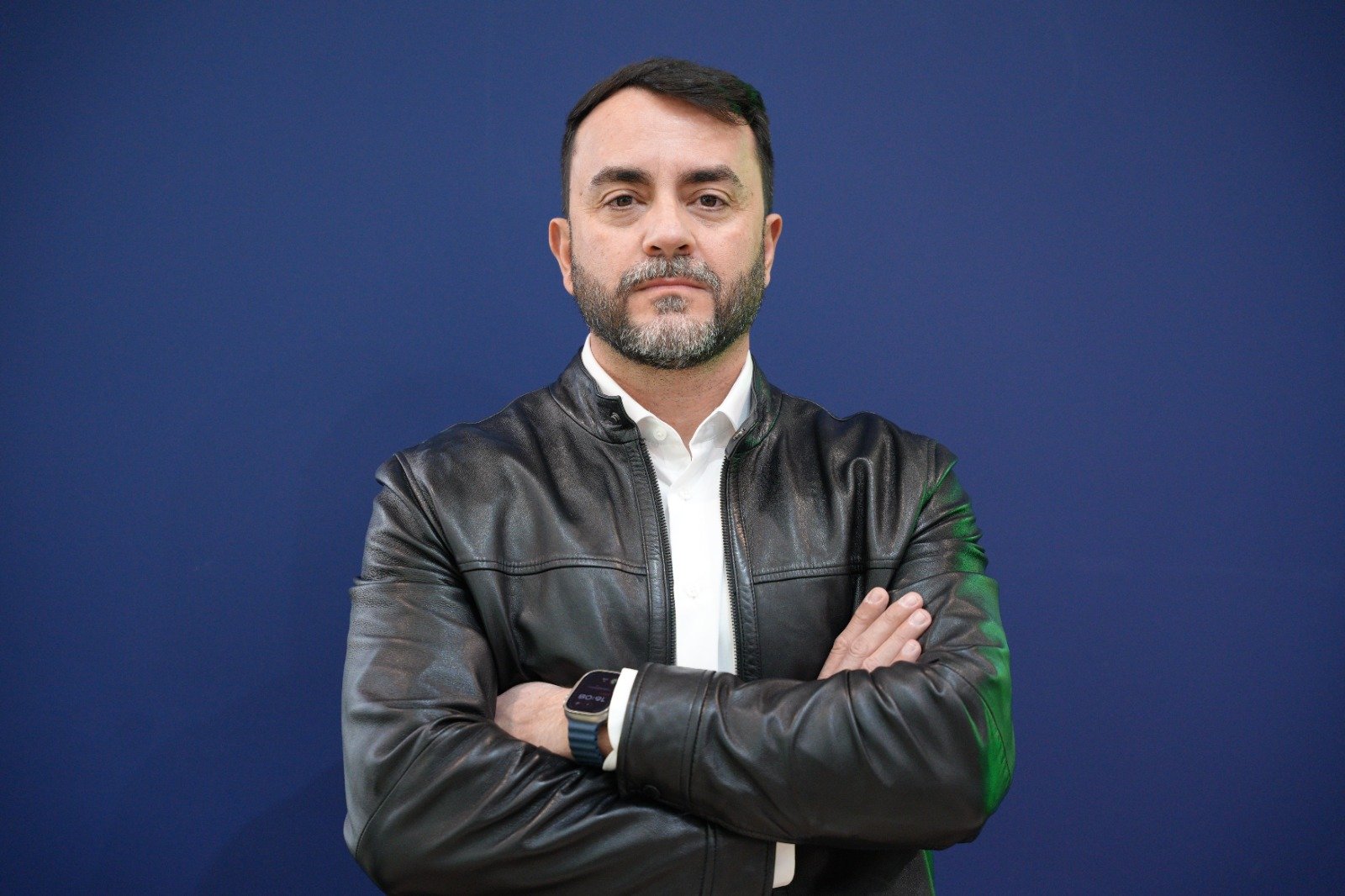
Argentina has significant potential to accelerate the adoption of biological agricultural inputs, but the next stage of market development will depend increasingly on local knowledge, field validation and farmer confidence in product performance, according to Ignacio Moyano, vice president of business development LATAM at DunhamTrimmer.
Speaking during the panel “Biologicals: A Global Perspective” at the Aapresid Congress 2026, Moyano said Argentina remains several steps behind other Latin American markets in terms of biologicals adoption, but has the fundamentals needed to accelerate growth.
The panel, which also included Dr. Fabricio Cassán, principal researcher at the Institute of Agrobiotechnology (INIAB-CONICET), and Solène Mira, technical coordinator at Aapresid, was moderated by consultant Martín Torres Duggan. Discussions focused on the barriers and opportunities shaping the adoption of biological solutions in Argentine agriculture.
“One of the main consensuses was that the barriers are no longer only about technology availability,” Moyano said. “The challenge is to generate more local information, strengthen field development and build greater confidence in results.”
The strong attendance at the session underscored the growing interest. According to Moyano, the room was packed, with extensive participation and questions from the audience, indicating that biologicals have moved beyond a niche discussion within Argentine agriculture.
“The interest in biologicals is already established. The challenge now is to continue transforming that interest into knowledge, confidence and adoption,” he said.
For DunhamTrimmer, this transition represents a decisive phase for Argentina. The market has considerable room to expand as farmers seek production systems that combine efficiency, sustainability and improved resource use. However, converting market interest into sustained adoption will require technologies to demonstrate consistent performance under local agronomic and climatic conditions.
This places greater importance on field trials, technical support and locally generated performance data. Rather than simply increasing the availability of biological products, companies will need to demonstrate how technologies fit into existing crop-management systems and deliver reliable results at farm scale.
Argentina’s $ 118 mln bioinputs market
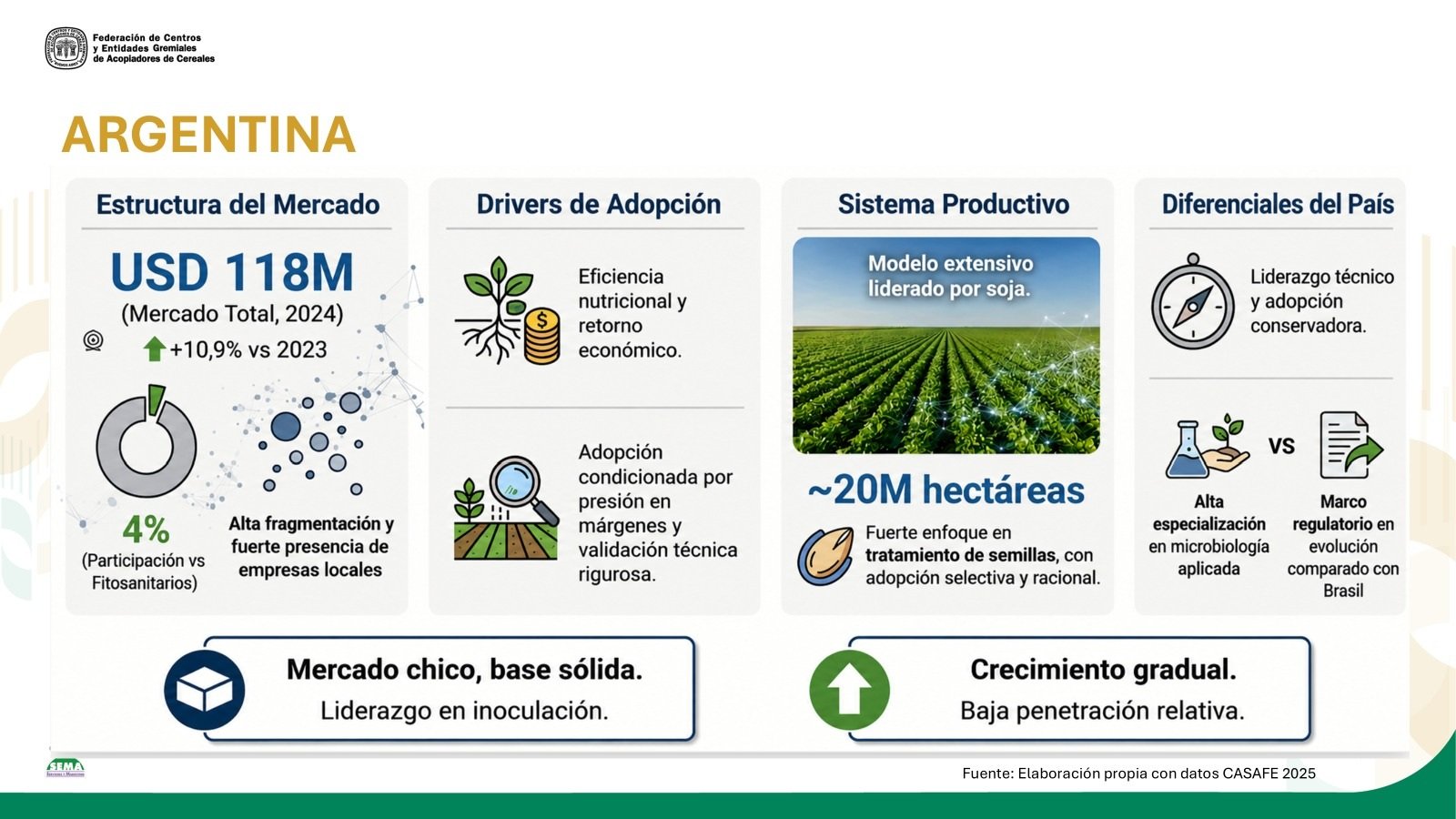
Argentina’s bioinputs market is valued at approximately $ 118 million, according to CASAFE (Agricultural and Fertilizer Health Chamber), representing a 10.9 per cent increase from 2023 and equivalent to around 4 per cent of the conventional crop protection market. The market remains highly fragmented, with a strong presence of local companies.
Inoculants account for the largest share, representing 39.7 per cent of the market, followed by foliar biostimulants at 30.8 per cent and seed-treatment biostimulants at 17.1 per cent . Pheromones represent 8.7 per cent , while bioinsecticides account for 2.9 per cent and biofungicides for 0.83 per cent .
The data indicate that Argentina’s biological-inputs industry is still primarily built around inoculation and biostimulation, while biological crop protection is gradually gaining ground in specific segments.
The analysis also highlights the characteristics of the Argentine production system. With approximately 20 million hectares under an extensive, soybean-led production model, adoption of biological technologies is strongly focused on seed treatment and remains selective. Nutritional efficiency and economic return are identified as key adoption drivers, while pressure on farm margins and rigorous technical validation constrain the pace of uptake.
The country’s technical leadership and relatively conservative adoption behavior represent another defining feature. CASAFE also points to a high degree of specialization in applied microbiology, alongside a regulatory framework that is evolving compared with Brazil.
Biocontrol remains smaller, but growth is accelerating
The biocontrol market accounted for 12.4 per cent of Argentina’s bioinputs market, compared with 87.6 per cent for the combined inoculants and biostimulants categories. Adoption is concentrated primarily in horticulture, fruit production and other systems with higher technical intensity.
However, the growth rates point to a rapidly changing segment. Biofungicides increased 98.3 per cent in value in 2024, according to CASAFE, making them the fastest-growing segment in the recent period. Total biocontrol recorded an average annual growth rate of 11 per cent over the past five years, while bioinsecticides declined 31 per cent in 2024, partly reflecting lower insect pressure and reduced treated area.
The data suggest that Argentina is gradually moving from a market dominated by inoculation toward more complex biological solutions. The transition, however, is likely to be gradual.
That reinforces Moyano’s assessment at Aapresid: the opportunity is substantial, but market expansion will depend on the industry’s ability to turn technical evidence into confidence and confidence into adoption.