In the spring of 2023, a small Jinan company called Shandong Shunfeng Biotechnology received a document that changed the trajectory of Asian plant science. It was China’s first biosafety certificate for a gene-edited crop. Within two years, China’s Ministry of Agriculture and Rural Affairs had issued ten such certificates across soybean, maize, wheat and rice. In mid-2026, the State Council’s new five-year plan for agricultural modernisation named gene editing a “critical core agricultural technology” for the first time.
Consider, by contrast, any Vietnamese breeder with a promising edited rice line. The first question is not agronomic but legal: will it be treated as a conventional variety or as a GMO? Vietnam still has no clear answer. That gap, between countries that have drawn the line and countries that have not, is now one of the most commercially important facts in Asian agriculture.
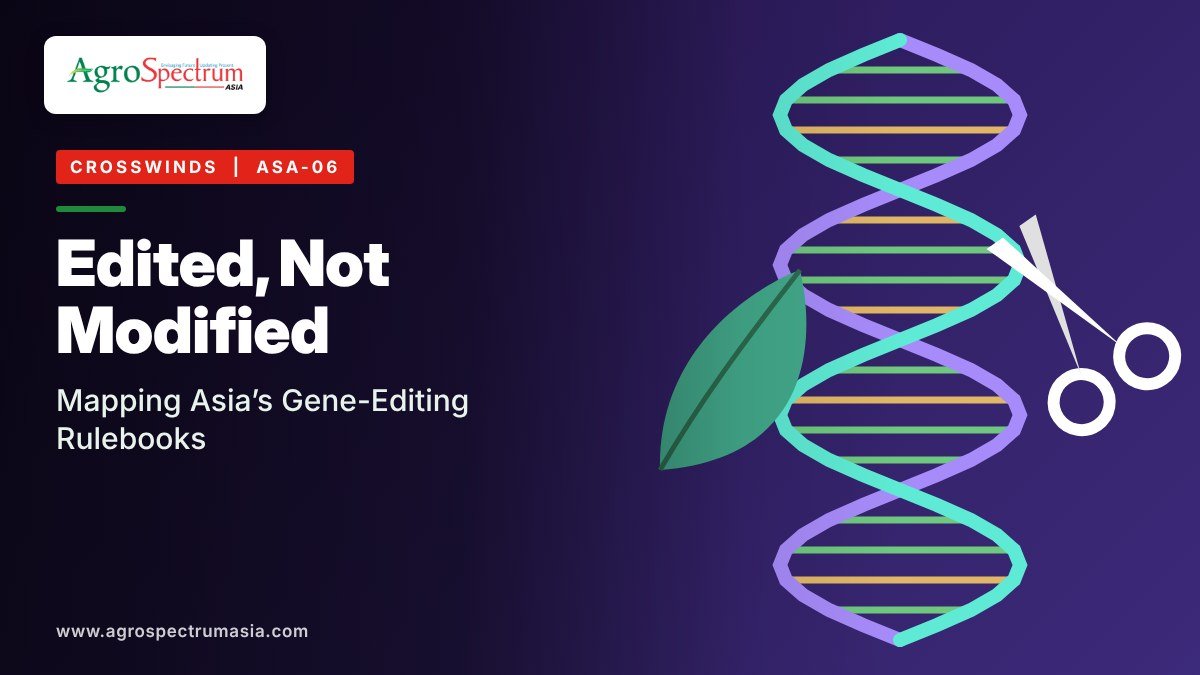
Gene editing tools such as CRISPR-Cas9 allow breeders to make small, targeted changes to a plant’s own DNA, often without adding any foreign genes. The regulatory question across the region is whether those plants should be governed like transgenic GM crops, with long and costly risk assessments, or like products of conventional breeding. Each jurisdiction has answered differently, and the answers determine where seed companies run their trials, which crops get funded, and which harvests can cross borders without friction.
This tracker maps ten Asia-Pacific jurisdictions, sets them against global comparators, and explains what the patchwork means for business.
The vocabulary that decides everything
Most Asian frameworks use a shared shorthand from the scientific literature. SDN-1 refers to edits where a cut in the DNA is repaired naturally, producing small deletions or changes with no template. SDN-2 uses a short template to guide a specific change. SDN-3 inserts a larger piece of DNA, which may come from another species.
The broad pattern is that SDN-1, and often SDN-2, products without foreign DNA are being moved out of GM rules, while SDN-3 stays inside them. The differences lie in the details: whether a regulator must confirm the classification case by case, whether food and environment agencies agree, and whether a product can be sold without a GM label.
Those details are where the commercial advantage lies. A developer who can secure a non-GM determination with a dossier and a consultation can move to variety trials quickly. One who faces a full GM process may wait years and spend heavily before a single seed is sold, a burden that weighs most heavily on public breeding programmes and smaller companies.
The regional tracker
Table: Asia-Pacific gene-editing rulebook tracker, October 2026 (status from published regulatory sources; pathway rating is AgroSpectrum Asia’s editorial assessment)
|
Jurisdiction |
How SDN-1 and SDN-2 crops are treated |
Key instrument |
Notable products |
Editorial pathway rating |
|
China |
Separate, lighter biosafety track for edits with no foreign genes; certificate still required |
MARA guidelines; 15th Five-Year Plan priority |
10 gene-edited biosafety certificates in 2023 to 2024 (5 soybean, 2 maize, 2 wheat, 1 rice) |
Open but managed |
|
Japan |
Not regulated as GM if no foreign DNA remains; pre-market consultation and notification |
MHLW and MAFF notification system, in place since 2019 |
Seven notified products by March 2025, including high-GABA tomatoes, waxy maize and a Simplot potato |
Open |
|
India |
SDN-1 and SDN-2 exempt from GM biosafety rules |
2022 exemption and DBT guidelines |
Two genome-edited rice varieties announced May 2025 |
Open, still testing |
|
Philippines |
Case-by-case; no novel genetic combination means non-GM |
DA Memorandum Circular No. 8 of 2022 |
Non-browning banana (2023); high-GABA tomato (2024) |
Open |
|
Australia |
SDN-1 excluded from gene technology regulation; food rules updated |
2019 gene technology regulation amendments; FSANZ P1055 (2025) |
Field research expanding |
Open |
|
New Zealand |
Still under 1996 HSNO Act; reform bill in Parliament |
Gene Technology Bill |
None commercial |
Closed, reform pending |
|
South Korea |
Treated as LMOs; exemption bill pending |
LMO Act amendment proposed in 2024 |
None commercial |
Closed, reform pending |
|
Indonesia |
Genome-edited food may be non-GE, but the scheme to tell them apart is still being drafted |
BPOM Regulation No. 19/2024 |
None commercial |
Partly open |
|
Vietnam |
No clear rules; edited crops risk default GM treatment |
Framework under discussion |
None commercial |
Undefined |
|
Bangladesh |
GM pathway established; gene-editing pathway less settled publicly |
Biosafety rules used for Bt brinjal |
None commercial |
Undefined |
Country briefs: the early movers
China. China’s approach is best described as open but managed. Gene-edited plants are defined by targeted changes with no foreign genes introduced, and these go through a lighter biosafety evaluation than transgenic crops. A biosafety certificate, however, is only the first step. Developers must then complete regional and production trials, obtain variety approval under the Seed Law, and secure production and business licences. The pipeline is moving: the fourth batch of certificates, issued at the end of 2024, added edited soybean, wheat, maize and rice lines, with certificates valid for five years. Beijing Qi Biodesign Technology now holds five certificates, and its high-oleic soybean became the first Chinese gene-edited product to receive a US regulatory exemption, in May 2024. China’s significance is less about speed than about scale and state backing: with gene editing written into national planning, Chinese developers enjoy policy certainty that few competitors have.
Japan. Japan was among the first in Asia to decide that SDN-1 products without residual foreign DNA would not be regulated as GM. Developers instead consult the authorities and notify them before commercialisation. The system has produced a varied portfolio: Sanatech Seed’s high-GABA tomato, a high-yield sea bream, a fast-growing tiger puffer fish, waxy maize, an olive flounder and, from October 2024, J.R. Simplot’s high tuber-set potato. Japan matters to Asian exporters because it is a demanding, premium food market. A product that clears Japanese notification carries credibility elsewhere.
India. India exempted SDN-1 and SDN-2 genome-edited plants from its GM biosafety rules in 2022, and the Department of Biotechnology issued guidelines setting out the process. The first fruits came in May 2025, when ICAR announced two genome-edited rice varieties: DRR Dhan 100 (Kamala), developed by ICAR-IIRR from Samba Mahsuri, and Pusa DST Rice 1, developed by ICAR-IARI from MTU1010. ICAR has linked them to higher yields, earlier maturity and better tolerance of salt and drought, though the varieties are still going through multi-season trials before wide release. The announcement also drew protest from farmer groups and civil society, a reminder that India’s long GM history, from the Bt brinjal moratorium to stalled GM mustard, shapes public trust. Patent licensing for CRISPR tools is another live concern for public breeders.
Philippines. The Philippines has been Southeast Asia’s quiet leader. Under Department of Agriculture Memorandum Circular No. 8 of 2022, developers submit products to the Bureau of Plant Industry, which issues either a biosafety permit, for a GMO, or a certificate of non-coverage. The test is product-based: if there is no novel combination of genetic material, the plant is not regulated as GM. Tropic Biosciences’ non-browning banana was the first product assessed, cleared in April 2023, and Sanatech Seed’s high-GABA tomato was certified as non-GM in June 2024. Guidelines for edited animals and fish are under discussion.
Australia. Australia moved early. Amendments to its gene technology regulations, in force since 2019, excluded SDN-1 organisms from regulation by the Office of the Gene Technology Regulator. The food side caught up in June 2025, when Food Standards Australia New Zealand approved new, outcome-based definitions of GM food under Proposal P1055. FSANZ said its assessment found many changes from new breeding techniques were equivalent to conventional breeding, and that the move brought Australia and New Zealand closer to Canada, Japan and England. The decision then passed to food ministers for review.
Country briefs: the jurisdictions in motion
New Zealand. New Zealand is the region’s most striking case of a country trying to move from one of the strictest regimes to one of the more permissive. Genetic modification is still governed by the Hazardous Substances and New Organisms Act of 1996. The Gene Technology Bill, introduced in late 2024 and modelled closely on Australia’s system, drew 14,947 written submissions. The Health Committee reported in October 2025, recommending it proceed with changes, and its second reading was scheduled for July 2026. Until the bill passes and a regulator is operating, New Zealand’s agricultural research institutes remain largely confined to the laboratory.
South Korea. Korea still treats gene-edited organisms as living modified organisms. A draft revision of the LMO Act, submitted in September 2024, would create a separate category for genome-edited organisms with no foreign genes in the final product, taking them out of the risk assessment regime. As of August 2026, the bill was still pending. Meanwhile Korea has tightened in another direction: a revision to labelling standards means products such as soy sauce, oils and sugars made from GM crops must carry GM labels even if no GM DNA or protein remains, with effective dates starting at the end of 2026.
Indonesia. Indonesia sits halfway through the door. BPOM Regulation No. 19/2024, signed in November 2024, states that genome-edited food may be either genetically engineered or not, and that only the former needs a food safety approval. However, the rules do not yet say how to tell the two apart. That task falls to the Biosafety Commission on Genetically Engineered Products, which is still drafting its scheme. Until it does, developers face uncertainty in one of Asia’s largest food markets.
Vietnam. Vietnam lacks clear rules, and the risk is that edited crops are treated as GMOs by default. Multinationals including Bayer and Corteva, along with public research institutes, have urged the government to clarify the scope. Michael Leader, who chairs the plant breeding innovation committee at the Asia and Pacific Seed Association, has called for a framework that is science-based, transparent and internationally aligned. Vietnam’s neighbours have moved: Singapore adopted a framework in 2024, Thailand has one in place, and Malaysia is drafting.
Bangladesh. Bangladesh has more GM experience than most of South Asia, having commercialised Bt brinjal through its biosafety system. Its gene-editing pathway is less clearly defined in public than India’s, which matters because the two countries share rice and vegetable breeding interests and cross-border seed flows.
Global comparators that set the tone
Asian regulators do not decide in isolation. Three outside developments are shaping the regional debate.
Argentina remains the reference model. Since 2015 it has used a prior consultation process to decide, case by case, whether an edited product is a GMO. That pathway allowed INTA’s non-browning potato, created by switching off the polyphenol oxidase gene in the Desiree variety, to be treated as conventional. In March 2026 Argentina went further with Resolution 255/2026, which merges environmental, food safety and commercial reviews of GM crops into a single procedure.
The European Union, long the world’s most cautious major market, has now changed course. Regulation (EU) 2026/1388 on new genomic techniques entered into force on 16 July 2026 and will apply fully from July 2028. Category 1 plants, with small targeted changes that could arise through conventional breeding, will be exempt from GMO rules. This matters for Asian exporters because Europe’s caution was often cited as a reason for Asian hesitation.
Within the region, Pakistan approved its National Agriculture Biotechnology Policy in June 2026, taking SDN-1 and SDN-2 plants out of GM regulation. Panama has adopted a rule allowing it to recognise other regulators’ non-GM determinations, an idea that could ease trade friction if Asian regulators adopt it.
Table: Approval milestones, 2019 to 2026
|
Year |
Milestone |
|
2019 |
Australia excludes SDN-1 organisms from gene technology regulation; Japan’s notification system begins |
|
2022 |
India exempts SDN-1 and SDN-2; Philippines issues Memorandum Circular No. 8 |
|
2023 |
China issues first gene-edited biosafety certificate; Philippines clears non-browning banana |
|
2024 |
Qi Biodesign soybean gains US exemption; Philippines certifies GABA tomato; Indonesia issues BPOM 19/2024; Korea LMO amendment submitted |
|
2025 |
India announces two genome-edited rice varieties; FSANZ approves new GM food definitions; NZ committee reports on Gene Technology Bill |
|
2026 |
Argentina Resolution 255/2026; Pakistan biotechnology policy; EU NGT regulation in force; China names gene editing a core technology |
Where the trials are going, and why
For seed and trait companies, the patchwork shapes a predictable strategy. Research and early field trials gravitate to jurisdictions where the classification is clear and the path from trial to variety registration is defined. On that measure, Japan, the Philippines, Australia and India stand out in the Asia-Pacific, alongside China for companies with a domestic presence.
The Philippines is especially attractive for tropical crops. Its product-based test, single lead agency and track record with a banana and a tomato give developers confidence that a dossier will be assessed on its merits. Japan offers a premium market and a clear notification system. Australia combines clear rules with a sophisticated research base and a temperate climate suited to wheat and canola. India offers enormous scale and a public research system now producing its own edited varieties.
Time to market is the other variable, and here the differences are structural rather than a matter of published deadlines. In Japan and the Philippines, the regulatory step is essentially a classification decision: once a product is confirmed as falling outside GM rules, it joins the normal path for any new variety. In India, the exemption removes the GM biosafety process, but edited lines still go through the same multi-season, multi-location testing as any rice variety before release, which is why the two ICAR varieties announced in 2025 are still in trials. China’s process is the longest by design, because the biosafety certificate is followed by regional trials, production trials, variety approval and licensing, each a separate gate. For a developer, that means a Chinese certificate is a strong signal of intent, but not a sign that seed will be on sale the following season.
These sequencing differences shape portfolio choices. Traits that add value to the processor or consumer, such as high-oleic oil, non-browning fruit or higher GABA content, tend to travel well through notification systems and premium markets. Agronomic traits such as drought or salt tolerance, which matter most to smallholders, depend more heavily on public breeding programmes and national variety trials.
The markets left behind are paying a hidden cost. When Vietnam, Korea or New Zealand cannot say how an edited crop will be classified, multinational trial budgets move elsewhere, and so does the know-how that local scientists would otherwise gain.
The export friction question
The final layer is trade. A crop that is conventional in one country and a GMO in another creates headaches for exporters and importers alike. A Philippine banana exporter selling a non-browning variety, or an Indian rice exporter whose fields include edited lines, needs confidence that destination markets will not reject consignments or demand GM labels.
Today, the risk is concentrated in markets that still regulate by process rather than product, and those with strict labelling rules, such as Korea. As the EU’s rules come into force and more Asian regulators finalise their own frameworks, the scope for friction should narrow. But there is no regional mechanism for mutual recognition of non-GM determinations, and until there is, trade lawyers will be as important to the commercial success of an edited crop as plant breeders.
For the industry, the message is clear. The science of gene editing is converging globally. The rulebooks are not, and in the near term, the rulebook decides the winners.
What to watch in 2027
- Whether New Zealand’s Gene Technology Bill completes its passage and a new regulator begins issuing decisions.
- The scheme Indonesia’s Biosafety Commission adopts for distinguishing genome-edited products from GE food.
- Progress on South Korea’s LMO Act amendment, and how it interacts with the country’s tougher GM labelling rules.
- China’s next batch of gene-edited biosafety certificates and the first variety registrations that follow them.
- Seed release and farmer uptake of India’s two genome-edited rice varieties after multi-season trials.
- Whether any Asian regulator follows Panama in recognising foreign non-GM determinations.
Ankit Kankar | ankit.kankar@mmactiv.com