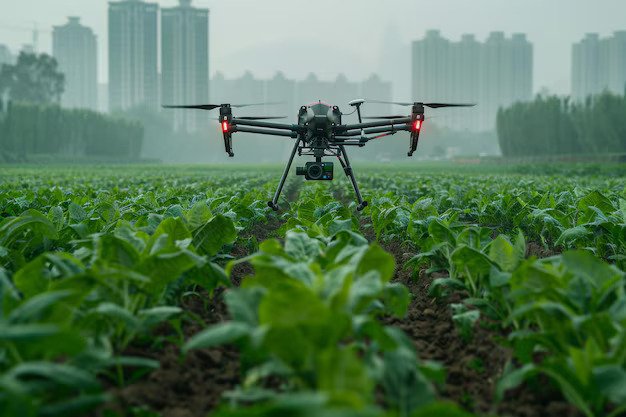
China has built the world's largest agricultural drone fleet, with more than 300,000 units operating across the country and an annual service area exceeding 30 million hectares, reflecting the rapid integration of low-altitude technology into farm operations.
The figures, reported by CCTV Finance on Wednesday, citing data from the Ministry of Agriculture and Rural Affairs, underline the growing role of drones in modernising agricultural production and addressing labour constraints. Initially adopted largely for crop-protection spraying, agricultural drones are now being deployed for fertiliser application, irrigation support and the transportation of farm produce. Their expanding use is changing how farmers manage labour, input costs and time-sensitive field operations.
Drones cut labour and input costs
Agricultural drones can operate at more than 20 times the efficiency of traditional manual labour, while reducing water consumption by over 50 per cent and pesticide use by 20–40 per cent, according to the reported figures. The economics are becoming increasingly relevant during peak agricultural seasons, when labour availability can be uncertain and timely field operations are critical.
In Huangyan district of Taizhou, Zhejiang province, farmers are receiving training in drone operations as the autumn harvest progresses. Among the trainees is 63-year-old Wang Zhiliang, who is learning flight operations, maintenance and the technical requirements for obtaining a drone pilot licence.
Wang said drone spraying offers a faster and more economical alternative to hiring manual labour. Spraying approximately three hectares using two workers costs around 450 yuan in wages, compared with about 280 yuan for drone operations.
For farmers managing larger holdings, the productivity gains can be more substantial. Huang Ning, who manages 13 hectares of melon cultivation in Yunnan province, said drones used for fertilisation and short-distance transportation have improved operational efficiency by 40–50 per cent, particularly during periods of labour shortages. Training, however, comes at a cost. Wang Haili, head of a local drone technology company, said a plant-protection drone operator training programme currently costs around 3,000 yuan.
From crop spraying to farm logistics
The application of drones is moving beyond conventional pesticide spraying to a wider range of agricultural services. At a water bamboo cooperative in Guan'ao village, Huangyan, drones can complete pesticide spraying and fertiliser application across 33 hectares in a single day. Jiang Liangzhen, deputy director of the cooperative, said the technology saves between 5,000 and 6,000 yuan per spraying operation. Annual labour cost savings are estimated at 30,000–40,000 yuan.
Drones also offer an operational advantage when fieldwork must be carried out outside conventional working hours. During summer, when pest and disease pressure tends to increase, nighttime spraying can improve the effectiveness of certain crop-protection operations. Drone deployment helps overcome the difficulty of recruiting workers for night shifts.
In mountainous farming regions, the technology is also addressing logistical bottlenecks. Drones are being used to transport freshly harvested oranges downhill, reducing the time and labour required to move produce from orchards to collection points.
For growers, faster movement from harvest to market can also influence product value. Local orange farmer Wang Tianbao said a particular variety generally sells for slightly above 6 yuan per kilogram, while his freshly harvested produce can fetch nearly 12 yuan per kilogram because it reaches buyers quickly and retains its quality.
Skills and standards emerge as industry challenges
The rapid expansion of agricultural drone services is creating demand for trained operators, technical support and more consistent operating practices. Nie Pengcheng, director of the ecological and environmental planning department at Zhejiang University's Institute of New Rural Development, said increasingly sophisticated drones are strengthening agricultural machinery services while generating new employment opportunities. However, he identified two constraints to wider adoption: a shortage of qualified drone operators and the need for stronger operational standards and quality-assessment systems.
These gaps could become more significant as drones take on increasingly complex tasks across crop management and agricultural logistics. Reliable performance will require not only access to equipment but also trained personnel, maintenance networks and clear standards for service delivery. China's expanding drone fleet points to a broader shift in agricultural mechanisation. What began as a technology for targeted crop spraying is becoming an integrated service platform for farm operations, from input application to produce transportation. The next phase of growth will depend on whether training, service infrastructure and operating standards can keep pace with the expansion of the technology.