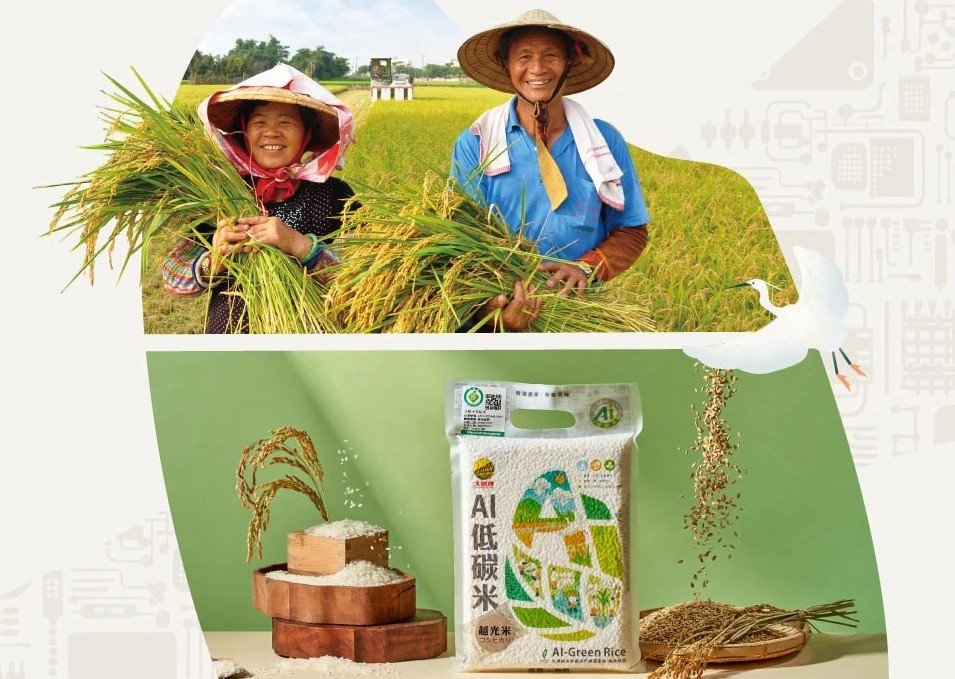
Taiwan-based Rice House Smart Agri has successfully transitioned its AI-driven sustainable rice cultivation programme from pilot stage to large-scale commercial production, marking a significant milestone in the application of digital technologies to climate-smart agriculture.
The initiative, marketed under the company’s flagship Dachiao brand as AI-Green Rice, combines artificial intelligence, precision irrigation management and sustainable farming practices to address some of the most pressing environmental challenges facing global agriculture, including water scarcity, greenhouse gas emissions and the growing demand for low-carbon food production.
Developed in collaboration with the AIMIA research team at National Chung Hsing University and supported by Taiwan’s National Science and Technology Council, the programme has expanded from an initial six-hectare pilot project to large-scale commercial operations across Erlin Township in Changhua County, one of Taiwan’s important agricultural regions.
Artificial Intelligence Transforms Paddy Field Management
At the heart of the programme lies an AI-powered irrigation decision platform designed to optimise water management in rice cultivation.
Traditional paddy farming relies on continuous flooding, a practice that consumes vast quantities of water while creating anaerobic soil conditions that stimulate methane production. Methane is widely recognised as one of agriculture’s most significant greenhouse gas contributors, particularly within rice-growing systems.
Rice House Smart Agri’s solution enables farmers to capture images of rice plants using smartphones and upload them to a cloud-based platform. Within seconds, artificial intelligence algorithms analyse plant growth conditions and spectral characteristics before generating irrigation recommendations tailored to field requirements.
The system supports an Alternate Wetting and Drying (AWD) cultivation model, allowing producers to apply water more precisely while maintaining productivity and crop performance.
By transforming irrigation decisions into a data-driven process, the platform enables growers to reduce unnecessary water use while simultaneously improving environmental outcomes and resource efficiency.
Delivering Measurable Environmental Impact
The commercial deployment has already demonstrated substantial sustainability gains compared with conventional rice production methods.
According to project data, every kilogram of AI-Green Rice produced delivers significant reductions in resource consumption and emissions, including lower irrigation requirements, reduced methane generation and decreased energy consumption associated with water pumping.
The AI-guided cultivation model achieves water savings of approximately two metric tonnes per kilogram of rice produced while reducing irrigation demand by up to 30 per cent. It also lowers carbon emissions by approximately 260 grams of CO₂-equivalent per kilogram and reduces methane emissions from paddy fields by as much as 35 per cent.
The environmental impact becomes even more significant at scale. Across the programme’s initial 180-hectare commercial implementation area, cumulative savings have already surpassed 1.35 million metric tonnes of water conservation, while greenhouse gas reductions exceed 142 metric tonnes of CO₂-equivalent emissions. Energy consumption has also declined substantially through reduced operation of irrigation infrastructure.
The results illustrate the growing potential of artificial intelligence to support agricultural decarbonisation efforts while enhancing the efficient use of natural resources.
Supporting Corporate Sustainability and ESG Goals
As food companies, hospitality operators and multinational corporations face increasing pressure to demonstrate measurable sustainability performance, low-carbon agricultural sourcing is emerging as an important component of Environmental, Social and Governance (ESG) strategies.
Rice House Smart Agri is actively working with restaurants, hotel chains and corporate procurement teams seeking to integrate lower-carbon food products into their supply chains and sustainability reporting frameworks.
The company believes that data-driven agriculture can provide businesses with verifiable environmental metrics while strengthening transparency throughout the food value chain.
To support traceability and consumer confidence, AI-Green Rice is certified under Taiwan’s Traceable Agricultural Product (TAP) system, enabling end-to-end visibility from farm production through to final consumption.
Premium Quality Meets Sustainability
While environmental performance remains central to the programme, Rice House Smart Agri maintains that sustainability must be accompanied by premium product quality to ensure long-term market acceptance.
The AI-Green Rice portfolio includes several of Taiwan’s most highly regarded rice varieties, including Koshihikari, Taichung No. 194, Tainan No. 16, Kaohsiung No. 147 and Taikeng No. 9, each recognised for distinctive flavour profiles, texture characteristics and culinary appeal.
By combining advanced cultivation technologies with premium varietal selection, the company aims to demonstrate that climate-conscious agriculture can deliver both environmental benefits and superior consumer experiences.
A Blueprint for the Future of Rice Farming
As governments, food manufacturers and retailers intensify efforts to reduce agricultural emissions and strengthen food system resilience, Rice House Smart Agri’s AI-Green Rice initiative offers a compelling model for the future of sustainable crop production.
The successful commercialisation of AI-assisted irrigation management highlights how digital innovation can simultaneously improve productivity, reduce environmental impact and support corporate sustainability objectives without compromising quality or profitability.
With growing global interest in regenerative and low-carbon agriculture, the project positions Taiwan’s rice industry at the forefront of next-generation farming solutions and underscores the increasingly important role of artificial intelligence in building resilient, resource-efficient food systems for the decades ahead.