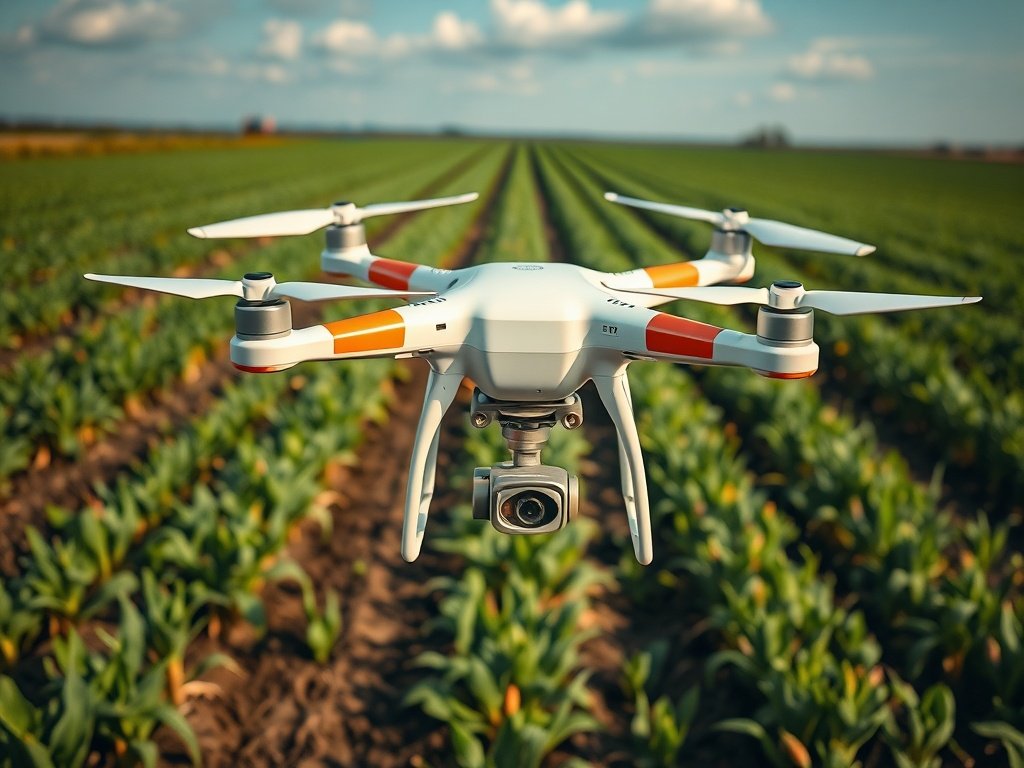
In a development that could reshape precision agriculture, researchers at the University of Tokyo and Kubota Corporation have unveiled a drone-based system capable of predicting potato yields weeks before harvest—without digging up a single tuber.
The breakthrough combines drone imagery, machine learning and crop growth modelling to estimate underground potato biomass, giving farmers an unprecedented ability to forecast production, optimise harvest schedules and improve farm management decisions long before crops reach maturity.
The innovation represents another step towards data-driven agriculture, where artificial intelligence and remote sensing are increasingly replacing traditional field sampling.
A Digital Window Beneath the Soil
Unlike cereals or fruits, potato yields have traditionally remained hidden beneath the soil surface until harvest. Farmers have relied on destructive sampling—digging up representative plants—to estimate production, a process that is labour-intensive, costly and often inaccurate across large fields.
The Japanese research team has developed a non-destructive alternative.
Using drones equipped with RGB and multispectral cameras, researchers periodically captured aerial images throughout the growing season. These images were analysed to extract key crop characteristics, including canopy height, vegetation indices, plant cover and colour profiles.
Machine-learning algorithms then translated these above-ground signals into estimates of underground tuber biomass. To forecast final production, researchers integrated the biomass estimates with a Gompertz growth curve—an S-shaped mathematical model widely used to describe biological growth—allowing yield predictions before harvest.
Accuracy That Matters
The technology was validated during two years of field trials conducted in 2023 and 2024 at the University of Tokyo's Field Science Center. Researchers tested multiple cultivation conditions, including different planting densities and seed tuber treatments.
According to the research team, the system achieved a correlation coefficient exceeding 0.8 for estimating underground biomass and more than 0.7 for predicting final harvest yields—levels considered highly promising for commercial agricultural applications.
The findings demonstrate that reliable yield estimates can be generated using only above-ground drone observations, eliminating the need for destructive crop sampling.
Precision Agriculture's Next Frontier
The implications extend well beyond potatoes.
Reliable pre-harvest yield forecasting enables farmers to optimise irrigation, fertiliser application, storage planning, logistics and labour deployment. Processors can better anticipate raw material supplies, while retailers and policymakers gain earlier visibility into food production. The technology also opens opportunities for variable-rate management, enabling producers to identify underperforming areas within fields and intervene before harvest.
As climate variability increases production uncertainty, predictive analytics are becoming essential tools for improving agricultural resilience.
Fueling Japan's Smart Farming Ambitions
The breakthrough comes as Japan rapidly expands its agricultural drone ecosystem.
Growing labour shortages, an ageing farming population and increasing demand for digital agriculture are accelerating investments in remote sensing, automation and artificial intelligence. Industry analysts project Japan's agricultural drone market to witness strong growth over the coming decade, driven by technologies capable of transforming field-level data into real-time management decisions.
The potato prediction system illustrates how drones are evolving beyond aerial spraying and crop monitoring into sophisticated decision-support platforms capable of forecasting yields before harvest.
From Research to Commercial Agriculture
The study was led by doctoral researcher Yuto Imachi, Professor Hiroyoshi Iwata and Associate Professor Wei Guo from the University of Tokyo, in collaboration with researchers from Kubota Corporation's Next-Generation Research Department, Masahiro Okada of Sarabetsu Prediction Co., Ltd., and Pieter M. Blok, now at Eindhoven University of Technology.
Developed under the joint Kubota Todai Lab initiative, the researchers believe the technology could eventually help farmers determine optimal harvest timing, improve cultivation strategies and strengthen food production planning.
As artificial intelligence, drone technology and predictive analytics continue to converge, innovations like this suggest the future of farming may depend as much on algorithms in the sky as on crops beneath the soil.