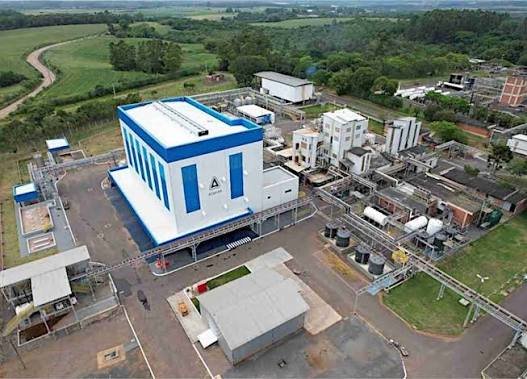
Adama will shut down its active ingredient manufacturing facility in Taquari, Rio Grande do Sul, just four years after its inauguration, in a move that highlights the growing pressure on Brazil’s domestic pesticide industry from imported products and changes in the global chemicals market.
The plant received investments of BRL 300 million (USD 54.5) and produced active ingredients including picoxystrobin, a fungicide used to control crop diseases, and trifluralin, a herbicide used against weeds. Both products will now be imported, according to the information provided.
In a statement, Adama said the decision followed a global review of its assets and active ingredient manufacturing network, reflecting changes in market conditions and the need to align production with long-term demand.
The company did not disclose the closure schedule or the number of employees affected. It acknowledged the impact on workers and said the process would be conducted with respect for its employees.
Adama stressed that the Brazilian state of Rio Grande do Sul would remain strategically important to its business. The company will maintain its commercial operations in the state and its distribution center in Carazinho. Brazil remains Adama’s largest operation and a strategic market, with manufacturing continuing at its facility in Londrina, Paraná, as well as commercial activities nationwide and new product development.
The closure comes amid a broader debate over the competitiveness of pesticide manufacturing in Brazil. Although picoxystrobin and trifluralin are not among the four formulated products covered by Sindiveg’s current tariff request, the decision illustrates the challenges facing local production in a country that lacks an integrated chemical industry. Manufacturers often need to import active ingredients and several formulation components, adding exposure to international supply chains and costs.
The National Union of the Plant Protection Products Industry (Sindiveg) attributes the loss of competitiveness primarily to the rapid growth of imported products. In a statement this week, the organization defended its request to raise tariffs on certain imported generic pesticides to as much as 35%, describing the measure as a legitimate trade policy initiative to preserve domestic production capacity, balance competitive conditions and strengthen the security of agricultural supplies.
According to Sindiveg, imports of products covered by its tariff requests increased from 166,700 tonnes in 2022 to 381,600 tonnes in 2025, a rise of 129%.
The organization, whose members include multinational companies operating in Brazil such as UPL, Sumitomo and Adama, rejected accusations of protectionism. It argued that the existing tariff structure for certain products has remained unchanged despite significant changes in market conditions, harming domestic pesticide manufacturers and their supply and packaging chains.
The tariff campaign has also deepened divisions within the industry. SML Brasil announced on Monday that it was leaving Sindiveg, becoming the third company to withdraw over the organization’s requests to the Foreign Trade Chamber (Camex). Tecnomyl and Alta Defensivos had announced their departures on Friday.
Like Tecnomyl, SML said it had not been consulted or involved in prior discussions about the tariff proposal, despite its potential impact on the market and food production costs. The company argued that strengthening domestic industry should rely on investment, innovation, technological development and efficiency gains rather than measures that could transfer additional costs to farmers.
Agriconnection, an importer and distributor of crop protection products, also questioned whether higher tariffs would deliver the intended industrial benefits. Daniel Dias, the company’s chairman and co-founder, said raising duties on imported formulated products would not, by itself, eliminate dependence on foreign chemical inputs or guarantee new investment and production capacity.
Dias added that Brazil does not currently have enough installed capacity to supply the entire volume of agrochemicals used in the country. He argued that any industrial policy should establish product-specific targets, assess available domestic capacity and identify imported inputs, alongside verifiable investment commitments.
The closure of Adama’s Taquari plant adds a new dimension to the debate over import tariffs. While domestic manufacturers argue that trade measures are needed to protect local production, other companies warn that higher duties alone cannot resolve structural weaknesses in the supply chain or guarantee greater manufacturing capacity. The central challenge remains how to strengthen Brazil’s industrial base without increasing costs for agricultural producers.