In Vienna, Vietnam Ambassador to Austria Vu Le Thai Hoang held a working session with Norbert Walter, President of the Vienna Chamber of Agriculture and Vice President of the Austrian Chamber of Agriculture. The two sides discussed labour recruitment needs for Vietnamese agricultural workers and ways to foster linkages between enterprises and agribusinesses in both countries.
During technical visits with Austrian fruit and vegetable producers and packers, the Viet Nam Trade Office in Austria recorded rising demand for coconut coir substrates to support soilless cultivation. This organic input is widely deployed in greenhouse horticultural models, conserving water, mitigating reliance on arable soil, and optimising fertigation control.
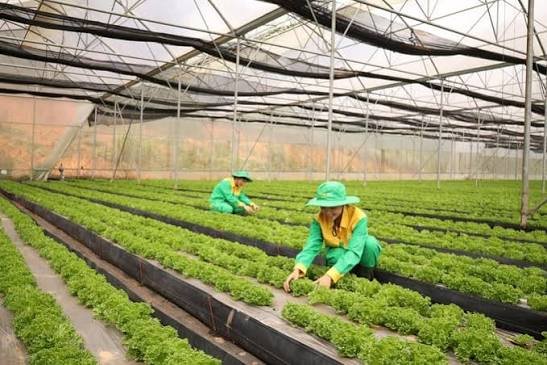
This demand stems from operational realities in Austria, where numerous greenhouse operators have adopted hydroponics and soilless cultivation utilising coco coir and comparable organic substrates. Vienna stands as one of the country's prime greenhouse production clusters, specialising in high-value crops such as tomatoes, cucumbers, and eggplants. These facilities increasingly prioritise precision automation for water management, nutrient dosing, and microclimate control.
Several production facilities across Vienna are also implementing greenhouse decarbonization initiatives, including biomass heating, closed-loop carbon dioxide capture and enrichment, and input optimisation. Paired with resource-efficiency mandates, this green trajectory is accelerating commercial demand for eco-friendly, bio-based cultivation inputs.
Meanwhile, Viet Nam holds significant comparative advantages in coconut biomass, anchored primarily in the Mekong Delta, the nation's premier coconut heartland. Processed coconut fiber and coco peat can be refined into horticultural substrates, enabling Vietnamese exporters to integrate deeper into Austria’s agricultural supply chain.
According to the Viet Nam Trade Office, Austrian enterprises seek qualified Vietnamese suppliers that can guarantee consistent export volumes, standardized specifications, and compliance with European Union market thresholds. The Trade Office affirmed it will facilitate direct business-to-business (B2B) engagements to negotiate technical standards, shipment quotas, and offtake agreements.
Austrian market requirements unlock opportunities for Viet Nam to transition from exporting unprocessed agro-commodities toward supplying advanced inputs for high-tech farming. This vector yields greater added value than raw feedstock exports, directly mirroring circular economy paradigms.
Per General Department of Viet Nam Customs data, two-way trade between Viet Nam and Austria approached 3 billion USD in the first 10 months of 2026, up 12.8% year-on-year, yielding a 2.1 billion USD trade surplus for Viet Nam. Vietnamese exports to Austria reached 2.5 billion USD, up 13.2%.
Nonetheless, mobile phones and components still accounted for 77% of Viet Nam’s aggregate export value to Austria. This concentrated structure underscores substantial headroom to diversify bilateral merchandise baskets, where agricultural commodities, farming supplies, and green-production inputs offer strong growth potential.
Conversely, Austria commands advanced competencies in turnkey greenhouse technologies, horticultural operations management, stringent environmental auditing, and high-value agricultural engineering. These fields represent fertile ground for Viet Nam to absorb technology, benchmark advanced models, and foster corporate joint ventures.
Concurrently, both parties reviewed seasonal agricultural labor mechanisms. Per the Vienna Chamber of Agriculture, Austria allocated an annual quota of 3,496 seasonal workers for agriculture and forestry in 2026, with 244 slots designated for Vienna. This track represents a complementary cooperation vector alongside core priorities in agricultural production, bio-based inputs, and technical transfers.