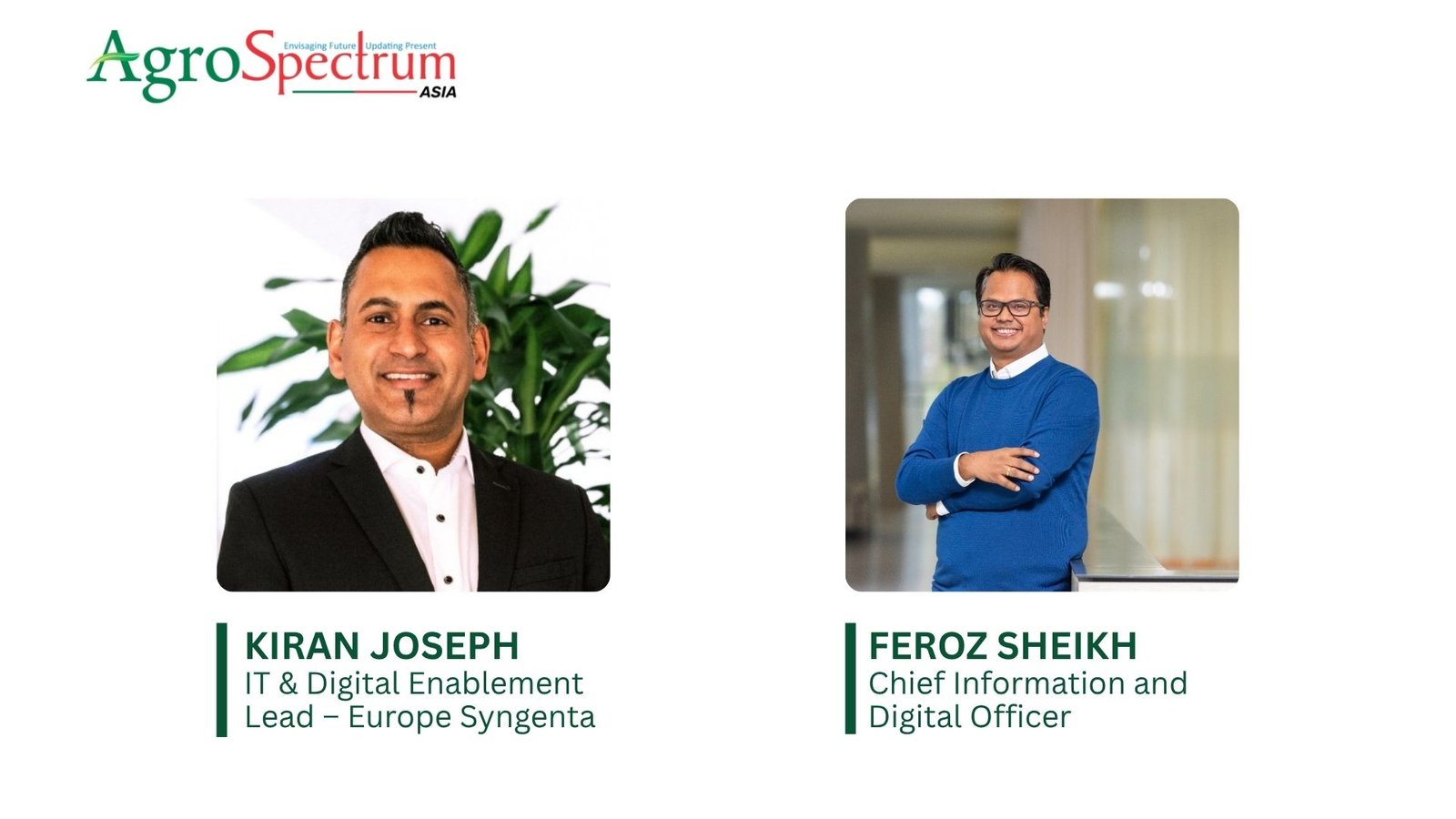
Artificial intelligence is rapidly reshaping agriculture, but its true value lies not in replacing agronomic innovation—it lies in making every farm decision smarter, faster and more precise. In an exclusive interview with AgroSpectrum, Feroz Sheikh, Chief Information and Digital Officer, Syngenta, and Kiran Joseph, IT & Digital Enablement Lead – Europe, Syngenta, explain how AI is redefining the company's role from a provider of seeds and crop protection solutions to a trusted predictive intelligence partner for farmers. They discuss the strategic significance of Syngenta's collaboration with ANNAM.AI, India's potential to become a global innovation hub for AI-enabled agriculture, and why data-driven intelligence will be as transformative as the next generation of seeds and biologicals. The conversation also explores how hyperlocal forecasting, multilingual advisory and responsible data governance can help farmers navigate increasing climate volatility while building trust in digital agriculture. As AI moves from pilot projects to large-scale deployment, the executives argue that success will depend on integrating technology seamlessly into farmers' daily decision-making rather than adding complexity. They also share why India's diverse farming systems offer the ideal environment for developing AI solutions that can eventually be replicated across Africa, Southeast Asia and other smallholder markets. The interview provides a forward-looking perspective on how AI could become as indispensable to farming as seeds, fertilizers and irrigation in the decade ahead.
Syngenta has traditionally been associated with seeds, crop protection and agronomic innovation. How do you see artificial intelligence transforming Syngenta’s role—from an input provider to a predictive intelligence partner for farmers?
Feroz considers AI increasingly helpful in enriching the nature of the relationship Syngenta has with farmers, positioning the brand from being a company that sells products at specific moments in the season to one that’s continuously helping farmers make better decisions. Now, with the kind of data Syngenta has from genomics to field performance to weather and satellite data, the company can use AI to turn all of that into predictive, real-time insights. So instead of just recommending a product, Syngenta now helps a farmer anticipate pest outbreak, optimize planting or spraying windows, or even manage climate risks before they impact yield. This approach is hyper-local, dynamic, and personalized down to the field level. So overall, AI is helping Syngenta strengthen its personal relationships with farmers and bringing to life the vision of ‘breakthroughs for every farmers in every field’.
India is home to more than 600 million people whose livelihoods are linked to agriculture. What makes the ANNAM.AI partnership strategically important for Syngenta’s long-term vision in one of the world's most complex agricultural markets?
India is a highly diverse ecosystem with millions of smallholder farmers, different agro-climatic zones, and extreme unpredictability in climate volatility. The partnership with ANNAM.AI will help build the foundation of a national, open, AI-driven agricultural intelligence platform, backed by government, academia, and technology players, designed to deliver hyperlocal, real-time, multilingual advisory at scale.
" For Syngenta, being a strategic partner in this ecosystem is significant because it allows us to plug our deep digital and agronomic expertise into an expansive infrastructure. We’re excited to be part of the core intelligence layer that is powering decision-making for millions of Indian farmers", says Kiran. "By contributing through our knowledge base that we’ve built through these years, we are helping build predictive capabilities that can transform the Indian agricultural space. It gives us reach, relevance, and trust, because the platform is designed to provide free, accessible intelligence, meeting farmers where they are, in their language and context ", he added.
The future of agriculture is increasingly being shaped by data. In your view, what will create more value for farmers over the next decade: new biological and chemical innovations, or AI-driven decision intelligence?
I don’t see this as one or the other or having to choose between the two. Breakthroughs in seeds, crop protection and biologicals will continue to define what’s possible on the farm, but the reality is that most of that potential is still not fully realized in day-to-day farming because external factors are so dynamic and unpredictable. According to Feroz, this is where AI-driven decision intelligence will come in to help farmers make better, more precise choices in real time based on weather, soil, crop stage and risk factors.
Many AI initiatives in agriculture generate impressive pilots but struggle to scale. What are the key ingredients required to translate AI research into measurable productivity gains at the farm level?
To me, the first ingredient is high-quality, integrated data that is reliable at field level. Next is embedding AI into the actual workflow of farmers and agronomists, not expecting them to adapt to technology, but ensuring the technology fits seamlessly into how decisions are already made in the field. Equally important is moving from insights to action, because farmers eventually benefit from clear, timely recommendations. Another key ingredient is scalability by design, where platforms are built to operate across crops, regions and varying levels of digital maturity rather than being optimized for a single use case. " Finally, success depends on strong integration between digital, R&D and commercial teams, because AI cannot sit in isolation ", states Feroz. When these elements come together, AI stops being a pilot and starts becoming an effective engine to drive agricultural progress.
Climate volatility is becoming a defining challenge for global food production. How can AI-powered forecasting and heat-stress intelligence help farmers move from reactive crisis management to proactive risk mitigation?
What’s really changing today is how farmers deal with uncertainty. What AI is doing now is helping farmers see risks coming before they become problems. Think of AI-powered forecasting as moving from a general weather report to something that is much more personal to your farm. That makes a huge difference, because timing is everything in agriculture. " Heat stress is a great example. There are certain moments, like flowering in maize or wheat, when heat can really hurt yields. AI can pick up those trends and warn the farmer in advance", Feroz opines. So instead of reacting after the crop shows stress, the farmer can act earlier maybe irrigate a bit sooner, adjust input use, or even change practices to protect the crop.
Over time, this starts changing behavior. Farmers begin planning ahead. It builds confidence too, because decisions are backed by evidence, not just experience or instinct.
As AI becomes more central to agricultural decision-making, concerns around data ownership, transparency and trust are growing. How does Syngenta envision a responsible framework for managing farmer data while driving innovation?
If AI is going to play a bigger role in farming, then trust becomes absolutely non-negotiable. At Syngenta, the way we think about it is quite straightforward that a farmer’s data belongs to the farmer. Any digital system we build must respect that from day one. That means being very clear about what data is being collected, why it’s being collected, and what value the farmer gets in return. There can’t be any ambiguity. Syngenta has strong governance around data privacy - around how data is stored, protected, and potentially shared across the ecosystem. That includes working with partners, governments, and platforms to ensure standards are consistent. " Innovation will only scale if farmers feel safe participating in it ", says Feroz.
Syngenta operates across vastly different agricultural systems worldwide. Could India emerge as a global innovation laboratory for AI-enabled agriculture, with solutions developed here being exported to other markets?
From a Syngenta perspective, smartphone and internet penetration in India brings a huge opportunity. Diversity in field sizes, complexities in regions and diverse weather conditions mean we need to co-create solutions in India that are not just technically sound, but also practical and usable at scale. And once they’re proven here, many of those learnings can be exported to regions where smallholder systems face similar challenges. " So, I strongly believe India can move from being just a large market to being a true innovation engine for global agriculture, especially in AI-led solutions. The ANNAM.AI partnership is a perfect example - solutions co-created for Indian complexity that can inform our approach in Africa, Southeast Asia, and beyond", opines Feroz.
You have described ANNAM.AI as an opportunity to build a transformative digital foundation for Indian agriculture. What does that future look like in practical terms, and how close are we to a world where AI becomes as indispensable to farming as seeds, fertilizer or irrigation?
The future we’re building with ANNAM.AI is about making AI quietly present in every important farm decision, without making it complicated for the farmer. In practical terms, it could look like a farmer starting their day with a simple app that tells them what matters most today, for example, maybe there’s a heat stress risk in the next few days, maybe pest pressure is building, or maybe it’s the right time to apply a certain input. It’s not overwhelming them with data, it’s guiding them with clarity. Over time, this becomes the way-of-farming for them. The system understands the farm better season after season - the soil, the weather patterns, the crop choices and keeps improving its recommendations.
" We’re very close to this ambition. What’s still evolving is scale, accessibility, and trust. Initiatives like ANNAM.AI are important because they bring all of that together - technology, local relevance, and farmer-centric design" , opines Kiran. " If we get it right, AI won’t feel like a separate layer. It will simply become part of a farmer’s routine - and that's when we know we've delivered a real breakthrough", he added.
-- Suchetana Choudhury (suchetana.choudhuri@agrospectrumindia.com)