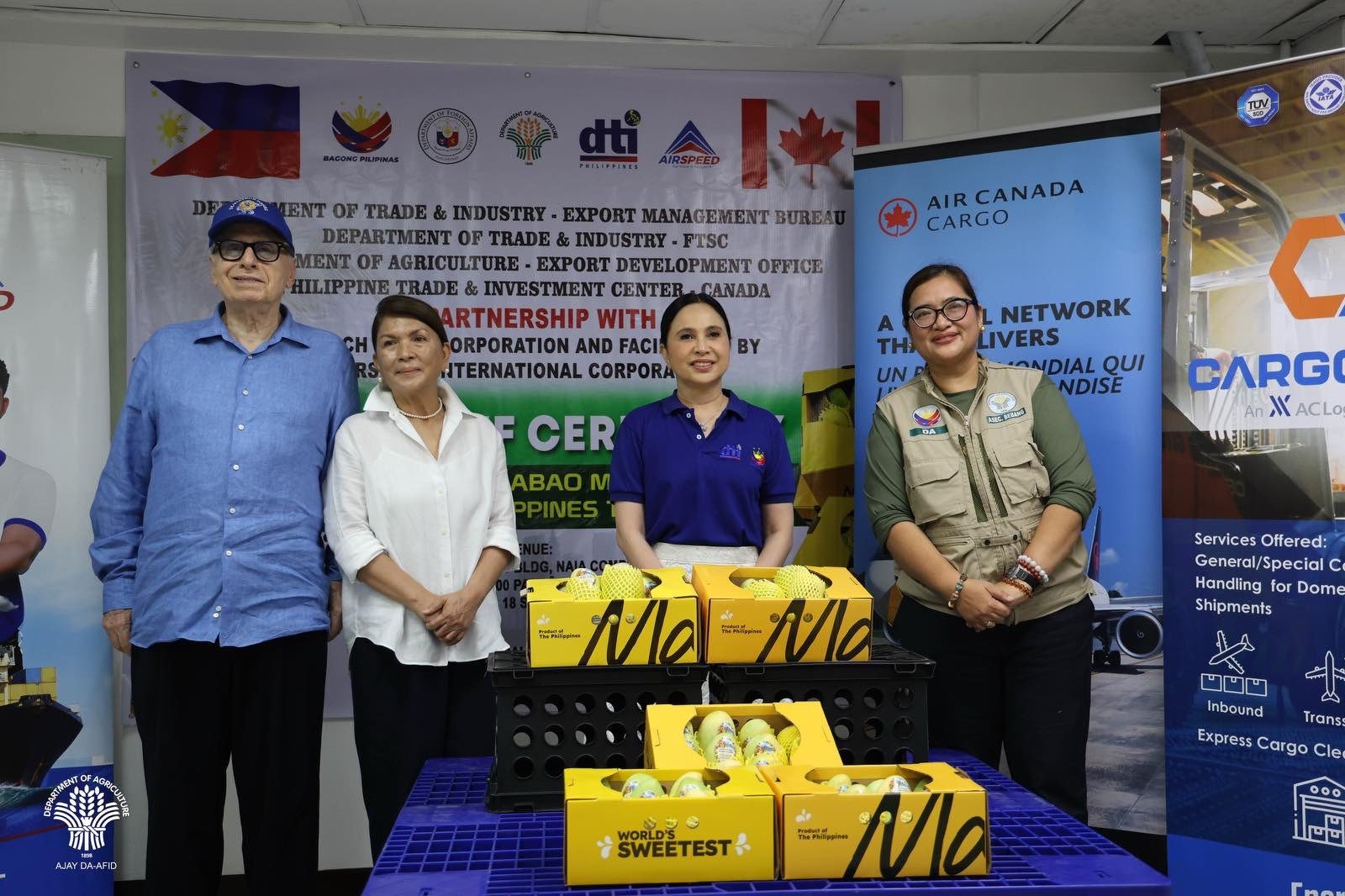
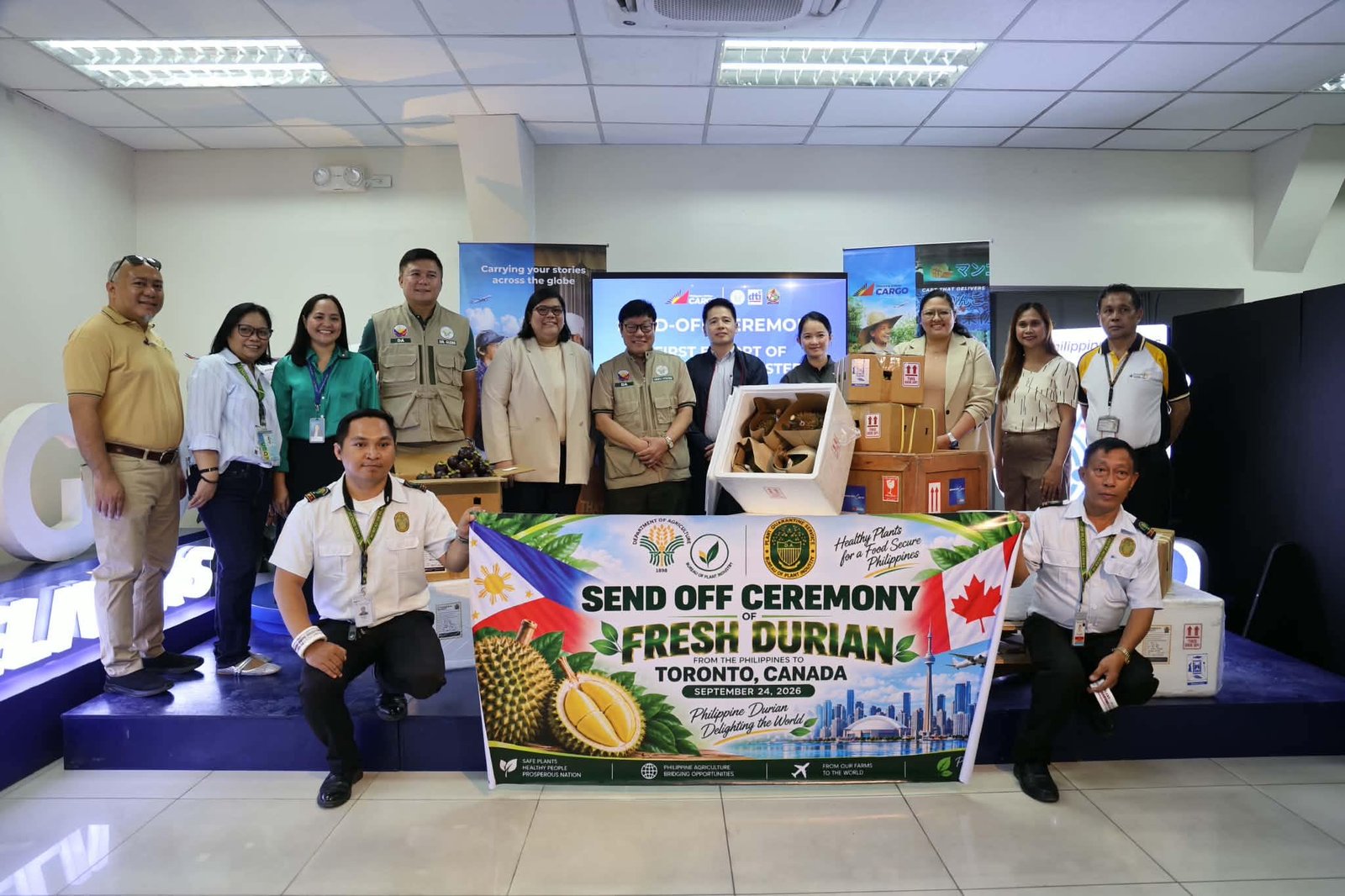
The Philippines is testing a new overseas market for its tropical fruit exports, with nearly one metric tonne of fresh durian and mangosteen being shipped to Canada as the government steps up efforts to expand farm exports and narrow a persistent agricultural trade deficit. A trial shipment comprising 300 kilos of durian and 120 kilos of mangosteen departed for Vancouver on September 23 for Canadian buyer Fresh Makers Ltd., represented by Jackson Ng. A second shipment, containing 300 kilos of durian and 200 kilos of mangosteen, is scheduled to leave for Toronto on September 24.
The shipments were flown aboard Philippine Airlines flights and represent another attempt by the Department of Agriculture (DA) to translate market-development efforts into commercial opportunities for farmers and exporters. Agriculture Secretary Francisco P. Tiu Laurel Jr. said the shipments respond to President Ferdinand Marcos Jr.’s directive for the DA to identify new international markets for Philippine agricultural commodities.
“The latest shipments of fresh durian and mangosteen is part of our broader effort of the Marcos administration to find new markets for local agricultural commodities to bolster farm incomes and sustain rural development,” Tiu Laurel said.
From market access to export growth
The Canada initiative forms part of a wider export strategy focused on high-value agricultural commodities, including durian, cacao, coffee and okra. The DA is seeking to diversify the Philippines’ agricultural export basket by identifying crops with stronger international market potential. Philip C. Young, Undersecretary for High Value Export Crops and Agri-Fishery Export Development and Promotion, said the objective is to move beyond market exploration and create commercially viable channels for farmers and exporters.
“These shipments underscore our unwavering resolve to position Philippine produce at the forefront of international trade,” Young said. “We continue to forge durable global partnerships, secure vital market shares, and showcase the quality of our high-value crops.” The timing of the push is significant. According to the DA, the Philippines’ agricultural trade deficit has exceeded $ 11 billion annually since 2022, increasing the pressure to develop higher-value export opportunities alongside domestic agricultural production.
For the government, expanding exports is not simply about increasing shipment volumes. The larger objective is to create additional sources of demand for farmers, particularly in commodities capable of commanding value in international markets.
Durian finds another route overseas
The Canada shipments also build on the exporter’s experience in Europe. Three air cargo shipments of fresh Philippine durian have already been completed to France, with weekly shipments continuing. The progression from France to Canada illustrates the potential for Philippine tropical fruits to move beyond established regional markets and reach consumers farther afield.
Durian and mangosteen, however, present a different challenge from many conventional agricultural exports. Their success in international markets depends not only on demand but also on the ability to maintain freshness, quality and consistency across long-distance supply chains. Air freight can open access to distant markets, but it also places greater pressure on logistics economics. For exporters, the commercial equation will ultimately depend on whether shipment costs, handling requirements and production volumes can support repeat trade rather than isolated consignments.
The test beyond the first shipment
The first consignments to Vancouver and Toronto provide an initial commercial foothold, but sustained export growth will require more than market access. Reliable supply, competitive logistics, consistent quality and sufficient production capacity will determine whether new overseas buyers can become recurring customers. The ability of growers, aggregators, exporters and logistics providers to coordinate across the supply chain will therefore be as important as securing access to the Canadian market itself.
That distinction matters for the Philippines’ broader agricultural export ambitions. Opening a market creates an opportunity; building a dependable supply chain determines whether that opportunity becomes an industry. With Canada now added to the destinations being explored for fresh Philippine tropical fruit, the government is attempting to build a wider export map for high-value agriculture. The immediate shipments are modest, but their significance lies in what follows: whether individual trial consignments can evolve into sustained commercial flows that deliver greater value back to growers and rural communities.