The first six months of 2026 will be remembered in Asian agriculture as a season of two clocks running at very different speeds. One clock — the one ticking inside research institutes, regulatory agencies and the slide decks of agri-food investors — moved unusually fast. Genome-edited rice advanced toward farmers' fields in India. China finalised its second registration list of genetically modified corn and soybean varieties. Singapore quietly logged its fourth cultivated-meat approval and published, for the first time, a consolidated public list of every novel food it has cleared. India's Union Budget rewrote the language of farm policy around artificial intelligence and digital public infrastructure. By almost any measure of institutional momentum, the science and the statecraft of agriculture in Asia accelerated.
The other clock belongs to the weather, the soil and the balance sheet — and it told a harder story. The India Meteorological Department opened the year with its most pessimistic monsoon forecast in more than two decades. Venture capital into the region's agritech sector remained roughly two-thirds below its peak. And the gap between a technology cleared in a lab and a technology working on a smallholding the size of a tennis court stayed stubbornly, frustratingly wide. The defining tension of H1 2026 was not whether Asian agriculture is innovating. It plainly is. The question is whether that innovation is reaching the ground fast enough to matter when the rains fall short.
The science finally moves
For more than a decade, the story of crop biotechnology in much of Asia was a story of stalled promise. India had approved exactly one genetically modified crop for commercial cultivation — Bt cotton, back in 2006 — and the political and regulatory machinery around transgenics had effectively seized up. What changed, and what came into sharper focus through H1 2026, is that the region has found a way around that impasse: genome editing.
The distinction matters enormously. Where conventional GM crops carry foreign DNA and trigger the full weight of biosafety regulation, genome-edited varieties produced through SDN-1 and SDN-2 techniques edit a plant's own genes and leave no foreign genetic material behind. A 2022 office memorandum from India's environment ministry exempted such transgene-free edited plants from the strictest tier of approval, requiring only that an institutional biosafety committee certify the absence of exogenous DNA. That single regulatory differentiation has done what years of debate over GM could not: it has put new traits on a credible path to farmers.
The proof points are now real rather than theoretical. India's two genome-edited rice lines — an improved Samba Mahsuri and an edited version of MTU-1010 — cleared multi-location trials, with the enhanced Samba Mahsuri showing a roughly 19 percent average yield uplift and the MTU-1010 variant demonstrating tolerance to saline and alkaline soils. A third candidate, a canola-quality mustard edited for disease and pest resistance, has been moving through its second year of trials across sixteen locations, with a possible release flagged for later in 2026. Behind these headline varieties sits a deeper strategic play: Indian scientists have been advancing indigenous gene-editing tools — TnpB-based miniature editors and platforms beyond the patent-heavy Cas9 — explicitly to reduce dependence on foreign intellectual property. A pipeline that includes drought-tolerant rice and maize, beta-carotene-rich banana, and high-oleic groundnut is no longer a wish list; it is a regulatory queue.
China spent the half-year pressing in the same direction, but from a position of far greater scale and urgency. As the world's largest importer of corn and soybeans, Beijing has framed seed self-reliance as a matter of national security, and its biotechnology programme reflects that framing. By early 2026 the country had finalised its second registration list of GM corn and soybean varieties — building on the first batch of production licences issued at the end of 2023 — and had approved its first gene-edited wheat and corn for domestic cultivation. The government's own projections put potential yield gains from these varieties at around 12 percent, and some industry analysts believe the eventual planted area could reach tens of millions of hectares. China still moves cautiously, public ambivalence about GM food remains real, and foreign investment in its agricultural biotech sector is largely walled off. But the trajectory through H1 2026 was unmistakable: a deliberate, state-driven push to close the yield gap with the Americas using domestically owned genetics.
Two of Asia's largest agricultural economies, in other words, spent the first half of 2026 demonstrating that the long biotech stalemate is breaking — not through the transgenic crops that dominated the last era's debates, but through precision editing that sidesteps both the regulatory burden and much of the political resistance.
Policy learns to speak in code
If genome editing was the science story of H1 2026, the digitalisation of farm policy was its administrative counterpart — and nowhere was the shift more explicit than in India's Union Budget for 2026-27, presented at the start of February.
The numbers themselves told a story of consolidation rather than transformation. Agriculture and allied activities drew an allocation in the region of ₹1.62 lakh crore, up around 7 percent on the previous year's revised estimates, with a separate fertiliser subsidy of roughly ₹1.71 lakh crore continuing to absorb global price shocks on farmers' behalf. Direct income support under PM-KISAN held flat at ₹63,500 crore for a third consecutive year — a sign that the transfer is now treated as a baseline entitlement rather than a lever to be pulled. The more revealing signals lay in where new money and new language went.
The budget leaned hard into what one agtech commentator described as an "AI-first" vision of agriculture. The headline instrument was Bharat-VISTAAR, a multilingual, AI-enabled advisory platform funded at ₹150 crore and designed to knit together the AgriStack digital identity framework and the Indian Council of Agricultural Research's package of practices into something a farmer can actually query in their own language. Alongside it sat the continuing build-out of the Digital Agriculture Mission, with a stated ambition to generate unique digital IDs for 110 million farmers. The thematic centre of gravity shifted, too — away from the wheat-and-rice staples and toward high-value agriculture, with dedicated promotion schemes for coconut, cashew, cocoa and sandalwood, and a record allocation for fisheries built around the integrated development of 500 reservoirs.
It would be easy to read all of this as unambiguous progress, and harder but more honest to note the tensions inside it. The same budget trimmed the flagship crop-insurance scheme, the Pradhan Mantri Fasal Bima Yojana, to its lowest allocation in years — a striking choice in a year when, by the government's own Economic Survey, weather shocks were inflicting heavier and more frequent yield losses. Allocations for agricultural research and education edged down even as the rhetoric of innovation rose. The architecture being built is genuinely impressive: a data layer, an AI advisory layer, a diversification push toward crops with better margins. Whether that architecture reaches the rainfed smallholder before the next failed monsoon does — that remains the open question of the entire enterprise.
What the budget made unambiguous is the direction of travel. Across Asia, the policy conversation has moved decisively from inputs and subsidies toward data, diversification and digital infrastructure. The instruments now carry names like AgriStack and Bharat-VISTAAR rather than minimum support prices. The bet is that intelligence — delivered cheaply, at scale, in the right language — can do what decades of input subsidy could not: make 140 million Indian farmers more resilient to climate and market volatility. It is a serious bet. H1 2026 placed it; the field will settle it.
The protein frontier grows up
Few corners of Asian agri-food have generated more heat over the past five years than alternative protein, and few entered 2026 in greater need of a reality check. The first half of the year delivered both fresh regulatory milestones and a sober recalibration of expectations — and Singapore, as ever, sat at the centre of the story.
The city-state remains the only place in Asia to have built a working, repeatable regulatory pathway for novel foods, and in H1 2026 it made that pathway newly transparent. In March, the Singapore Food Agency published its first consolidated public list of approved novel foods — fourteen products and ingredients spanning cultivated meat, algal protein and a range of fermentation-derived foods. For an industry that had long operated against a backdrop of case-by-case decisions, a centralised, citable register was more than housekeeping; it was a signal of regulatory maturity that the rest of the region will study closely.
The approvals kept coming, too. In April, the Paris-based startup Parima — formed from the merger of Gourmey and Vital Meat — won clearance for cultivated duck, six months after its cultivated chicken was approved, making it the first company anywhere to hold regulatory green lights for two animal species and bringing Singapore's tally of approved cultivated-meat products to four. Parima's stated playbook is instructive: begin in high-end gastronomy, where a cultivated duck endorsed by Michelin-starred chefs can command a premium, then move toward targeted retail. Its production model — cells grown in suspension in standard industrial bioreactors, deployable in partner infrastructure across Asia-Pacific without rebuilding a facility from scratch — points to where the economics of this sector may eventually have to land.
And yet the most important alternative-protein development of the half-year was arguably a step back rather than a step forward. Singapore confirmed that it is retiring its long-standing "30 by 30" local-production target in favour of a broader strategy — the Singapore Food Story 2 — built on four pillars: local production of protein and fibre, import diversification, stockpiling and global partnerships. Cultivated meat and other alternative proteins, the government made clear, are no longer counted as part of the near-term food-security plan. The reasons were candid: higher-than-expected production costs and weaker-than-expected consumer acceptance globally. The sector has not been abandoned — R&D funding continues, and officials left the door open to a larger future role "if and when" the economics turn — but the framing changed from imminent solution to long-term option.
That recalibration is healthy, and it captures something true about the whole alternative-protein moment in Asia. The regulatory science is maturing; the regulatory transparency is improving; the species count is climbing. What has not yet arrived is the cost curve and the consumer pull that would turn a string of approvals into a meaningful share of the protein on Asian plates. H1 2026 was the half-year in which the industry stopped over-promising and started, more usefully, to grow up.
The capital reckoning
Underwriting all of this — the gene-editing pipelines, the digital platforms, the bioreactors — is capital, and the capital story of H1 2026 was one of hard-won discipline after an exuberant boom.
The defining document arrived in April, when Omnivore, Beanstalk AgTech and Briter released a data-driven analysis of the agritech landscape across thirteen Southeast Asian markets, backed by the IFC, FMO Ventures and the Rabo Foundation. Its central claim was bullish: digitalisation and agritech adoption could unlock more than US$90 billion in annual GDP gains across Southeast Asia by 2033, in a region where agriculture contributes roughly 15 percent of GDP and employs up to 40 percent of the workforce. But the report's value lay in its candour about how that prize had been pursued so far. Agritech investment across the region peaked at over US$750 million in 2022 before falling nearly 70 percent by 2025 — a sharp correction as investors confronted the structural realities of fragmented value chains and the genuine difficulty of scaling ventures across markets that share a map but little else.
The report's most useful conclusions were its uncomfortable ones. There is, it argued, no unified Southeast Asian market to conquer; roughly two-thirds of documented cross-border expansion attempts had failed, and premature regional expansion was the cause of more than 60 percent of venture collapses between 2022 and 2025. The most defensible opportunities, it concluded, are single-market plays built around the right value chain, the right business model and a local execution team — not the pan-regional land grabs that defined the boom years. As Omnivore's Mark Kahn put it, patient, disciplined capital that understands local market dynamics is what actually moves these ecosystems forward.
Tellingly, the authors held up India as the instructive model — a market whose venture ecosystem matured through a hard decade of governance reform, exits and the unglamorous work of building market infrastructure. Development finance institutions and impact investors have committed a combined US$650 million to agrifood funds across the region and remain central to the capital stack, but the report was clear that the next phase of scaling will require a blend of equity, credit and concessional capital rather than venture money alone.
For an industry that spent the early 2020s chasing valuations, this is a more sober and more durable foundation. The money flowing into Asian agritech in 2026 is more patient, more local and more honest about the structural friction of fragmented smallholder agriculture. That is not a retreat. It is the sector learning, expensively, how the region actually works.
The field doesn't care about any of this
And then there is the weather, which has the disconcerting habit of ignoring every register of approved novel foods and every line of an AI advisory platform.
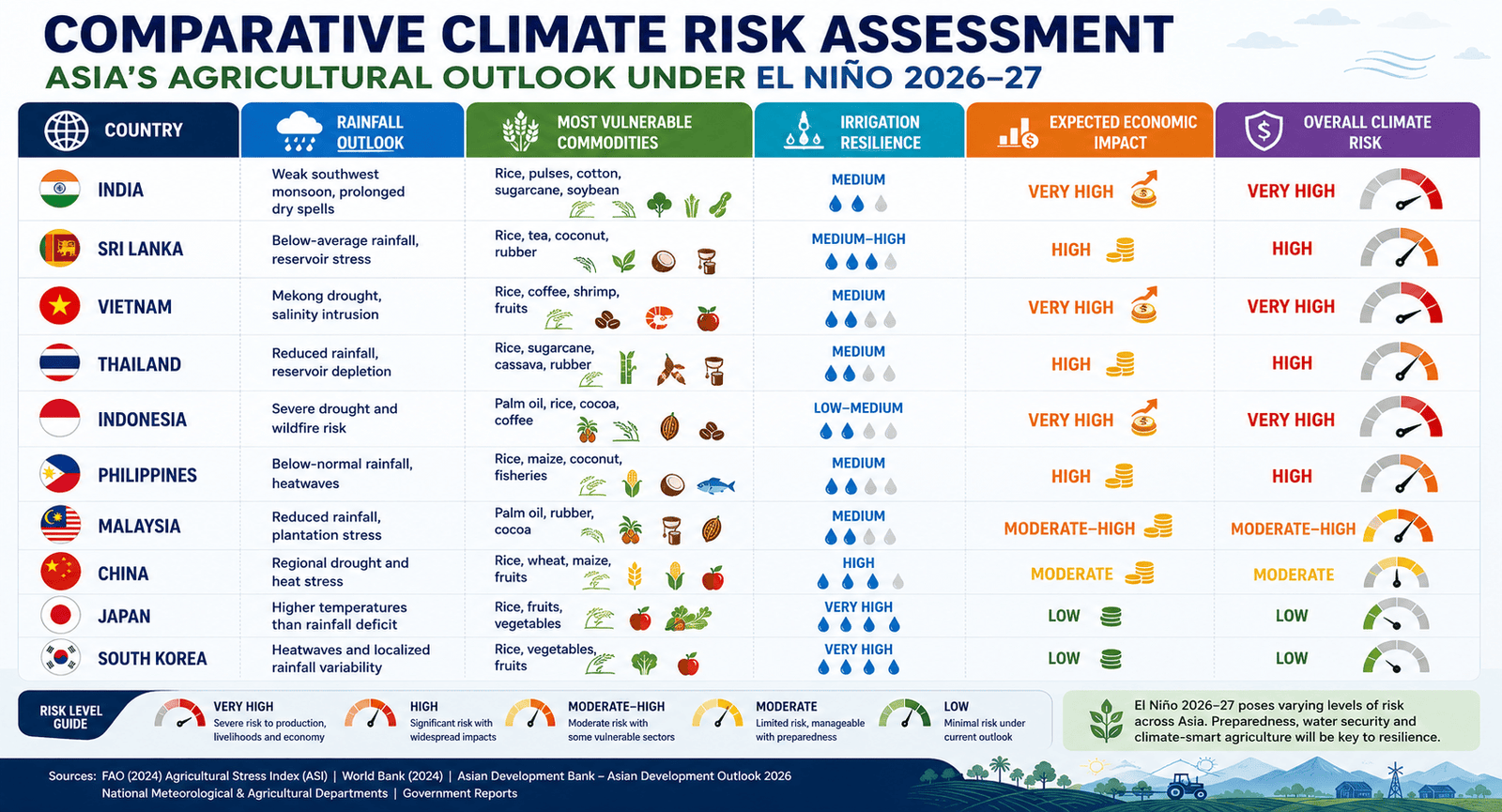
The single most consequential development of H1 2026 for hundreds of millions of Asian farmers was not a clearance or a funding round. It was the India Meteorological Department's first-stage forecast, issued in April, that the 2026 southwest monsoon would deliver around 92 percent of the long-period average — a below-normal season, and by some accounts the lowest first-stage forecast in at least twenty-five years. The climate signals behind the number were ominous: weak La Niña conditions transitioning toward neutral, with a meaningful probability of El Niño developing during the monsoon season itself. The historical record is unforgiving on this point — across the El Niño years India logged between 1951 and 2022, every drought year was an El Niño year.
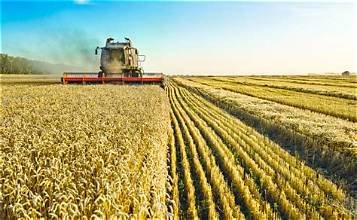
By mid-year the strain was already visible. The season opened well below normal, agriculture officials flagged El Niño risk across a dozen states and called for district-level contingency plans, and crop-weather monitors issued severe dry alerts across the soybean and groundnut belts, threatening to delay sowing and shorten the growing window. Roughly 60 percent of India's farmers depend on monsoon rainfall, and close to half the country's farmland lacks assured irrigation; the kharif crops sown from June — rice, soybean, cotton, pulses, groundnut — rely almost entirely on those rains. Reservoir buffers, fuller than in recent years, offer some cushion, and a late-developing positive Indian Ocean Dipole could yet offset part of the El Niño signal as it did in 2023. But variability, not the aggregate number, will decide the season. Ratings agencies were already pencilling in downside risks to agricultural growth and upside risks to food inflation.
This is the context against which every laboratory triumph of the half-year has to be read. A genome-edited drought-tolerant rice is precisely the kind of innovation that matters in a 92-percent monsoon year — but the edited Samba Mahsuri reaching commercial scale and the drought-tolerant lines reaching farmers are still future events, not present realities. An AI advisory platform is exactly what a smallholder facing an erratic kharif season could use — but Bharat-VISTAAR's value depends entirely on whether it reaches remote, rainfed districts in time to change a planting decision. The crop-insurance scheme that would cushion a failed season was trimmed in the same budget that funded the AI platform.
There is a related, quieter argument that gained traction in the region's agtech commentary at the start of 2026: that the sector has over-indexed on inventing new tools and under-invested in deploying the ones it already has. Asia-Pacific accounts for half of the 1.3 billion tonnes of food wasted globally each year; in South Asia, where a staggering share of the population is born underweight or stunted, around 40 percent of all food perishes before it is eaten. The toolbox to address this — from biologicals to gene-editing to AI robotics — is already substantial. The constraint is rarely the technology. It is the absence of a safety net that lets a smallholder absorb the risk of trying something new, and the persistent difficulty of tracing a benefit back to the tool that produced it. The most important agricultural work of 2026, on this reading, is less about the next breakthrough than about closing the distance between the breakthrough and the farm.
Where the two clocks meet
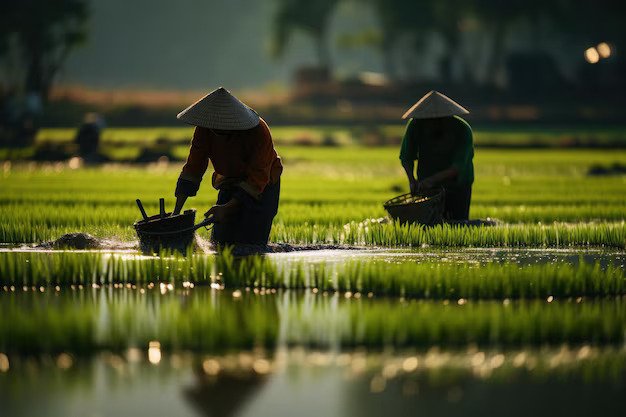
If H1 2026 had a single physical setting where its two clocks were visibly synchronised, it was the exhibition floor. In May, Agritechnica Asia returned to Bangkok under the theme "Farm. Farmer. Future." — co-located with HortEx Thailand, drawing around 350 exhibitors and an expected 18,000-plus visitors from across the region, and headlined by a new conference on smart agriculture and unmanned agricultural systems. Taiwan's Asia Agri-Tech Expo ran in the same month with a comparable emphasis on AI smart farming, automation and aquaculture. The Southeast Asian agricultural mechanisation market that these events serve is projected to keep growing at around 4 percent annually toward US$2.5 billion by 2028, driven by rice, sugarcane, cassava and maize across the Philippines, Vietnam, Indonesia, Thailand and Malaysia.
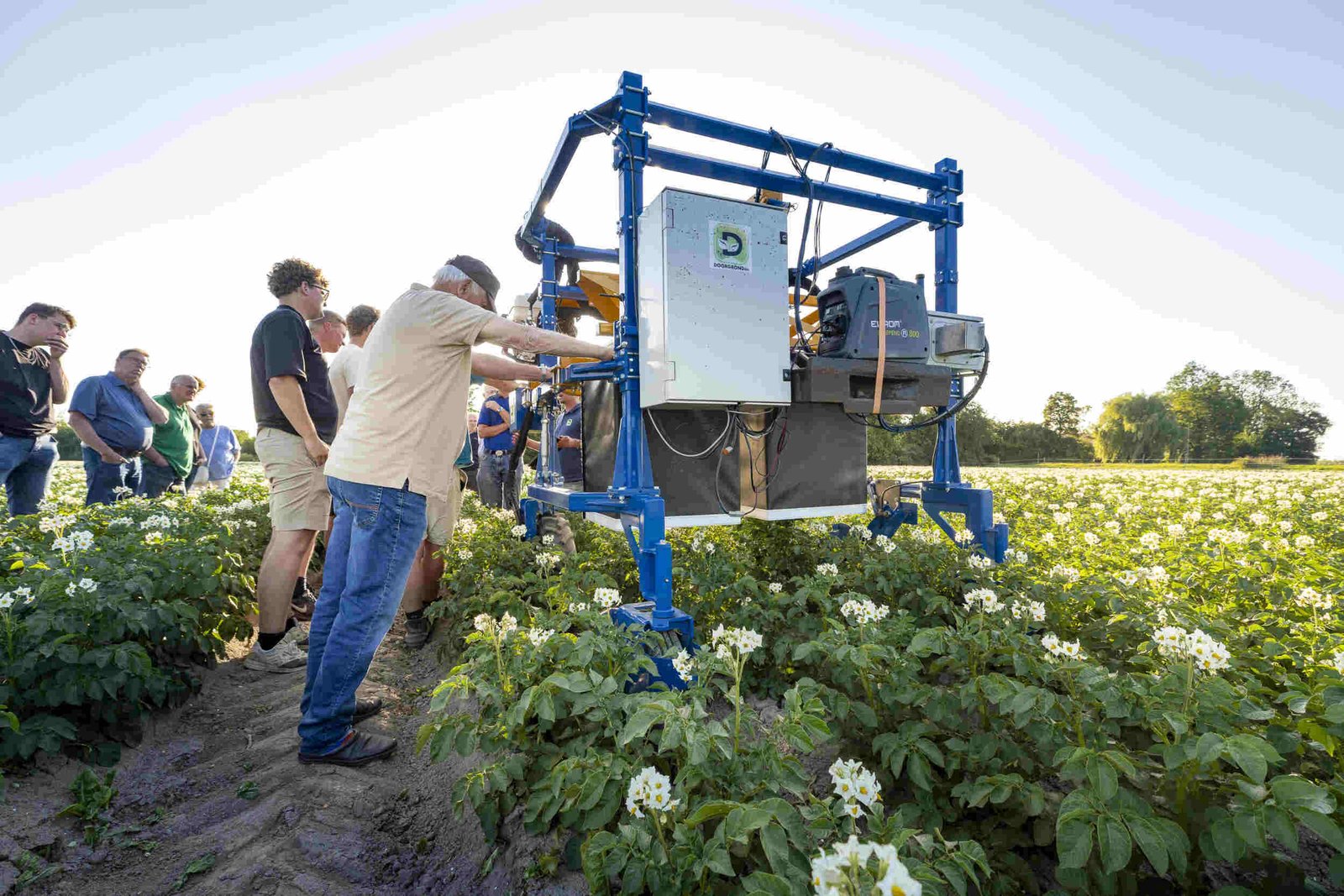
What these gatherings made tangible is the through-line of the entire half-year: physical AI is moving from the conference panel to the field. Robotics, sensors, unmanned systems and data platforms are no longer the speculative content of a startup zone; they are increasingly the practical content of a mechanisation strategy adapted to Asian production systems and smallholder economics. The relevant question across the region has shifted from whether the technology works to whether it can be put, affordably and durably, into the hands of the farmer who needs it.
That is the right question, and it frames what the second half of 2026 will test. Watch for India's genome-edited mustard, which could secure release in the coming months and would mark the first edited oilseed to reach the field. Watch how the kharif season actually resolves once July and August — the months that carry the bulk of the rainfall and cover the critical growth stages — deliver their verdict on the El Niño signal. Watch whether the capital discipline the Omnivore report prescribed translates into the patient, single-market, locally led ventures it championed. And watch, at October's Asia-Pacific Agri-Food Innovation Summit in Singapore, whether the alternative-protein sector can show a cost curve to match its lengthening list of approvals.
The first half of 2026 proved that Asian agriculture can innovate at speed across science, policy and capital. The genome editors are working, the AI platforms are funded, the regulatory pathways are maturing, and the money is wiser than it was. What the half-year could not yet prove is the only thing that ultimately counts: that this acceleration reaches the field before the field runs dry. The lab clock is fast. The field clock is the one keeping real time. Closing the distance between them is the work that remains.