China's glyphosate industry appears to be entering a new chapter. After months of soaring prices driven by tight supplies and expensive raw materials, the market is beginning to cool. Demand has softened following the end of the spring farming season, inventories are building, and prices are retreating across much of the supply chain. Yet even as manufacturers grapple with weaker margins, they are continuing to invest in new products, signalling confidence that demand for glyphosate will remain strong over the longer term.
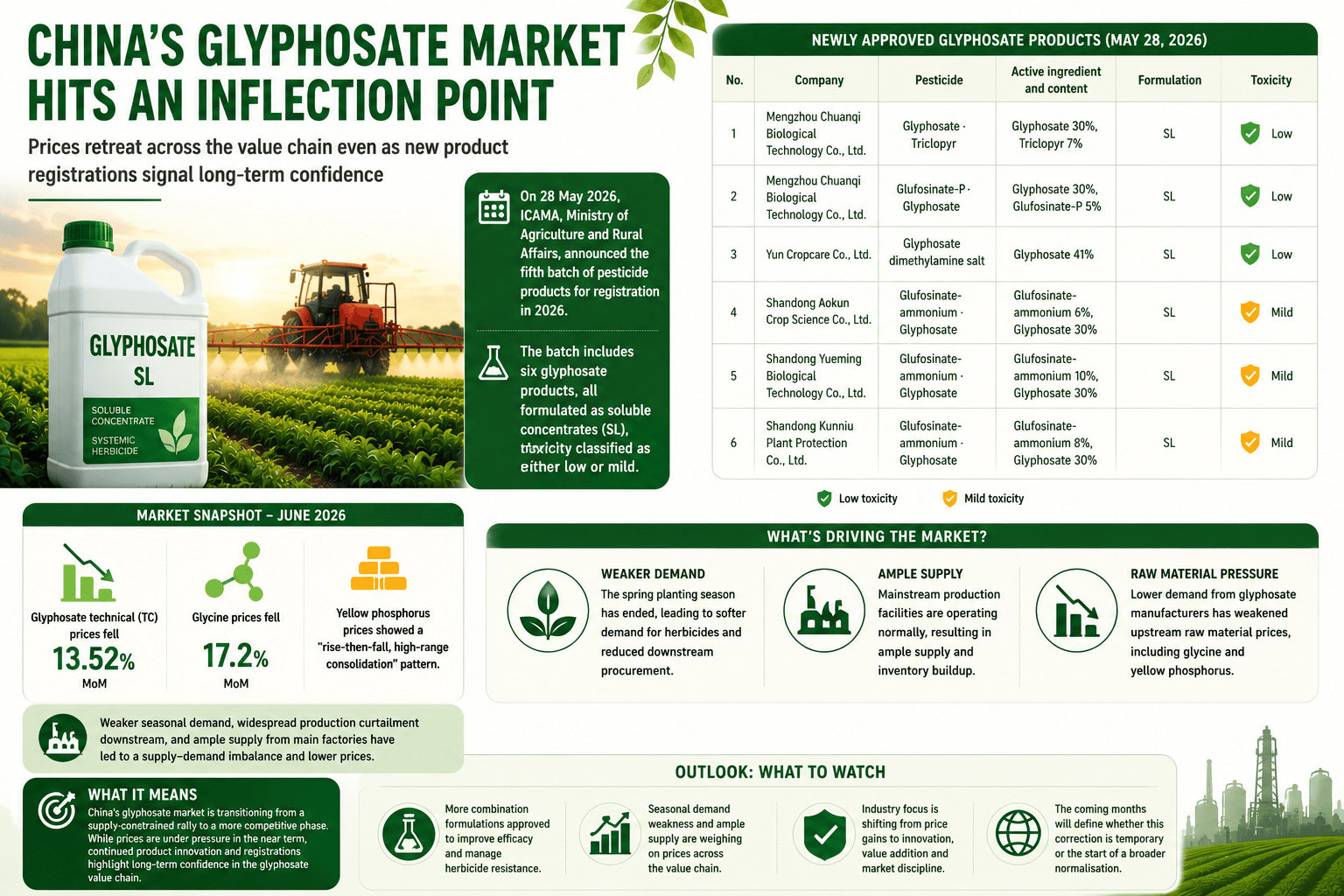
That contrast—between slowing prices and steady product innovation—captures the current state of the world's largest glyphosate-producing nation. On May 28, 2026, China's Institute for the Control of Agrochemicals (ICAMA) under the Ministry of Agriculture and Rural Affairs unveiled the fifth batch of pesticide products proposed for registration this year. Among them were six new glyphosate formulations, all registered as soluble concentrates (SL) and classified as either low or mild toxicity.
The approvals reveal where the industry is heading. Rather than relying on standalone glyphosate products, companies are increasingly combining active ingredients to broaden weed control and help farmers manage herbicide resistance.
Mengzhou Chuanqi Biological Technology Co., Ltd. received approval for two low-toxicity formulations: one combining glyphosate 30 percent with triclopyr 7 percent, and another blending glyphosate 30 percent with glufosinate-P 5 percent. Yun Cropcare Co., Ltd. secured registration for a 41 percent glyphosate dimethylamine salt formulation, the highest glyphosate concentration among the newly approved products.
Meanwhile, Shandong Aokun Crop Science Co., Ltd., Shandong Yueming Biological Technology Co., Ltd. and Shandong Kunniu Plant Protection Co., Ltd. each received approval for formulations combining glyphosate 30 percent with glufosinate-ammonium at concentrations of 6 percent, 10 percent and 8 percent, respectively. All three products were classified as mildly toxic. While regulators continue to approve new products, market conditions have become noticeably less favourable.
According to the latest domestic market monitoring, glyphosate technical (TC) prices fell 13.52 percent month-on-month in June, extending a decline that began after prices reached multi-month highs earlier this year. The biggest reason is seasonal. With China's spring planting season now over, demand from downstream buyers has slowed considerably. At the same time, manufacturers have continued operating at normal production rates, creating a market where supply is comfortably exceeding demand. That imbalance is now putting downward pressure on prices throughout the glyphosate supply chain.
The weakness is also spreading upstream. Glycine, one of glyphosate's key raw materials, recorded a 17.2 percent month-on-month decline in June. As glyphosate producers reduced purchases, demand for glycine weakened sharply, even though production levels remained largely unchanged. The result was an oversupplied market and falling prices. Yellow phosphorus, another essential feedstock, told a slightly different story. Prices fluctuated throughout June, rising early in the month before easing later, producing what market analysts describe as a "rise-then-fall" pattern. Even so, overall prices remained relatively elevated compared with the beginning of the year.
Looking at the broader trend, the numbers highlight how dramatic the market has been over the past six months.
China's glyphosate technical prices climbed from $3,649 per tonne in December 2025 to $5,013 per tonne in April 2026, before easing to $4,863 per tonne in May as buying momentum weakened. Glycine followed a similar trajectory, rising from $1,603 per tonne in December to $2,666 per tonne in April before dropping to $2,013 per tonne in May. Yellow phosphorus moved steadily higher throughout the period, increasing from $3,272 per tonne to $4,433 per tonne, reflecting continued strength in upstream raw material markets despite recent volatility.
The trend was equally visible across glyphosate formulations. Prices for glyphosate DEA remained below $920 per tonne through February before jumping to $1,407 per tonne in March and peaking at $1,615 per tonne in April. By May, however, they had slipped back to $1,345 per tonne, mirroring softer market demand.
Glyphosate IDAN proved more resilient. After falling from $1,696 per tonne in December to $1,495 per tonne in January, prices gradually recovered over the following months, reaching $1,531 per tonne by May. One of the strongest price rallies came in 98 percent PMIDA, a key glyphosate intermediate. Prices rose from $2,261 per tonne in December to a peak of $3,332 per tonne in April before easing to $3,063 per tonne in May. Although prices softened, they remained well above levels seen at the end of last year. Another upstream material, phosphorus trichloride, experienced relatively modest fluctuations. Prices slipped from $919 per tonne in December to $883 per tonne in January before gradually recovering to $904 per tonne in May, suggesting a more balanced supply-demand situation than elsewhere in the industry.
Taken together, the data suggest China's glyphosate market is moving away from the supply-driven rally that defined the first half of the year. Price momentum is fading as seasonal demand eases, but companies are not slowing their investment in product development. The latest registrations show a clear focus on combination herbicides that deliver broader weed control and support resistance management—an indication that manufacturers are preparing for a market where innovation, rather than pricing power alone, will increasingly determine competitive advantage.
Source: CCM Data & Business Intelligence
-- Suchetana Choudhury (suchetana.choudhuri@agrospectrumindia.com)