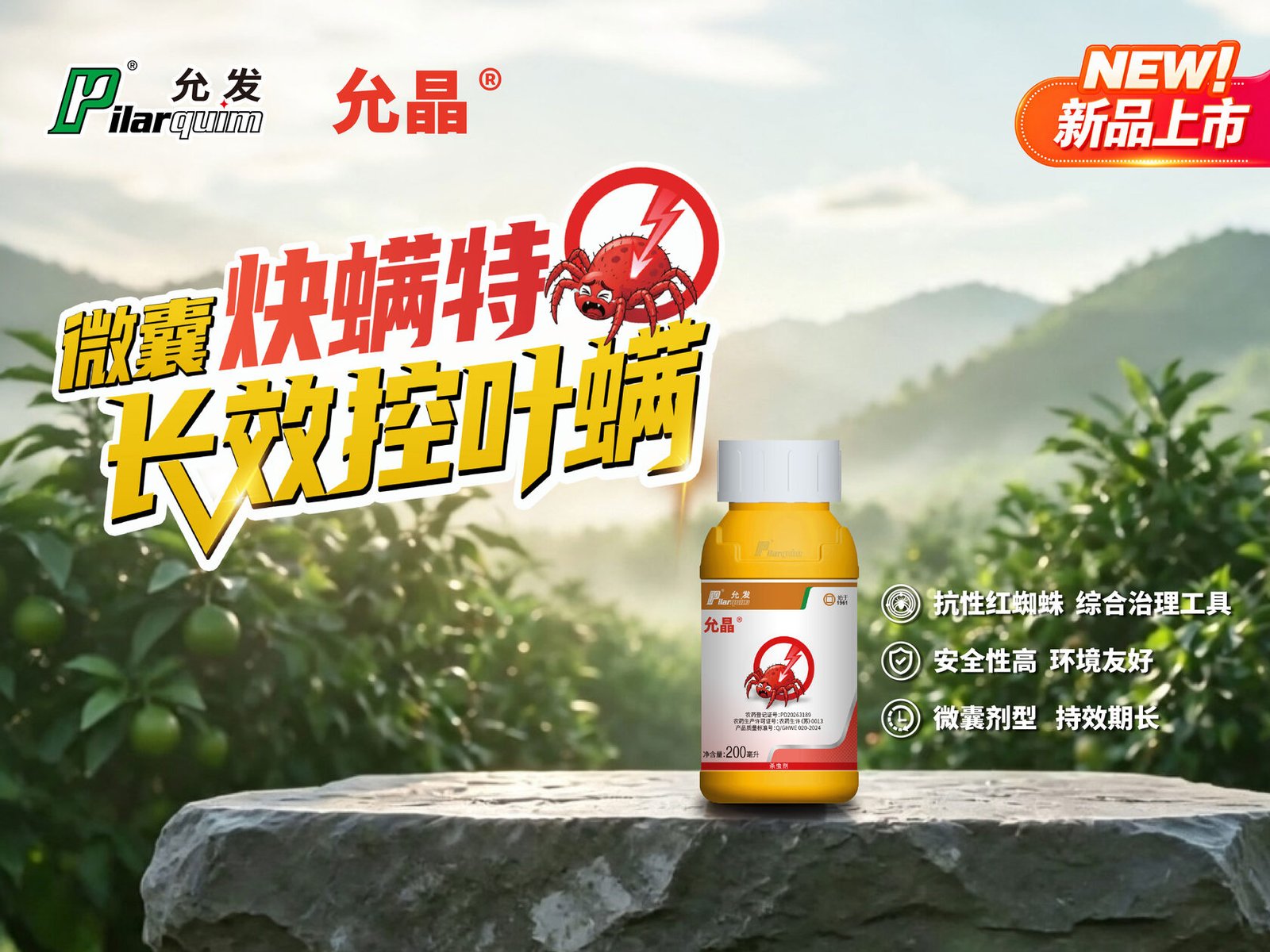
Pilarquim has launched Yunjing, a 30 per cent propargite microcapsule suspension concentrate (CS), in China, targeting the growing challenge of spider mite resistance in fruit trees, vegetables and other economically important crops.
Introduced in August 2026, the product uses the company's proprietary microencapsulation technology to regulate the release of propargite, an acaricide used to control spider mites. The formulation is designed to improve rainfastness and photostability, extend residual activity and reduce the frequency of pesticide applications.
Spider mites pose a persistent crop protection challenge because of their short reproductive cycles and overlapping generations, which can accelerate the development of resistance to pesticides. As conventional treatments lose effectiveness, growers face increasing pressure to adopt products and application strategies that sustain control while limiting repeated chemical exposure.
Pilarquim said propargite's distinct mode of action and established history of field use make it a useful component of resistance-management programmes. By encapsulating the active ingredient in slow-release particles, the new formulation is intended to maintain effective exposure over a longer period than conventional formulations.
The company also highlights crop safety as a key feature of the product. The microcapsule coating reduces direct contact between propargite and sensitive plant tissues, including young leaves and developing fruit, potentially lowering the risk of phytotoxicity under high-temperature and high-humidity conditions. This could allow more flexible use during mid-season growth and at tender-shoot stages, subject to approved label directions.
According to Pilarquim, the formulation acts against adult and nymphal spider mites, rapidly suppressing feeding and egg-laying while providing extended residual control. The company also reports low toxicity to bees and natural enemies, positioning the product for use within integrated pest management programmes.
Yunjing is registered for use on citrus in China, with a recommended dilution rate of 1,000–1,500 times. Pilarquim also identifies apples, cotton, beans, strawberries and peppers as potential crops for spider mite and carmine mite management. Actual use must follow the applicable crop registrations and approved product label.
The company says the formulation can be tank-mixed with ovicidal acaricides, including fluazinam, to broaden control across mite life stages and potentially extend protection. Such combinations should be used only where permitted by the relevant product labels and supported by compatibility and crop-safety guidance.
The launch marks another step in Pilarquim's development of advanced pesticide formulations, with the company aiming to improve application efficiency and crop protection performance while reducing unnecessary treatment frequency.
However, the extent of the benefits will depend on field conditions, mite species, resistance status and application practices. Independent comparative field data would help establish how consistently the microcapsule formulation improves control, crop safety and application economics over conventional propargite products.
As resistance continues to complicate mite management, formulation innovation could offer growers an additional tool. Its long-term value will depend on integration with resistance-management strategies, including the rotation of products with different modes of action and the conservation of beneficial organisms.