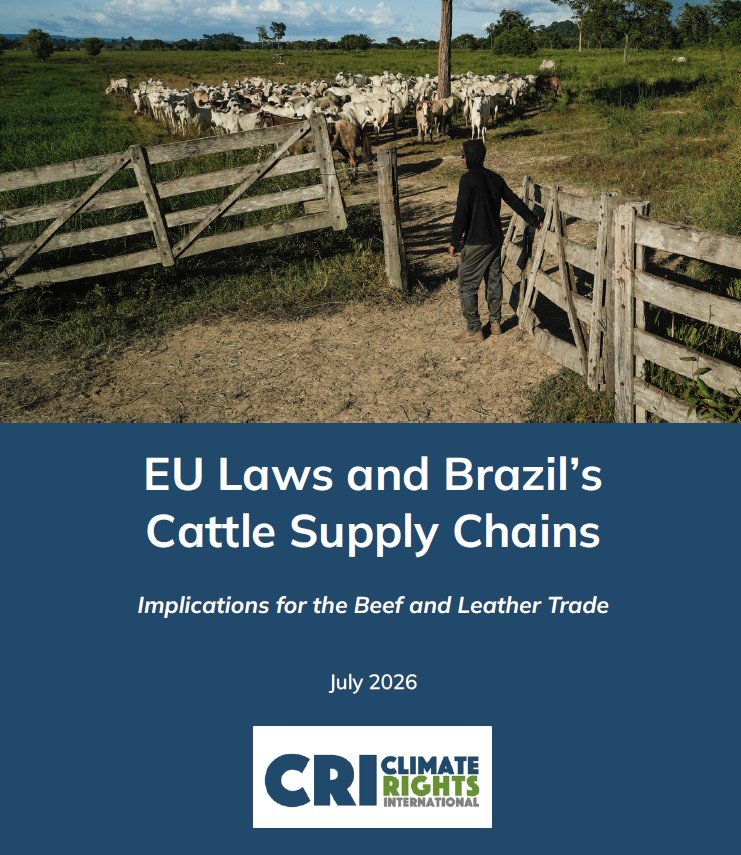
Companies sourcing beef and leather from Brazil could lose access to the European Union (EU) market unless they can demonstrate compliance with sweeping EU requirements addressing deforestation, forced labor, and other serious environmental and human rights risks, Climate Rights International said in a report released today. The report identifies a practical approach that companies can use to reduce those risks while supporting efforts in Brazil to curb cattle-driven deforestation and related human rights abuses.
The 52-page report “EU Laws and Brazil’s Cattle Supply Chains: Implications for the Beef and Leather Trade” examines how three major EU laws—the EU Deforestation Regulation (EUDR), the Forced Labour Regulation (FLR), and the Corporate Sustainability Due Diligence Directive (CSDDD)—will require companies to be able to trace their supply chains, to ensure that products are not linked to deforestation, forced labor, or other serious environmental and human rights harms, and to demonstrate compliance through credible documentation.
Companies that do not meet the new requirements could face exclusion from the EU market, administrative penalties, civil litigation, and—in serious cases involving environmental crime—criminal liability under national laws implementing the EU Environmental Crime Directive.
“These EU laws will significantly raise the stakes for companies using due diligence practices that have proven woefully inadequate to address deforestation and human rights abuses in Brazil’s cattle supply chains,” said Daniela Ikawa, legal and policy expert at Climate Rights International. “Unless companies revamp their practices to meet EU requirements, they could soon face substantial legal and economic consequences in Europe.”
Leather products manufactured outside the EU are not covered by the EUDR, but companies importing leather and leather products will remain subject to the Forced Labour Regulation (FLR) and the Corporate Sustainability Due Diligence Directive (CSDDD).
Under pressure from business interests, cattle hides, skins, and leather could also be excluded from the EUDR after a recent proposal adopted by the European Commission on 13 July 2026. The Commission’s proposal is now subject to a two-month scrutiny period, during which the European Parliament and the Council of the European Union may object and stop it before it enters into force.
Brazil has significantly reduced deforestation under President Luiz Inácio Lula da Silva, but forest loss remains dangerously high, particularly in the Amazon, where cattle ranching remains the single largest driver. Scientists warn that continued destruction of the Amazon could push the rainforest toward a tipping point, releasing vast amounts of carbon into the atmosphere, disrupting rainfall patterns across South America, and seriously undermining global efforts to address climate change.
As Climate Rights International documented in its 2025 report, “Before It’s Too Late,” cattle-driven deforestation is frequently associated with forced labor, invasions of Indigenous lands, and other serious abuses. Climate Rights International documented deforestation and attacks on environmental rights defenders in community conservation areas in the Amazon in another 2025 report, “Chainsaws, Smoke, and Silence.”
Cattle often pass through multiple farms before reaching slaughterhouses and tanneries. As a result, for every direct supplier, beef and leather exporters typically have multiple indirect suppliers—farms whose cattle pass through one or more intermediary properties before reaching the slaughterhouse. While some meatpackers and tanneries have improved oversight of their direct suppliers, tens of thousands of indirect suppliers remain unmonitored. Several companies have announced plans to develop new tracing systems to address this gap, but these will depend on the voluntary sharing of GTA data by suppliers at every level—something that cattle experts consulted by Climate Rights International consider highly unlikely.
"Companies will need to do much more to strengthen their own due diligence and supply-chain controls," Ikawa said. "But when it comes to indirect suppliers, that will not be enough on its own. Companies have a responsibility to recognize that gap—and do something about it."
Brazil has begun developing official traceability and monitoring mechanisms to help overcome this challenge. Minas Gerais and Pará have established government-backed systems that combine cattle-movement records with compliance data to identify whether indirect suppliers are linked to deforestation. Several other states are developing similar systems, which could be expanded beyond deforestation to cover forced labor, invasions of Indigenous lands, and other serious abuses.
To address the indirect supplier problem, companies should prioritize sourcing from supply chains operating in Brazilian states with credible mechanisms for tracing and monitoring cattle, and screening upstream suppliers for links to deforestation. They should also announce that, beginning on a specified future date, they will prioritize supply chains operating in states whose mechanisms also screen for forced labor, invasions of Indigenous lands, and other serious abuses. Companies should use their purchasing power to support the expansion of these mechanisms to additional states and, ultimately, the creation of a transparent national traceability and monitoring system.
“These laws can do more than keep high-risk products out of Europe,” Ikawa said. “If companies use them well, they can help change the economic incentives that have long fueled deforestation and serious human rights abuses—and reinforce Brazil’s own efforts to address them.”
To read the full analysis click : https://cri.org/reports/eu-laws-brazil-cattle-supply-chains/