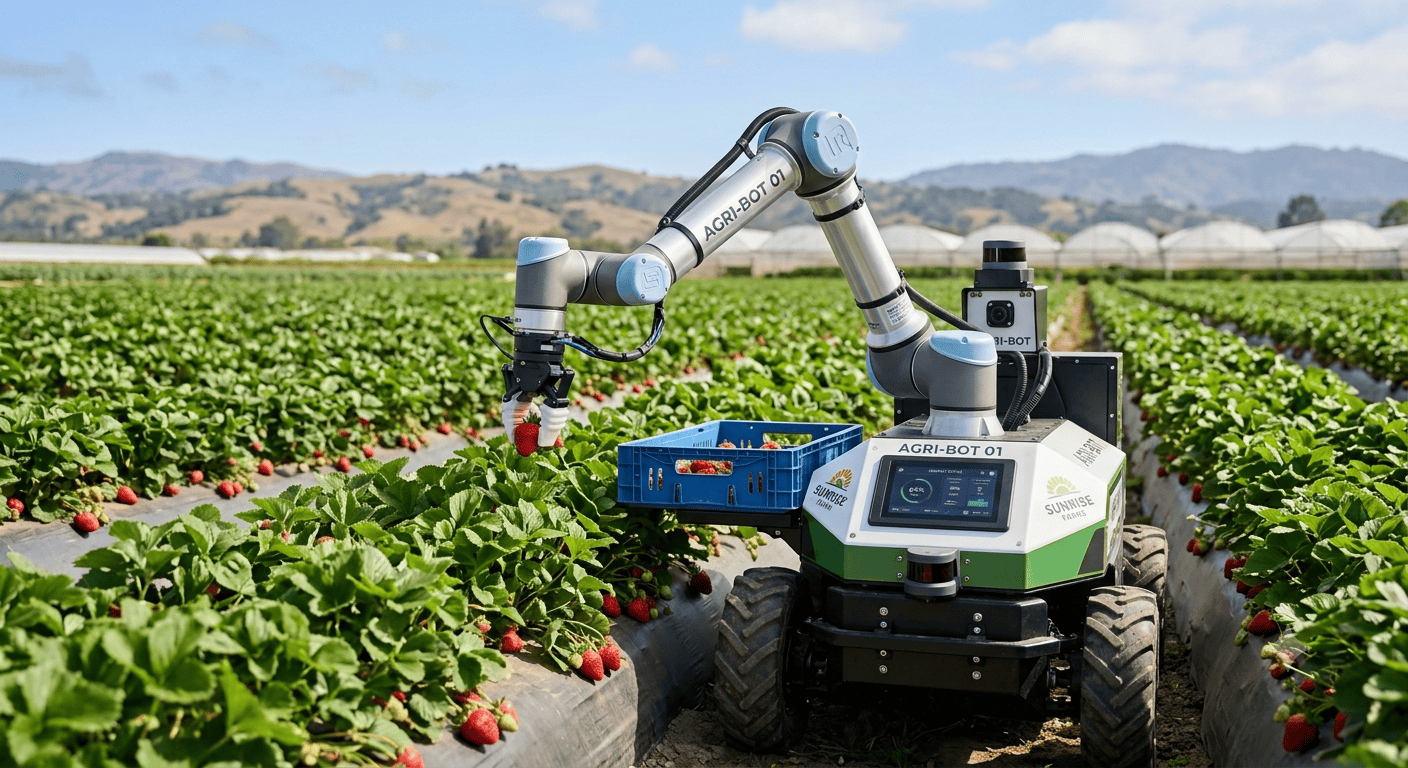
According to the latest research by Growth Market Reports, the global agricultural cobot market reached $1.53 billion in 2025, reflecting the rapid and sustained adoption of collaborative robots, or cobots, across modern farming operations worldwide. The market is expected to grow at a CAGR of 23.1 per cent from 2026 to 2034, reaching approximately $11.58 billion by 2034.
The expansion is being driven by the growing need for automation in agriculture, persistent labour shortages and increasing pressure on farmers to improve productivity while supporting more sustainable and efficient farming practices. Agricultural cobots are emerging as an important part of the broader agricultural automation landscape, with applications ranging from harvesting and sorting to planting, weeding and crop monitoring. Similar market research across the agricultural robotics sector also identifies labour scarcity, precision agriculture and advances in AI and sensing technologies as major growth drivers.
Market Growth Driven by Automation
The agricultural cobot market is benefiting from increasing pressure on farms to produce more while managing labour availability and rising operating costs. Many agricultural activities, including harvesting, sorting, planting, weeding and crop monitoring, require substantial manual effort. Cobots provide an opportunity to automate selected tasks without completely removing human involvement.
Unlike fully autonomous systems, collaborative robots are designed to work alongside farmers and agricultural workers. This enables them to support repetitive and physically demanding activities while allowing workers to focus on decision-making and specialised tasks.
Rising Labour Challenges Encourage Adoption
Labour shortages are among the key factors encouraging agricultural automation. Seasonal farming operations often depend on large numbers of workers for activities that must be completed within narrow timeframes. When sufficient labour is unavailable, farms can experience production delays, crop losses and increased operating expenses.
Cobots can help address these challenges by performing repetitive tasks for extended periods. Their collaborative design allows agricultural workers to remain involved in decision-making and specialised activities while robotic systems handle physically intensive or repetitive processes.
Improving Productivity and Precision
Agricultural cobots can contribute to more consistent execution of farming tasks. Automated systems can follow programmed movement patterns and use sensors to identify crops, obstacles and environmental conditions.
This capability can support precision agriculture by improving task accuracy and potentially reducing unnecessary use of agricultural inputs. Across the broader agricultural robotics market, technologies such as computer vision, sensors and AI are increasingly being integrated to support applications including crop management, harvesting and precision operations.
Technology Development Creates New Opportunities
Advances in artificial intelligence, computer vision, machine learning, sensors and robotic mobility are creating new opportunities for agricultural cobots. Modern systems are increasingly capable of interpreting environmental information and responding to changing conditions rather than relying solely on fixed instructions.
The integration of cameras and vision systems can help cobots distinguish crops from weeds or identify produce at different maturity stages. Artificial intelligence can further improve decision-making, while connectivity enables agricultural operators to monitor robotic systems and collect operational data.
Challenges Could Influence Market Expansion
Despite the strong growth potential, agricultural cobot adoption faces several challenges. Initial investment costs can be significant, particularly for small and medium-sized farms. Agricultural environments can also be unpredictable, with changing weather, uneven terrain, dust, moisture and variations in crop conditions creating technical difficulties.
Farmers may also require training to operate, maintain and integrate robotic systems into existing workflows. Compatibility with different crops and equipment remains another important consideration, as agricultural operations vary substantially by region and farm type.
Competitive Landscape
The competitive landscape includes Blue River Technology, Naïo Technologies, ecoRobotix, Agrobot, Octinion, FFRobotics, Harvest CROO Robotics, Iron Ox, Small Robot Company and Lely. The agricultural cobot sector includes both specialised robotics companies and larger agricultural technology players developing automation solutions for harvesting, weeding, crop monitoring and other farm operations.
Future Outlook
The future of the agricultural cobot market will likely depend on making robotic systems more affordable, modular and easier to integrate with existing farm equipment. Robotics-as-a-service models could also broaden access by reducing the need for significant upfront investment.
As artificial intelligence, sensing technologies, connectivity and robotic manipulation continue to advance, cobots could become an increasingly practical partner for farmers, helping address labour constraints while improving productivity, precision and operational efficiency.