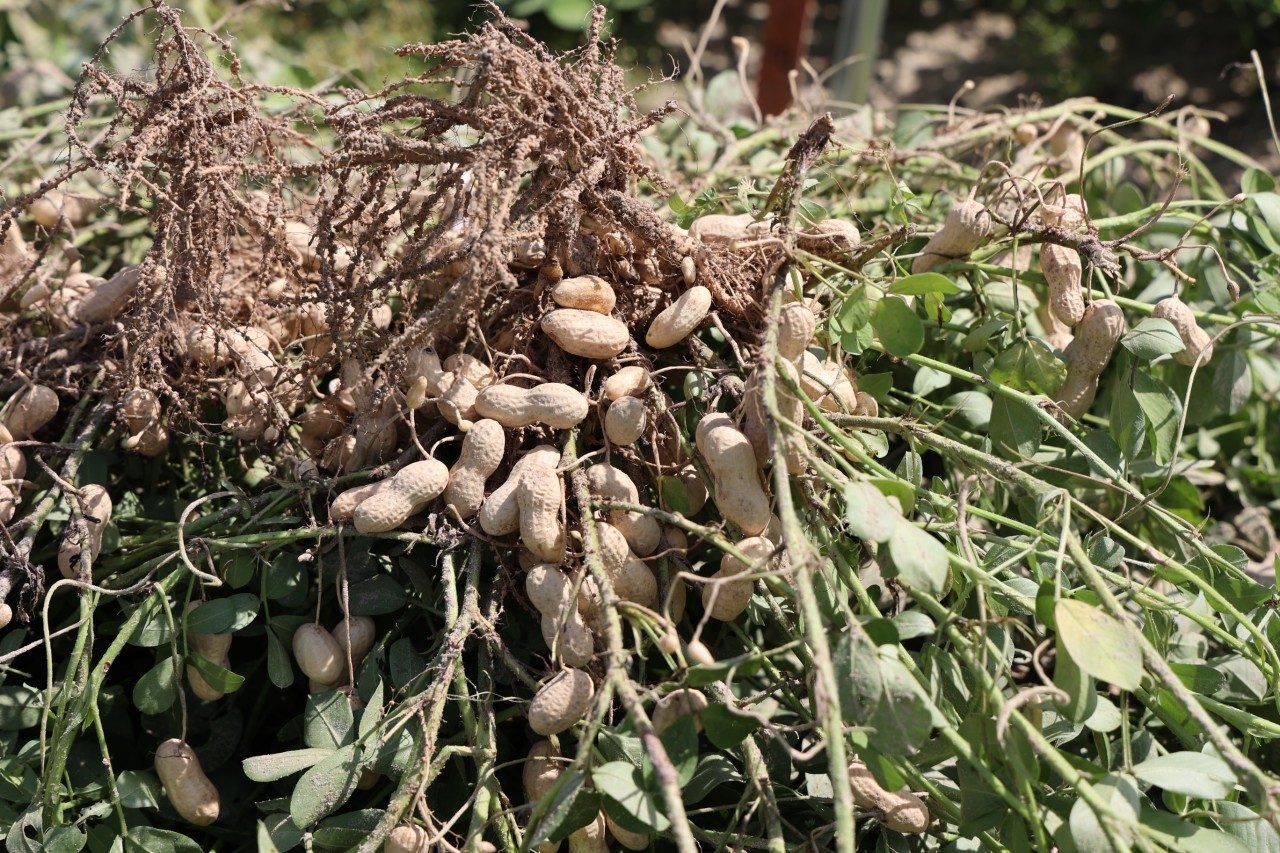
A new peanut variety developed by China’s Oil Crops Research Institute (OCRI) has demonstrated a significant yield advantage in one of the country’s most challenging peanut-growing regions, highlighting the potential of disease-resistant breeding and integrated crop management to improve productivity in marginal agricultural areas.
During an on-site yield assessment in August, experts from the Agricultural Development Center of Macheng City, Hubei Province, evaluated Zhonghua 29 at a demonstration base in Songbu Town. The variety recorded an average yield of 387.9 kg per mu, 50.35 per cent higher than locally grown conventional varieties, setting a new yield benchmark for peanuts in the hilly and mountainous areas of the Yangtze River basin.
The result is particularly significant for the Dabie Mountains, where peanut production faces a combination of poor soils, sloping farmland and high incidence of bacterial wilt. Field mortality among susceptible varieties can exceed 70 per cent, while conventional resistant varieties typically produce only around 260 kg per mu.
Zhonghua 29 was developed specifically for peanut-growing areas affected by bacterial wilt. According to OCRI, the variety has a bacterial wilt incidence of below 5 per cent, alongside high oleic acid content of up to 79.9 per cent and protein content of up to 29.5 per cent.
Its agronomic profile also includes tolerance to drought and waterlogging, making it suitable for the dryland and variable-weather conditions found across parts of the Yangtze River basin. These characteristics are particularly relevant as growers in hilly regions contend with increasingly uneven rainfall and disease pressure.
OCRI has been working on peanut varieties suited to bacterial-wilt-affected areas of the Dabie Mountains since the 1970s. Its breeding programme has produced four generations of disease-resistant varieties, including Xiekangqing, Zhonghua No. 4, Zhonghua 21 and Zhonghua 29.
The latest field results suggest that the breeding effort is moving beyond disease resistance alone, combining yield potential, nutritional quality and resilience to environmental stress. The performance of Zhonghua 29 at the Macheng demonstration site was supported by OCRI's integrated green prevention and control system for peanut soil-borne diseases.
Rather than relying on a single intervention, the approach combines ARC microbial agents, seed treatment, ridge cultivation and precision pesticide application during the middle and later stages of crop development. The integrated system has been promoted by China's Ministry of Agriculture and Rural Affairs as a key agricultural technology for four consecutive years, from 2022 to 2025.
Its deployment alongside Zhonghua 29 addresses two of the region's longstanding production constraints—high disease incidence and low yields. The combination of resistant genetics and targeted agronomic management could offer growers a more practical route to raising output without depending solely on increased chemical inputs.
The Macheng results therefore carry implications beyond a single demonstration plot. For peanut-producing areas where disease, terrain and soil quality limit conventional varieties, the experience points to a broader model in which variety selection and crop-management technology work together to improve farm productivity.
The 387.9 kg-per-mu yield achieved by Zhonghua 29 represents a substantial improvement over the roughly 260 kg-per-mu average associated with conventional resistant varieties in the region. More importantly, the result was achieved under the challenging production conditions characteristic of the Dabie Mountains rather than in a high-input, favourable growing environment.