
For decades, agricultural strategy rested upon a reassuring trinity of land, water, and seeds. It was a stable geometry of governance, almost Euclidean in its simplicity, upon which the grand architecture of food security was assumed to rest. However, history has a mischievous habit of adding footnotes in geopolitical ink. The Russia–Ukraine war offered, in effect, a masterclass in the weaponisation of agricultural interdependence. When conflict disrupted exports from two of the world's foremost suppliers of wheat, corn and sunflower oil, global grain markets convulsed with almost theatrical immediacy. Food prices soared to historic highs, import-dependent nations scrambled to secure supplies, and agricultural commodities were transformed from mundane items of trade into instruments of strategic leverage. A regional war, in remarkably short order, metastasised into a global inflationary contagion.
The Red Sea crisis provided a second, equally sobering lesson. Attacks on commercial shipping along one of the world's most vital maritime arteries forced vessels to abandon the Suez Canal and undertake the far longer voyage around the Cape of Good Hope. Transit times stretched, freight costs ballooned, insurance premiums surged, and supply chains—carefully calibrated over decades of globalisation—began to fray. What first appeared to be a shipping disruption soon revealed itself as an agricultural cost shock by another name.
The Strait of Hormuz crisis, however, goes a step further. It exposes a deeper and more uncomfortable truth: modern food production is, at its core, an energy-dependent enterprise. Fertilisers are manufactured from natural gas, tractors run on diesel, irrigation depends on electricity, and food processing and cold chains require uninterrupted power. The farm may appear distant from geopolitics, but it is tethered to it at every stage.
For India, with its dual dependence on imported energy and fertiliser inputs, this linkage is especially consequential. As Rahul Mirchandani, Managing Director of Aries Agro Ltd, observes, “India has entered the Kharif season with reasonably comfortable fertiliser stocks, but prolonged disruption would raise landed costs and create availability concerns. Rising energy costs directly impact ammonia and urea production, increasing the government's subsidy burden on urea, DAP and other conventional fertilisers.”
It is for this reason that the Strait of Hormuz can no longer be regarded merely as an energy chokepoint. Nearly a fifth of the world's petroleum consumption and some 80 million tonnes of LNG pass through its narrow waters each year. Less appreciated, but perhaps equally significant, is the fact that roughly one-third of global urea exports and up to 30 per cent of ammonia trade also transit this corridor. For India, Hormuz is not merely a distant maritime passage. It is an unseen but indispensable pillar of food security—one through which the geopolitics of energy increasingly shapes the economics of every harvest.
That vulnerability was laid bare with startling speed following the military escalation of February 28, 2026, under Operation Epic Fury. What began as a geopolitical confrontation swiftly metastasised into a logistical paralysis. Commercial traffic through the Strait of Hormuz ground to a halt, major shipping lines suspended Suez Canal transits, and airspace across much of the Gulf was abruptly closed. Within hours, vessels were being rerouted around Africa's Cape of Good Hope, while those already inside the Persian Gulf sought refuge in ports from Jebel Ali to Doha.
The scale of the disruption was extraordinary. By March 2, more than 138 container vessels carrying nearly 470,000 TEUs were stranded inside the Gulf. Industry giants including MSC, CMA CGM, Maersk, COSCO and Hapag-Lloyd found themselves caught in a maritime bottleneck of historic proportions. Predictably, costs surged. Emergency conflict and war-risk surcharges ran into thousands of dollars per container, while rising fuel prices, rerouting expenses and insurance premiums compounded the burden. By mid-March, the crisis had evolved from a regional security challenge into a systemic supply-chain shock. Voyages between Asia and Europe suddenly required an additional 10–14 days, while congestion rippled through alternative hubs from Singapore and Colombo to Mundra and Salalah.
Diplomatic efforts proved futile. By April 12, vessel traffic through Hormuz had collapsed by more than 95 per cent from pre-conflict levels. One of the world's most important trade arteries had, for all practical purposes, ceased to function.
The consequences for agriculture followed swiftly. Approximately one-third of global urea exports and up to 30 per cent of ammonia trade normally pass through Hormuz. Qatar’s QAFCO complex, one of the world’s largest urea producers, reportedly operated at sharply reduced levels. Urea prices surged by more than 60 per cent within weeks. Freight rates on Asia–Europe routes rose by around 20 per cent, while transpacific rates to the US West Coast increased by roughly 40 per cent compared with pre-war levels.
For India, the immediate threat is not physical scarcity but escalating cost pressure. The country enters each agricultural cycle dependent on imported fertilisers, LNG, sulphur, phosphates, and potash. The government has responded with buffer inventories and substantial subsidy support. Fertiliser subsidy allocations rose from Rs 1.68 lakh crore (2024–25 budget) to Rs 1.92 lakh crore after additional approvals. For Kharif 2026, phosphatic and potassic fertiliser subsidies are estimated at Rs 41,534 crore, approximately Rs 4,317 crore higher than the previous season. India’s total fertiliser requirement for Kharif 2026 is projected at more than 390 lakh metric tonnes.
Why Fertilisers Sit at the Epicentre
If oil is the bloodstream of the global economy, then natural gas is its quieter, less theatrical but far more intimate counterpart in the realm of agriculture—and fertilisers are the point at which this invisible circulation is transmuted into something politically consequential: Food.
It is one of the defining paradoxes of our age that the most technologically sophisticated food system in human history is also among its most geopolitically fragile. For beneath the reassuring vocabulary of yields, hybrids, and harvest cycles lies a far more elemental dependency: Energy. Nearly 80 per cent of ammonia production costs stem from natural gas, rendering nitrogen fertilisers less an agricultural input than a chemically transformed extension of global energy markets. Ammonia anchors the nitrogen chain, feeding into urea—the most widely used fertiliser in India and, arguably, one of the most consequential commodities in its agrarian economy.
The scale of this dependence is neither marginal nor theoretical. India consumes approximately 35 million tonnes of urea annually, a figure that reflects both the sheer scale of its agricultural system and the structural limits of domestic nutrient production. Despite meaningful local manufacturing capacity, India remains persistently reliant on imported LNG, ammonia, phosphates, and potash. In effect, it does not merely import fertilisers; it imports the external conditions under which food becomes possible.
The latest data from the World Bank Group brings this into sharp focus. The global fertiliser price index rose by more than 12 per cent in Q1 2026 (quarter-on-quarter), marking its sixth increase in seven quarters, and by April 2026 reached its highest level since October 2022. Within this surge, urea led the rally, while phosphate and potash markets exhibited relatively moderated movements. Yet even this moderation demands caution. Prices remain below the extraordinary peaks of 2021 and 2022, when fertiliser markets surged by more than 100 per cent and 55 per cent respectively, following disruptions in Russia and Belarus—two foundational suppliers of global nutrients. Those episodes had already demonstrated that fertiliser markets are, in essence, energy markets in agricultural disguise.
However the present crisis is not occurring in a vacuum.
During 2022, European ammonia production collapsed as natural gas prices surged in the aftermath of the Russia–Ukraine war. Ammonia plants across the continent either sharply curtailed operations or shut down entirely as production economics disintegrated. The effects propagated outward with remarkable speed: a global fertiliser price shock that reached farmers in Brazil’s soybean belt and Bangladesh’s rice fields with equal force. India, while partially insulated through aggressive subsidy expansion, nonetheless absorbed a significant fiscal shock. The lesson was unambiguous: when natural gas prices rise, ammonia production contracts; when ammonia contracts, fertiliser supply tightens; and when fertiliser supply tightens, global food systems enter synchronized distress.
Against this historical backdrop, the current Strait of Hormuz crisis acquires its full significance. Beneath India’s narrative of agricultural self-reliance lies a less acknowledged dependency. The nation continues to import approximately 10 million tonnes of urea each year; ICRIER estimates that 5.6 million tonnes were imported in 2024–25 alone, accounting for nearly 15 per cent of domestic demand. At the same time, India sourced close to 27 million tonnes of LNG, much of it from the hydrocarbon-rich states of West Asia. Collectively, Saudi Arabia, Oman, Qatar, the UAE, and Bahrain account for nearly 37 per cent of India’s fertiliser imports, in addition to supplying essential inputs such as ammonia, sulphur, and LNG for domestic production.
The consequence is unmistakable: The foundations of India’s nitrogen economy rest not merely on domestic policy and agronomy, but on the stability of a region whose geopolitical convulsions can reverberate directly through the country’s fertiliser supply chain.
The market reaction has been swift and quantifiable. The World Bank notes that fertiliser prices are projected to rise by more than 30 per cent in 2026, driven by higher input costs—especially nitrogen and phosphate fertilisers—and sustained global demand. A moderation is expected only in 2027, contingent upon restored supply chains and incremental capacity additions. But the balance of risks remains decidedly skewed upward, particularly if energy prices remain elevated or if Hormuz-linked disruptions extend beyond 2026 Q3.
Energy Is Agriculture's Hidden Input
The numbers, taken together, do not merely describe a disruption—they describe a system under strain, where geography, energy and trade converge into a tightly wound transmission mechanism of risk. At the centre of this architecture lies the Middle East, with much of this energy flowing, in the normal course of commerce, through the Strait of Hormuz—a narrow maritime chokepoint that has migrated from the margins of geopolitics to its very centre.
Since 1 March 2026, most commercial shipping lines have suspended or curtailed operations through the route due to heightened security risks. Markets have reacted with immediate force. Brent crude has surged to $82–84 per barrel from $66–67 in January–February 2026, according to Crisil. Asian spot LNG prices have climbed even more sharply, from about $10/MMBtu to $24–25/MMBtu. These are not incremental adjustments but macroeconomic shockwaves—repricing the cost of energy, and by extension, the cost of everything that depends on it.
As Vinod Goyal, CEO of Agricare Corporation, notes, “Domestic factories use LNG to manufacture nitrogen-based fertilisers like urea. With 55–65 per cent of India's LNG arriving from the Middle East, reduced gas supplies have forced multiple factories to halt production. The crisis has also disrupted supplies of sulphur and phosphoric acid, both critical for DAP manufacturing.”
His observation lays bare an uncomfortable truth: fertilisers are not merely agricultural inputs; they are energy transformed into nutrients. Urea is natural gas in granular form. DAP is the product of globally traded minerals moving through vulnerable supply chains. When LNG prices spike, ammonia costs rise; when ammonia tightens, fertiliser markets follow.
Yet, hydrocarbons are merely the opening act.
Compounding this vulnerability is India’s dependence on imported liquefied petroleum gas (LPG), with roughly two-thirds sourced externally and the overwhelming share originating in the Middle East. LPG is primarily a household fuel, meaning its price transmission bypasses industrial buffers and enters directly into kitchens. Only about 10 per cent is used industrially, limiting corporate exposure but amplifying its social sensitivity.
The disruption extends well beyond energy markets into the arteries of global trade. Freight rates across air and sea corridors have risen sharply, while insurance premiums for cargo moving through exposed maritime routes have escalated with equal urgency, adding a persistent layer of margin compression across trade-linked sectors.
Nowhere is this structural exposure more pronounced than in fertilisers, where chemistry and geopolitics intersect with unusual intensity. India imports about 30 per cent of its fertiliser requirement, with nearly 40 per cent of these imports sourced from the Middle East, which also supplies around 30 per cent of imports of rock phosphate, phosphoric acid, and muriate of potash. More critically, the region sits upstream of domestic production itself, accounting for roughly 60–65 per cent of LNG imports and 75–80 per cent of ammonia imports required for fertiliser manufacturing. In such a configuration, fertilisers cease to be merely an agricultural input; they become a derivative instrument of energy geopolitics.
It is at the consumption end, however, that the abstraction of global shocks acquires its most intimate—and politically consequential—form. Pushan Sharma, Director at Crisil Intelligence, captures this translation from geopolitics to kitchen economics with disarming clarity. As he notes, “The cost of home-cooked vegetarian and non-vegetarian thalis increased 5 per cent and 7 per cent year-on-year, respectively, in May, driven by higher prices of tomatoes, vegetable oil and liquefied petroleum gas (LPG).” In other words, macroeconomic turbulence is no longer an external headline; it is a line item in the daily plate.
The underlying food inflation mechanics, Pushan further explains, are sharply differentiated. “Tomato prices surged 57 per cent to Rs 36 per kg from Rs 23 per kg in May 2025, primarily on account of a 3–4 per cent decline in production. Meanwhile, global supply-side pressures pushed up vegetable oil and LPG prices by 8 per cent and 7 per cent on-year, respectively.” The asymmetry is telling: small supply contractions, when filtered through fragile logistics and global energy stress, translate into disproportionate price spikes.
Yet even within this inflationary current, the system retains pockets of absorption. Sharma points to the stabilising role of staples: “Prices of pulses are expected to be subdued supported by comfortable domestic availability,” aided by higher projected production in marketing year 2027 and robust government stocks of around 43 lakh tonnes—the highest in three years—built through procurement under the Price Support Scheme. Even as import uncertainties around tur from Mozambique persist, duty-free imports of tur and urad, along with buffer stocks, are expected to cap upside pressures.
At the edible oil frontier, the transmission is even more explicit. As Jayashree Nandakumar, Director at Crisil Ratings, observes, “Since the West Asia conflict began, the average import price of sunflower crude oil has risen to $1,420–1,440 per tonne, compared with $1,275 per tonne on average for the trailing 12 months,” with a weakening rupee and higher freight costs compounding landed inflation. This upstream shock is already visible at retail level: refined sunflower oil now trades at Rs 170–175 per litre versus around Rs 150 in January 2026.
Substitution effects are beginning to reshape demand itself. With rice bran and soybean oils cheaper by Rs 10–20 per litre, consumers are gradually shifting away from sunflower oil, with demand projected to fall by nearly 10 per cent in fiscal 2027, opines Crisil.
The World Bank data reinforces the transmission with striking clarity. The global fertiliser price index rose over 12 per cent in Q1 2026, its sixth increase in seven quarters, reaching the highest level since October 2022. The natural gas price index climbed 24 per cent in March 2026 after the closure of the Strait of Hormuz. Asian LNG prices surged nearly 94 per cent, while European benchmarks rose 59 per cent, even as the United States remained relatively insulated due to strong domestic supply—an instructive reminder that global shocks originate broadly but are absorbed unevenly.
India sits at the sharper end of this system. It imports 88 per cent of its crude oil, about half of which typically passes through Hormuz, along with over 60 per cent of LPG and more than half of LNG imports. The resulting inflation transmission is layered: 71 per cent from primary energy, 27 per cent from downstream commodities such as fertilisers and chemicals, and just 2 per cent from freight and insurance. Physical stress adds another dimension, with gas allocations to fertiliser plants cut to 70 per cent of prior levels, signalling scarcity rather than price adjustment. Air transport costs, meanwhile, have risen 23.7 per cent due to petroleum intensity.
Food inflation continued its upward trajectory, rising to 4.8 per cent in May, as persistent heatwaves disrupted supply chains and exerted renewed pressure on the prices of vegetables, dairy products, and eggs, according to a Crisil analysis. The report noted that part of the estimated 36-basis-point direct impact on CPI from the cumulative Rs 7.5 per litre increase in petrol and diesel prices during May has already been reflected in inflation data, with the remaining pass-through likely to materialise in June.
At the same time, fuel inflation (covering electricity, gas, and other fuels) edged up marginally to 0.8 per cent. “While base effects continued to temper the overall rise, electricity deflation narrowed and LPG as well as PNG inflation eased on a year-on-year basis, even as sequential price increases remained evident,” said Dharmakirti Joshi, Chief Economist at Crisil Limited.
He noted that inflation in alternative fuels such as kerosene, coal, and firewood accelerated further, reflecting substitution pressures as consumers increasingly turned to these options amid higher LPG costs and supply constraints. “Looking ahead, fuel inflation is likely to remain sticky—particularly for LPG—given ongoing geopolitical tensions in West Asia and the recent Rs 29 per cylinder increase in domestic LPG prices. The impact of this hike is expected to be reflected in June inflation data,” Joshi added.
Corporate exposure follows a clear hierarchy. Petronet LNG Ltd sits at the most vulnerable end through regasification volumes. Fertiliser firms—National Fertilizers Ltd, Rashtriya Chemicals & Fertilizers Ltd, and Deepak Fertilisers & Petrochemicals Corporation Ltd—face margin compression. Refiners absorb dual input shocks, city gas distributors pass through price pressure, while ONGC, Reliance Industries Ltd, and GAIL (India) Ltd gain selectively from pricing strength and supply re-routing.
What emerges is a single integrated system where a maritime chokepoint, a gas molecule, a fertiliser bag, and a plate of food are bound in one continuous chain of consequence.
Beyond Hormuz: Reimagining Fertiliser Security
If the Strait of Hormuz crisis has delivered one lesson with unmistakable clarity, it is this: food security and energy security are no longer separate policy domains. They are, in effect, different chapters of the same story.
For much of independent India's history, agriculture was narrated through the familiar grammar of monsoons, irrigation networks, seeds, soils and yields. Yet the turbulence of 2026 has revealed a more intricate reality. In an age where fertilisers are forged from natural gas, nutrient chains depend upon maritime corridors, and farm economics can be reshaped by events unfolding thousands of kilometres away, the story of food increasingly begins not in the field, but in the geopolitics of energy.
India maintains one of the world’s most generous fertiliser support mechanisms, fixing the retail price of urea at a mere Rs 242 per 50-kg bag (approximately $60 per tonne) and absorbing the often-vast gulf between this politically mandated price and the realities of global import markets through a sizeable subsidy outlay borne by the exchequer. National Fertilizers Limited (NFL) recently received bids as low as $449.3 per tonne, including freight, for importing 1.7 million tonnes of urea—a dramatic retreat from the $959 per tonne bids quoted in Indian Potash Limited's (IPL) earlier 2.5 million-tonne tender during the height of the Hormuz panic. Yet the significance lies not in the decline, but in the extraordinary volatility itself. Within weeks, urea prices travelled from near-crisis levels to relative moderation, illustrating how profoundly nutrient markets have become entangled with energy prices, shipping disruptions and geopolitical risk. The fertiliser bag, once regarded as a routine agricultural input, has quietly become a barometer of global instability.
For New Delhi, this volatility carries a fiscal price. The government's longstanding commitment to insulating farmers from global price shocks has required ever-larger subsidy interventions. As Vinod Goyal observes, "To keep retail prices cheap for everyday farmers, the Indian government heavily subsidizes fertilizer. To counteract the Hormuz crisis, the government hiked subsidies by 11 per cent. This response means the national fertilizer subsidy bill will overshoot its budget estimate by an extra Rs 200 to Rs 250 billion, placing a massive strain on the country's finances."
Yet the deeper question extends beyond subsidy arithmetic. How long can India continue importing not merely fertilisers, but the geopolitical stability upon which fertiliser production itself depends?
For Komal Shah Bhukhanwala, Executive Director of SML Limited and Sumil, the answer lies in technological transformation. "Escalating geopolitical tensions and energy volatility are exposing the risks of India’s dependence on imported fertilizer raw materials and global supply chains," she notes. "In this environment, the government should advocate the use of high Nutrient Use Efficiency (NUE) fertilizers and advanced nutrient technologies that can reduce bulk fertilizer dependence by 25–50 per cent." Such innovations, she argues, offer not merely efficiency gains but a pathway towards a more resilient and self-sustaining agricultural ecosystem.
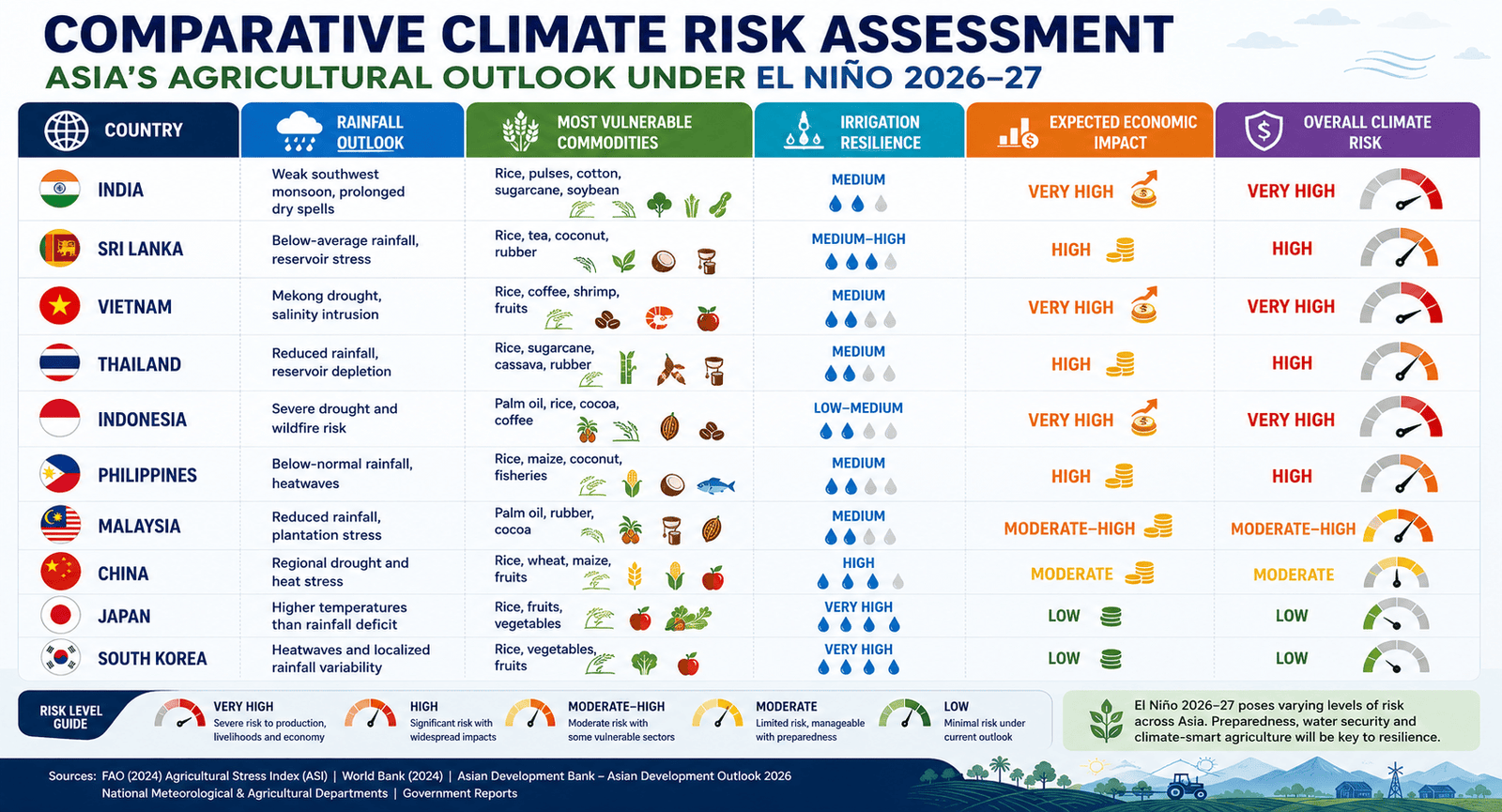
The timing could scarcely be more consequential. Geopolitical uncertainty is now intersecting with climatic anxiety. Rahul Mirchandani warns that meteorological agencies are signalling the possibility of a Super El Niño-like weather pattern, potentially exposing crops to additional heat and moisture stress. At the same time, persistent uncertainty surrounding Chinese fertiliser exports continues to tighten global supply chains. The convergence of climate risk and nutrient insecurity threatens to create a far more complex challenge than either factor would pose in isolation.
It is for this reason that fertiliser security is increasingly being viewed through a strategic lens. "India must now treat fertiliser security as part of national food security through strategic reserves, diversified sourcing, domestic urea capacity expansion, overseas mineral asset partnerships and greater policy thrust on biological and natural nutrient alternatives," argues Dushyant K. Tyagi, CEO of Farmgate Technologies.
But resilience cannot be built through stockpiles alone. It requires a more sophisticated redesign of the entire supply architecture. Anand Chandra, Co-founder and Executive Director of Arya.ag, advocates a broader approach encompassing diversified sourcing, feedstock security, stronger domestic production, pre-season planning and granular visibility over district-level demand and inventories. Strategic reserves may have a role, he suggests, but they must be tailored to India's agricultural realities rather than borrowed wholesale from energy-sector playbooks.
There is, however, another dimension to the crisis—one that speaks not of vulnerability but of opportunity.
As global supply chains undergo a fresh bout of introspection, Siddharth Gupta, Co-Founder of Atomgrid, believes India has an opening to reposition itself. "When Indian companies stop being described as 'China alternatives' and start being the first call, when customers build their global supply chain architecture around India rather than as a hedge against China—that is the real transition," he says. The transformation may take years, but moments of disruption often accelerate shifts that would otherwise unfold over decades.
Taken together, these developments underscore a larger reality. The challenge before India is not merely to secure the next cargo of urea or expand the next subsidy allocation. It is to build an agricultural and economic system that is less vulnerable to external shocks and better equipped to navigate an increasingly uncertain global landscape.
Recent events have offered a stark reminder of that vulnerability. The current ceasefire between the United States and Iran and the subsequent reopening of the Strait of Hormuz triggered an immediate response across global markets. The Indian rupee climbed to a five-week high of Rs 94.45 against the US dollar in intraday trade, recovering 2.6 per cent from its record low of Rs 96.96 on May 20, before closing at Rs 94.71. The rally was accompanied by a sharp decline in crude oil prices, with Brent falling below $85 per barrel and hovering around $83 as fears of supply disruptions eased.
The speed of the market reaction highlighted the extent to which geopolitical developments continue to shape economic outcomes far beyond their point of origin. For India, where agriculture remains closely linked to energy markets through input costs, logistics and inflation dynamics, such volatility carries implications that extend well beyond currency and commodity trading floors.
As FAO Chief Economist Máximo Torero has observed, "While food markets remain more stable than during previous crises, the current shock underscores the vulnerability of interconnected energy and agrifood systems." The recent Hormuz episode reinforces that assessment. A diplomatic standoff in one of the world's most strategically important waterways was enough to unsettle energy markets, move currencies and alter economic sentiment across importing nations.
--- ---- Suchetana Choudhury (suchetana.choudhuri@agrospectrumindia.com)