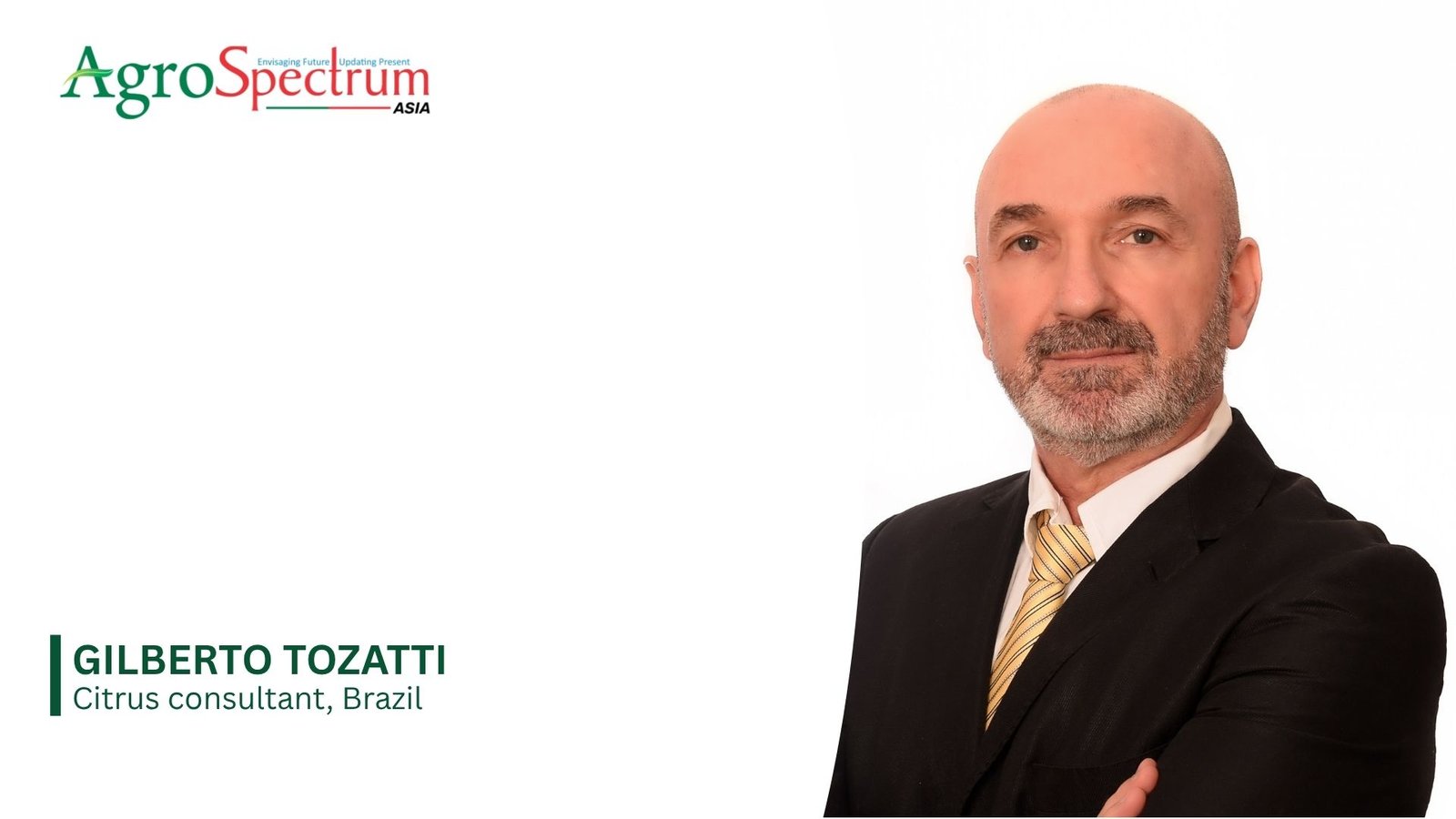
Every crisis in agriculture leaves behind a lesson, and the global citrus industry is learning one of its toughest yet. Huanglongbing (HLB), or citrus greening disease, has evolved from a plant health challenge into an economic, technological, and sustainability crisis that no citrus-producing nation can afford to ignore. In this exclusive AgroSpectrum interview, leading citrus consultant Gilberto Tozatti shares decades of field experience to explain why managing HLB today demands far more than pesticides or tree replacement—it requires a fundamental shift in how orchards are planned, protected, and managed. His perspective is grounded in science, yet shaped by the realities growers face every single season. The conversation also explores the intersection of climate change, innovation, economics, and policy, offering practical lessons for citrus-producing regions well beyond Brazil. As countries work to safeguard their citrus industries against mounting biological and climatic threats, Tozatti's insights serve as both a warning and a roadmap. This is indeed an essential conversation about the future resilience of global fruit production.
Brazil has spent more than two decades fighting HLB, yet disease incidence has climbed to nearly 50 per cent in its most productive citrus belt. Has the industry reached the limits of conventional disease management, and does this crisis require an entirely new production model rather than incremental improvements?
Brazil is indeed facing very high HLB incidence in its main citrus belt, close to 50 per cent of symptomatic trees in recent surveys. However, the latest Fundecitrus data suggest some stabilisation in several areas, indicating that current management efforts are having an effect, even if they are not enough to reverse the problem quickly. I do not believe this means conventional management has reached its limit. The recent stabilisation is largely associated with better psyllid control, improved insecticide rotation to reduce resistance risk, and more region-specific management. HLB pressure is not uniform across the citrus belt, so management cannot be the same everywhere.
Although Brazilian regulations require the eradication of symptomatic trees, grower adoption is not always uniform. Some remove trees rigorously, while others delay eradication to continue harvesting fruit, especially under economic pressure. This inconsistency weakens regional control efforts. At this stage, I do not see an entirely new production model replacing the current principles of HLB management. What Brazil needs is continuous improvement of the existing system, with better vector control, more coordinated regional action, more rational decisions on tree removal and orchard renewal, and gradual incorporation of new technologies. In practice, Brazil is learning to produce citrus under permanent HLB pressure, and progress will depend more on strengthening integrated management than on a single disruptive change.
Orange production is forecast to decline by almost 13 per cent this season, with HLB and climate stress acting simultaneously. How much of today's production loss is truly attributable to climate variability, and how much reflects years of underestimating the long-term economic impact of greening?
It is difficult to assign a precise share of current crop losses to climate stress versus HLB, because the two factors increasingly interact. Climate is inherently less predictable, and Brazil has experienced significant weather variability over the last five crop seasons, affecting flowering, fruit set and final yield. HLB, however, is a more structural and predictable problem over the long term. While climate drives seasonal volatility, HLB progressively reduces the productive capacity of the citrus belt by lowering yield, shortening orchard lifespan and increasing replanting and management costs.
In 2024, at the 7th International Research Conference on HLB in California, I presented, together with colleagues, a crop forecasting model indicating that orange production in Brazil’s citrus belt could decline by nearly one-third over the next ten years if no disruptive change occurs. This suggests that, although climate explains part of the year-to-year fluctuations, the main long-term threat to Brazilian citrus production is HLB itself. There is also an important economic dimension. Future production will depend not only on disease management, but also on whether orange prices remain attractive enough to support investment in new orchards, including expansion into surrounding regions with potentially lower disease pressure.
The industry has relied heavily on vector control and tree removal, but disease spread continues. Looking back, were there strategic mistakes in the way Brazil approached HLB management, and what lessons should emerging citrus-producing countries learn before they face similar outbreaks?
When HLB was first detected in Brazil and the United States in 2004–2005, the available knowledge was limited. Management was essentially based on three principles: planting certified healthy nursery trees, controlling the psyllid vector and removing symptomatic trees. Over the past 20 years, however, our understanding of the disease has evolved considerably. Today, we know the importance of regional vector control, orchard location, planting in more isolated areas when possible, protecting young trees, using kaolin, improving insecticide management to reduce resistance, and recognising the strong border effect in disease spread. HLB management is now far more sophisticated than it was two decades ago.
The main lesson is that no single measure is sufficient. Success depends on implementing all available strategies simultaneously and consistently, both at the orchard and regional level. Emerging citrus-producing countries should build on the knowledge accumulated in Brazil and the United States rather than repeating the long and costly learning process we experienced. Early adoption of integrated management can substantially reduce future economic losses.
Technologies such as trunk injection, bactericides, biologicals, reflective mulches and precision agriculture are expanding the disease-management toolbox. Which of these innovations do you believe has the greatest potential to fundamentally change HLB management, and where do you still see critical technological gaps?
In my view, there is no single technology that will fundamentally change HLB management across all situations. The first point is that disease incidence varies greatly among regions, so management must be adapted accordingly. In areas with low HLB incidence, the priority should remain prevention: certified healthy nursery trees, careful site selection, planting in more isolated areas when possible, rigorous psyllid control, especially in young orchards, strict border management, and tools such as kaolin to reduce vector pressure in the early years.
In areas where HLB incidence is already high, the focus shifts toward maintaining orchard productivity and longevity. In these situations, nutritional and hormonal management, improved soil fertility to support root health, and the use of more tolerant scion varieties and rootstocks become increasingly important. Among the innovations with the greatest long-term potential, I would highlight more tolerant varieties and rootstocks, because they can improve orchard resilience under chronic HLB pressure. The main technological gaps remain the lack of reliable tools to reduce the impact of the bacterium inside the plant and the need for better genetic tolerance and more region-specific management strategies.
The use of antibiotics such as oxytetracycline remains controversial because of antimicrobial resistance and export market concerns. How can the citrus industry balance the need for effective disease suppression with growing global scrutiny over antibiotic use in agriculture, and what safeguards are essential?
HLB management cannot depend on any single tool, and that also applies to antibiotics. Effective control will continue to depend on an integrated strategy combining protected nursery trees, vector control, orchard renewal, and good nutritional and soil management. Oxytetracycline is clearly a controversial tool. It has been authorised for use in the United States, but it is not approved for citrus in Brazil. For that reason, any decision on antibiotic use must go beyond efficacy alone and also consider regulatory approval, food safety, antimicrobial resistance concerns, export market acceptance and consumer perception.
In my view, antibiotics should only be considered if they are supported by strong scientific evidence, clear regulatory approval, strict residue monitoring and traceability, and acceptance by the market. Even then, they should be treated only as a possible component of an integrated HLB management programme, not as a central solution.
HLB has dramatically increased production costs while reducing orchard lifespan and productivity. Is the economics of citrus farming approaching a tipping point where small and medium growers may no longer remain viable without major technological breakthroughs or policy intervention?
Yes. In Brazil, rising citrus production costs have become a structural problem. HLB has increased spending on vector control, tree replacement, nutrition, monitoring and overall orchard care, while reducing productivity and orchard lifespan. In my own studies, the average break-even point over the last eight years has been around 859 boxes of 40.8 kg per hectare, while average productivity has been about 828 boxes per hectare. This means that many orchards and many growers are already operating below the level needed to cover full production costs.
So, in practical terms, this tipping point is not a future risk; it is already happening, especially for small and medium-sized growers with less capacity to absorb margin compression and invest in orchard renewal. In Brazil, the response will likely depend much more on improving productivity through technology and better management than on government intervention.
Climate change is intensifying pest pressure, water stress and production volatility across citrus-growing regions. How should breeding programmes, crop protection strategies and orchard management evolve over the next decade to build genuine resilience rather than simply reacting to successive crises?
In perennial crops such as citrus, technological solutions take time, often more time than the urgency of the current problems would require. For that reason, resilience over the next decade will depend not only on new genetic or crop protection technologies, but also on better technical decisions at farm level. Key decisions such as where to plant, which varieties and rootstocks to use, and which management strategy to adopt will become increasingly important under higher pest pressure, greater water stress and more volatile production conditions.
In this context, specialised technical guidance plays a major role in helping growers make better decisions and avoid costly mistakes. In Brazil, citrus consultants have contributed significantly to grower decision-making under HLB pressure and climatic uncertainty. I am part of a citrus consulting group called GCONCI, which brings together 18 specialists and has helped producers define planting strategies, varietal choices and management practices. In my view, this type of technical support will be increasingly important in building resilience in citrus production.
Looking ahead to 2035, do you believe HLB will still be managed as a chronic production constraint, or are we approaching a scientific breakthrough—through gene editing, RNA technologies, advanced bactericides or resistant rootstocks—that could permanently redefine the future of global citrus production?
By 2035, I believe HLB will still be a major chronic constraint in citrus production, with limited supply and continued market volatility. At the same time, I do believe we are moving closer to innovations that can make an important difference in the future. Brazilian citrus has already overcome major phytosanitary challenges such as citrus variegated chlorosis and citrus sudden death, both of which once appeared highly threatening to the industry. HLB is more destructive than any of these previous diseases, but the scale of effort now being mobilised by researchers, growers, consultants and the industry is also much greater.
In my view, the key word is cooperation. The combination of scientific research, field experience, investment and coordinated action gives reason to believe that meaningful progress will occur. Whether that progress will be fully transformative by 2035 is still uncertain, but I believe the chances of important breakthroughs are real.
-- Suchetana Choudhury (suchetana.choudhuri@agrospectrumindia.com)