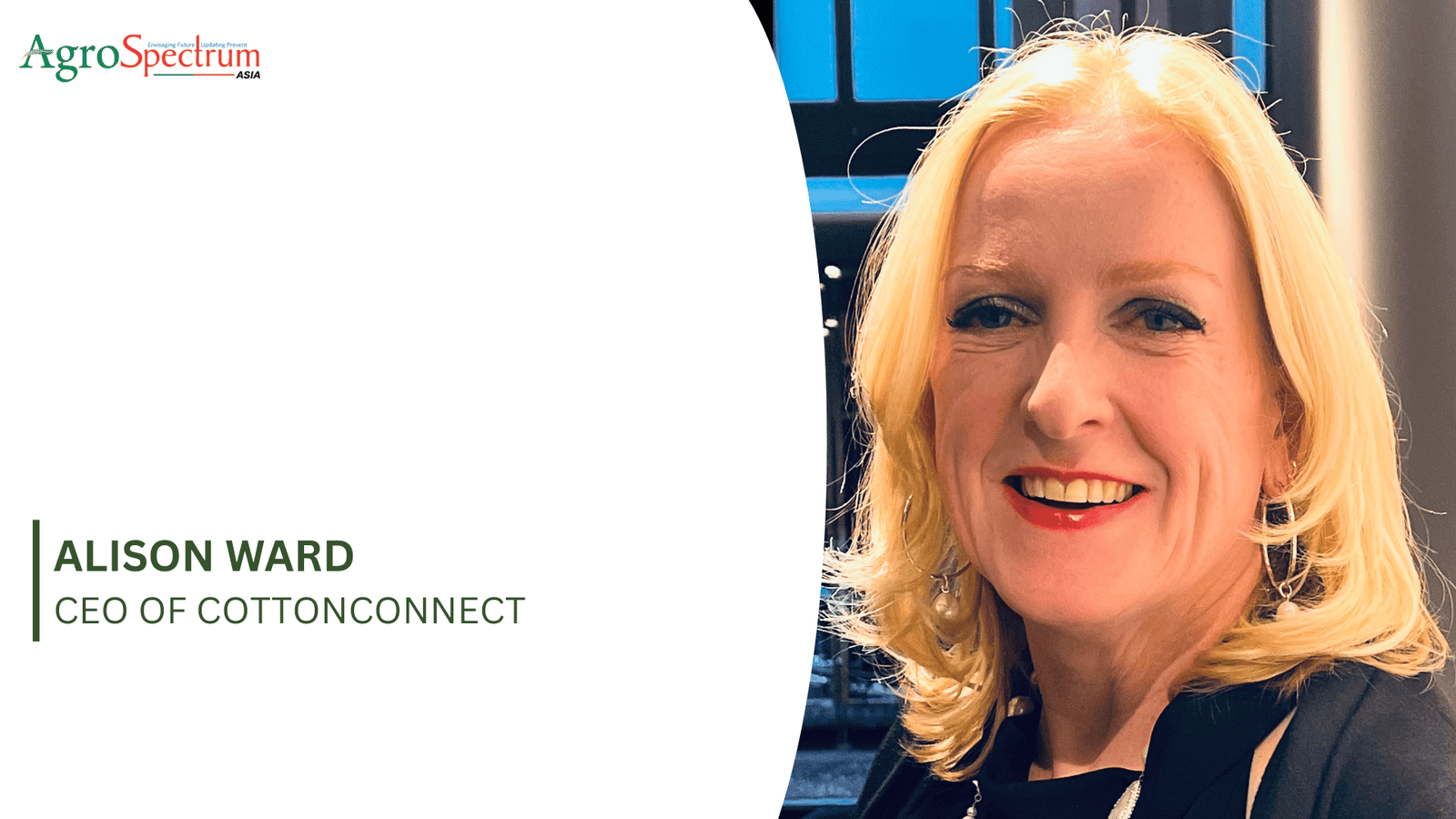
For decades, cotton farming has measured success in tonnes harvested and yields achieved. But as climate extremes become more frequent, that definition is beginning to change. In this exclusive conversation with AgroSpectrum, Alison Ward, CEO of CottonConnect, explains why El Niño is more than a weather event—it is exposing structural weaknesses in conventional cotton production, from degraded soils and rising input costs to fragile supply chains. She makes a compelling case that resilience, not just productivity, will determine the future competitiveness of the cotton sector. Backed by evidence from CottonConnect's work with farmers, Alison discusses how regenerative practices are improving profitability while reducing dependence on synthetic inputs and scarce natural resources. She also highlights the growing role of brands, traceability and long-term partnerships in building climate-ready cotton value chains. At a time when agriculture is being forced to adapt faster than ever before, this interview offers an important perspective on what it will take to grow cotton sustainably in an increasingly unpredictable world.
The Stress Test for Modern Cotton Farming
El Niño events often expose vulnerabilities that remain hidden during normal growing seasons. Why do periods of extreme heat and erratic rainfall tend to reveal the limitations of input-heavy cotton production systems more sharply than other climatic events?
El Niño acts as a stress test because it combines multiple pressures at once, extreme heat, delayed rainfall, and sudden shifts in growing conditions. Cotton systems that rely heavily on external inputs such as irrigation, fertilisers, and pesticides are typically designed around stable, predictable environments. When those conditions change, their effectiveness becomes less reliable.
Over time, the intensive use of chemical inputs can weaken soil biology. That matters because climate resilience is also about whether the farming system itself is strong enough to cope when weather patterns become more volatile. When heavy rainfall follows dry periods, for example, soils with poor structure are more vulnerable to erosion and runoff. El Niño does not create entirely new risks, but it makes existing weaknesses much more visible. This is why we have worked with local partners in regions affected by El Niño to run education sessions for farmers on preventative measures and share government technical advisories with them.
When More Inputs Deliver Diminishing Returns
Many cotton-growing regions have responded to climate uncertainty by increasing applications of fertilizers, pesticides and irrigation. At what point does this strategy become a form of risk amplification rather than risk management, particularly under El Niño conditions?
In many cotton-producing regions, increasing inputs has been seen as a way to manage uncertainty. However, under conditions of extreme heat and water stress, the efficiency of those inputs declines. Fertilisers are less effectively absorbed, pest dynamics become harder to predict, and irrigation becomes both more costly and less reliable. At a certain point, this dynamic shifts from risk management to risk amplification. Farmers are investing more in inputs while outcomes become increasingly unpredictable. This raises the cost base without guaranteeing returns.
Evidence from CottonConnect’s programmes shows that reducing reliance on synthetic inputs, through approaches such as improved soil management and biological alternatives, can lower input costs while maintaining or improving yields, leading to stronger overall profitability. Farmers in these programmes have seen a 15.4 per cent reduction in input costs alongside a 7.5 per cent increase in yields, contributing to a near 35 per cent increase in profitability. This suggests that resilience is not necessarily about increasing inputs, but about improving how the system functions.
The Water-Energy-Fertilizer Nexus
Delayed monsoons and prolonged dry spells frequently coincide with rising irrigation costs and reduced nutrient-use efficiency. How does El Niño challenge the economic logic of production systems that are heavily dependent on external inputs?
El Niño intensifies the interdependence between water, energy, and fertiliser use. Delayed rainfall increases reliance on irrigation, which in turn raises energy costs for pumping water. In some areas, delayed monsoons can also contribute to the depletion of underground water tables altogether, making it even harder for farmers to access water for irrigation. At the same time, dry soil conditions reduce nutrient-use efficiency, so fertilisers are less effectively absorbed. Farmers are therefore exposed to rising costs across multiple inputs, while productivity becomes less predictable.
Cotton systems in some regions are already highly dependent on irrigation, particularly in areas with low rainfall, where production cannot take place without it. El Niño intensifies this dependency and exposes its economic vulnerability. This is where approaches that reduce synthetic fertiliser use, improve soil health and promote more efficient irrigation practices can help lower water consumption and reduce overall input dependency, improving the economics of production and increasing farmer profitability. CottonConnect’s 2025 Impact Report shows that the REEL Programme recorded reduced input costs, reduced chemical fertiliser and pesticide use, and increased farmer profit compared with control farmers, supporting the case for shifting from input intensity to more resource-efficient farming systems.
Resilience Versus Productivity
For decades, cotton innovation has largely focused on maximizing yields. Has the industry underestimated resilience as a breeding and management objective, and are El Niño years forcing a rethink of what agricultural success should actually look like?
Historically, cotton production has prioritised yield maximisation, often under the assumption of relatively stable growing conditions. This has been shaped by the need to meet rising global demand and ensure consistent supply. El Niño, however, exposes the limits of measuring success through yield alone. Success cannot be simply about meeting demand today, but ensuring cotton can continue to be produced reliably in the years to come. As climate volatility increases, that requires a broader view of agricultural success, one that values resilience alongside productivity.
Through CottonConnect's programmes, we encourage farmers to view farming as a holistic business, helping them to consider profitability, risk management and the long-term health of their farms. With our support, many farmers are adopting regenerative practices such as intercropping, biodiversity enhancement and Integrated Pest Management. These approaches help improve productivity, lower input costs, diversify income streams and enable farmers to adapt to a changing climate.
Brands also have an important role to play. Building resilience takes time, and farmers are more likely to invest in long-term improvements when they know they have sustained support. By investing in farmer training, water management, farm infrastructure and other resilience-building interventions, brands can help strengthen farming communities while securing a more stable and sustainable cotton supply for the future. Traceability and due diligence systems are equally important, providing the visibility and assurance needed to support long-term sourcing relationships.
Soil Health as Climate Infrastructure
Many agronomists argue that healthy soils function as a form of natural climate insurance by improving water retention and nutrient cycling. To what extent do El Niño episodes highlight the consequences of neglecting soil biology in favour of input-driven productivity models?
Healthy soils play a critical role in buffering crops against climate variability. They improve water retention, support nutrient cycling, and maintain structure during heavy rainfall. Where soils have been degraded, often through overuse of synthetic inputs and limited organic matter, this buffering capacity is reduced. Crops become more vulnerable to both drought and flooding, both of which occur as a result of El Niño, and inputs become less effective.
Regenerative agriculture can play an important role in reducing reliance on synthetic inputs and supporting long-term soil stewardship. In 2024-25, CottonConnect's programmes have seen a 127.3 per cent increase in the use of natural pesticides and a 107.6 per cent increase in the use of natural fertilisers, alongside a 15.2 per cent reduction in chemical pesticide use and an 11.8 per cent reduction in chemical fertiliser use. Whilst El Niño holds a magnifying glass up to some of these issues around soil health, it is a conversation that is, and must continue to be, much more widely had in order to scale up regenerative farming practices in all regions and across all industries that rely on agriculture.
Rethinking Risk in Cotton Economics
When rainfall becomes unpredictable and heat stress intensifies, farmers often face rising input costs alongside declining returns. Does El Niño expose a deeper flaw in how agricultural risk is currently assessed and managed within cotton value chains?
El Niño exposes a deeper issue in how risk is assessed within cotton value chains. Traditional approaches have often assumed a relatively predictable relationship between inputs and outputs: if farmers invest more in fertilisers, pesticides and irrigation, they should achieve higher yields and stronger returns. As climate volatility increases, that relationship becomes far less certain. Farmers can face rising costs at the same time as yields become more variable, making it harder to predict whether those investments will pay off.
This challenge is compounded by the fact that input costs are rising faster than cotton prices in many markets, placing increasing pressure on profitability. As a result, agricultural risk management must account for both climate volatility and economic pressures, with a greater focus on building farming systems that can withstand both.
Ultimately, El Niño highlights a structural imbalance within cotton value chains. Farmers often absorb the immediate impacts of climate and market volatility, while the wider value chain depends on a stable supply of cotton. Responding effectively requires a broader view of risk, extending beyond production to the people and communities that underpin cotton supply chains.
At CottonConnect, we take a systematic approach to identifying and addressing these risks through risk mapping, Human Rights Due Diligence interventions, stakeholder engagement, training and a 24/7 grievance mechanism. Building resilience starts with supporting the farmers, workers and partnerships that sustain cotton production over the long term.
The Future of Regenerative and Climate-Smart Cotton
There is growing interest in regenerative agriculture, biological inputs and diversified farming systems. Are these approaches proving more resilient during El Niño years, or is the evidence still insufficient to justify a large-scale transition away from conventional input-intensive models?
Approaches that enhance soil health, reduce synthetic inputs, and improve water management are showing measurable benefits, including reduced input costs, improved yield performance and greater profitability for farmers. CottonConnect's 2024 Life Cycle Assessment also found significant environmental benefits associated with practices such as improved irrigation and reduced fertiliser use. Compared with conventional production, the REEL Cotton Programme demonstrated a 35.4 per cent saving potential in greenhouse gas emissions, a 44 per cent reduction in eutrophication, a 42 per cent reduction in ecotoxicity, and around 35 per cent lower water use per kilogram of fibre.
That said, evidence on performance under extreme weather events such as El Niño is still developing, and outcomes can vary by location. So, the case is not for an overnight replacement of existing systems, but for a managed transition towards lower-risk, more resource-efficient production models that can better support farmers and supply chains in a changing climate.
Beyond Adaptation: Designing the Cotton System of the Future
If climate variability becomes the new normal rather than an occasional disruption, what fundamental changes will be required in cotton production systems, supply chains and agricultural policy to ensure long-term viability in an increasingly volatile climate?
As climate variability becomes more persistent, the cotton sector will need to move beyond short-term adaptation and focus on structural change across farming systems and supply chains. At farm level, this means strengthening the natural resilience of production systems. In practice, this includes improving soil organic content through composting and bio-based inputs, adopting intercropping, mulching and reduced tillage techniques, and supporting farmers with continuous training, demonstrations and practical advisory tools.
But farm-level change cannot happen in isolation. Farmers need access to knowledge, technical support, markets, finance, local institutions and enabling policy if these practices are to be adopted at scale. This is why partnerships matter: they help connect individual farm practice with the wider systems that shape whether farmers can actually make and sustain change. CottonConnect works with a strong network of local NGO partners with grassroots reach, as well as agricultural science centres, the International Cotton Advisory Committee, Bangladesh’s Cotton Development Board, the Sustainable Agriculture Network, the Cotton Textiles Export Promotion Council and local government departments. These partnerships support practical interventions such as soil and water conservation, tree plantation and access to government schemes. That makes resilience bigger than any one farm, because it links farmer training with local expertise, public support and supply chain demand.
Traceability will also play a critical role. CottonConnect has achieved 100 per cent traceability for REEL Cotton through TraceBale, while the REEL Cotton and REEL Regenerative Codes have evolved into sustainability standards with producer group certification. This visibility and standardisation helps verify how cotton is produced and whether sustainability efforts are translating into real-world outcomes, supporting the wider transition to more resilient and sustainable cotton supply chains.
-- Suchetana Choudhury (suchetana.choudhuri@agrospectrumindia.com)