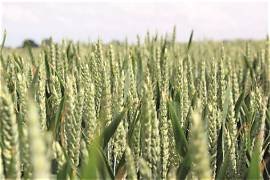
Australian Grain Technologies (AGT) has launched two new Australian Premium Hard (APH) wheat varieties, AGT-Agile and AGT-Glamour CL Plus, giving growers across northern New South Wales and Queensland additional tools to manage increasingly complex decisions around planting windows, disease pressure and crop rotation.
The varieties were officially launched at the University of Sydney Plant Breeding Institute Field Day in Narrabri, with AGT positioning the two releases as complementary additions to its northern wheat portfolio. Both varieties have been developed around practical agronomic gaps rather than simply yield potential, reflecting the growing importance of flexibility in variety selection as growers manage tighter planting windows, disease risks and herbicide-residue constraints.
AGT Variety Support Manager for northern NSW and Queensland, Douglas Lush, said the two varieties address distinct requirements while maintaining the grain quality characteristics demanded by end users. “Growers are seeking varieties that combine reliable yield performance with practical agronomic advantages,” Lush said. “AGT-Agile and AGT-Glamour CL Plus have each been developed to address specific grower needs, whether that's capturing the benefits of earlier sowing opportunities or providing greater flexibility where herbicide residues may limit rotational options.”
AGT-Agile targets the early planting window
AGT-Agile has been developed as a very slow-maturing APH wheat suited to mid- to late-April planting, providing growers with an alternative to Sunmax while occupying a maturity position between Sunmax and LRPB Raider.
That positioning is important in northern farming systems, where the choice of maturity can determine how effectively growers use available planting opportunities while managing seasonal conditions. AGT says AGT-Agile combines a broader planting window with improved grain size, stronger disease resistance and strong physical grain quality characteristics.
Wheat breeder Dr Meiqin Lu said the breeding programme was focused on overcoming some of the limitations associated with existing varieties while maintaining performance and grain quality.
“Our breeding objective was to provide growers with a high-performing variety that offers greater flexibility and consistency across the early planting window,” Lu said. “AGT-Agile delivers a strong package of yield potential, APH grain quality and very strong resistance to stem rust, stripe rust and leaf rust, giving growers confidence in a range of production environments.”
The disease-resistance package is a significant part of the variety's proposition as growers contend with disease pressure alongside the need to optimise sowing dates. AGT says trials have demonstrated the variety's fit within northern farming systems, particularly for growers targeting mid-April sowing opportunities.
According to Lush, AGT-Agile also brings improvements in grain size, disease resistance and overall performance compared with current alternatives. Its shorter and more conservative plant type, combined with good lodging tolerance, is designed to add another layer of agronomic reliability.
“It combines dependable yield, excellent grain quality and a shorter, more conservative plant type with good lodging tolerance, making it a valuable addition to the northern wheat portfolio,” Lush said.
AGT-Glamour CL Plus brings slower maturity to Clearfield wheat
AGT's second release, AGT-Glamour CL Plus, addresses a different constraint: the need for a slower-maturing herbicide-tolerant wheat that can be incorporated into earlier planting programmes across NSW and Queensland. The variety is described by AGT as the only APH-quality Clearfield-tolerant wheat available in a slow maturity suited to earlier planting in these regions. Derived from Coolah, AGT-Glamour CL Plus combines tolerance to Clearfield Intervix herbicide with high and stable grain yield, low screenings and high test weights.
Its agronomic package also includes very good resistance and tolerance to root lesion nematode, or Pratylenchus thornei, a soil-borne constraint relevant to wheat production across parts of the northern cropping belt. The variety's development reflects a long-standing demand from growers and advisers for a higher-performing Clearfield wheat that could be planted earlier without sacrificing APH-quality grain.
“For many years growers and advisers have been looking for a high-performing Clearfield wheat that could be planted earlier while still delivering APH-quality grain,” Lu said. “AGT-Glamour CL Plus answers that demand, providing the performance growers expect together with the flexibility of Clearfield tolerance in a slow-maturing background.” The herbicide-tolerance characteristic could become particularly valuable where winter crop decisions follow summer cropping programmes involving imidazolinone herbicides. Residual herbicides can narrow subsequent planting choices, making crop selection a strategic part of managing the entire rotation rather than simply the next crop.
Lush said AGT-Glamour CL Plus gives growers an additional plant-back option where residues could otherwise complicate the transition into winter cropping.
“Growers can sometimes face difficult rotational decisions where herbicide residues remain in the soil,” he said. “AGT-Glamour CL Plus provides an excellent plant-back option in these situations, allowing growers to move confidently into their winter cropping program while maintaining strong yield and grain quality potential.” AGT is also positioning the variety as more than a specialist herbicide-tolerant release. According to Lush, its yield performance has consistently matched leading non-herbicide-tolerant competitors, while the added tolerance provides greater flexibility in crop planning.
“This is not simply a niche herbicide-tolerant variety,” Lush said. “AGT-Glamour CL Plus has consistently matched the leading non-herbicide tolerant competitors for yield performance while offering the added benefit of Clearfield tolerance, making it a compelling option for a broad range of growers.” The launch highlights a broader shift in wheat breeding towards varieties that deliver multiple forms of value at farm level. Yield remains fundamental, but the commercial value of a variety increasingly depends on how well it fits into a grower's entire production system, including sowing dates, disease management, herbicide programmes, grain quality requirements and rotation planning.