Some plants are thought to supplement their carbon needs by obtaining carbon through underground fungal networks connected to other plants. This symbiotic relationship is known as mycoheterotrophy. Researchers from Chiba University found evidence that Gentiana squarrosa, a Gentian family plant, can receive carbon through arbuscular mycorrhizal fungal networks in addition to photosynthesis. The findings support the existence of partial mycoheterotrophy and could improve understanding of underground plant–fungus interactions.
Beneath forests, grasslands, and wetlands lies a hidden underground network of fungi known as mycorrhizal networks, sometimes nicknamed the “wood-wide web.” These fungi live in partnership with plant roots, helping plants absorb nutrients from the soil in exchange for carbon compounds produced through photosynthesis. These fungal connections can also link neighboring different plant species.
Some plants rely partly or entirely on these fungal networks for carbon compounds through a process called mycoheterotrophy. Fully mycoheterotrophic plants obtain carbon from fungi instead of conducting photosynthesis. Others are thought to be partially mycoheterotrophic, meaning they produce their own carbon through photosynthesis but also receive some from fungi. This strategy may be especially important for plants growing on shaded forest floors.
Although scientists have long suspected that some green plants receive carbon through fungal networks, proving this has been difficult. Researchers often examine carbon-13 (¹³C) enrichment to test whether plants obtain carbon through fungi in some (partially) mycoheterotrophic plants in the Orchidaceae and the Ericaceae having symbioses with Basidiomycetes or Ascomycetes fungi. However, in arbuscular mycorrhizal (AM) fungi, the most ubiquitous mycorrhizal fungi, carbon isotope signatures often resemble those of host plants, making it difficult to detect carbon transfer.
Now, researchers from Chiba University and Kobe University, Japan, have found that Gentiana squarrosa Ledeb., a small flowering plant in the Gentianaceae, is partially mycoheterotrophic. The study, published in Volume 36 of the journal Mycorrhiza on May 28, 2026, reveals that the plant not only produces carbon through photosynthesis but also receives carbon through underground fungal networks.
The research team was led by Professor Masahide Yamato, together with Moe Sasuga from the Graduate School of Education, Chiba University; Keito Shimabukuro from the Faculty of Education, Chiba University; Dr. Ryota Kusakabe from the Graduate School of Horticulture, Chiba University; and Dr. Kenji Suetsugu from the Department of Biology, Graduate School of Science, Kobe University, Japan.
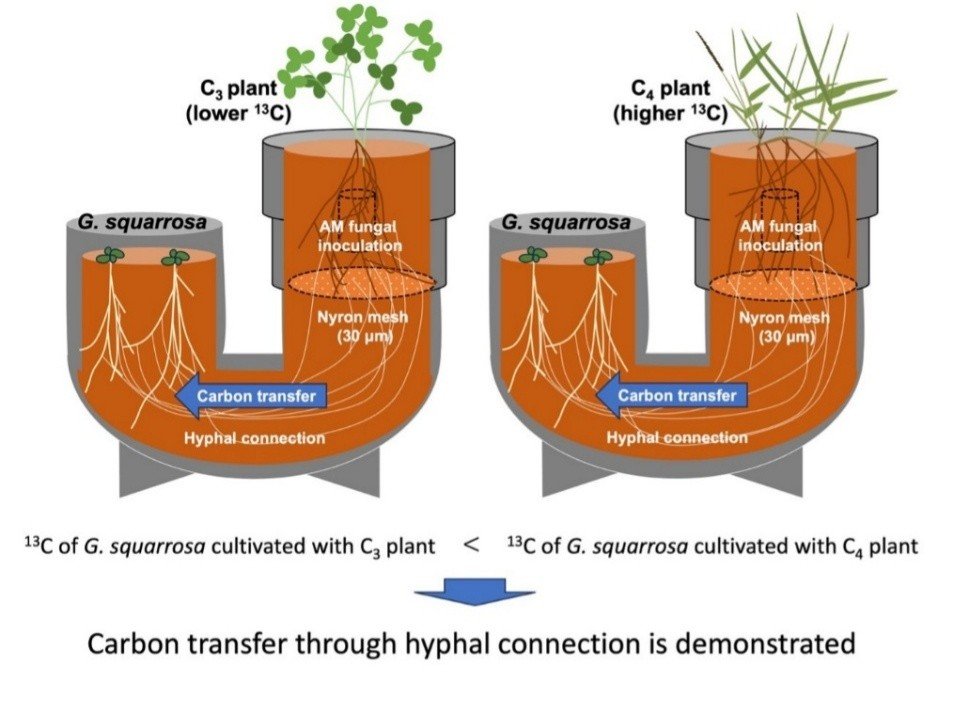
To trace carbon movement through fungal networks, the researchers used carbon donor plants that naturally contained different amounts of carbon-13. They chose C₃ and C₄ plants, where C₄ plants naturally contain more carbon-13 than C₃ plants. The researchers hypothesized that if carbon moved through fungal networks, the carbon signature of the donor plant would be reflected in G. squarrosa.
“Specifically, if carbon transfer occurs through AM fungal connections, the carbon-13 isotope ratio should be higher in G. squarrosa seedlings grown with a C₄ companion plant than in those grown with a C₃ companion plant,” explains Prof. Yamato.
For their experiments, the researchers grew G. squarrosa seedlings with either C₃ or C₄ companion plants in a specially designed U-shaped pot system. Here, the roots of the companion plant and G. squarrosa were separated by a fine nylon mesh that prevented roots from passing through while allowing the mycelium of AM fungi to pass through.
The experiments supported this hypothesis, with shoot carbon-13 values in G. squarrosa significantly higher when seedlings were connected to a C₄ companion plant than to a C₃ companion plant. Moreover, among plants grown with a C₄ companion, shoot growth was positively correlated with carbon-13 levels, suggesting that the mycoheterotrophy contributed to growth under the experimental conditions tested.
The results support the existence of partial mycoheterotrophy in G. squarrosa, suggesting that the species obtains carbon through both photosynthesis and fungal symbiosis.
“The U-shaped pot cultivation experimental system developed in this study will enable us to verify the presence or absence of carbon transfer between plants via AM fungi in various plant species. If confirmed in diverse plants, the hyphal network may not simply be a pathway for nutrient absorption but may also function as a site for ‘energy distribution’ where carbon compounds move between plants,” says Prof. Yamato.
As researchers continue to study plant–fungus relationships, these findings could provide new insights into how plants interact with mycorrhizal networks.
Reference:
Title of original paper: Partial mycoheterotrophy in the arbuscular mycorrhizal Gentiana squarrosa (Gentianaceae) demonstrated by coculture assays using C₃ and C₄ plants
Authors: Masahide Yamato¹, Moe Sasuga¹, Keito Shimabukuro², Ryota Kusakabe³, and Kenji Suetsugu⁴
Affiliations:
Graduate School of Education, Chiba University
Faculty of Education, Chiba University
Graduate School of Horticulture, Chiba University
Department of Biology, Graduate School of Science, Kobe University
Journal: Mycorrhiza
DOI: 10.1007/s00572-026-01271-6