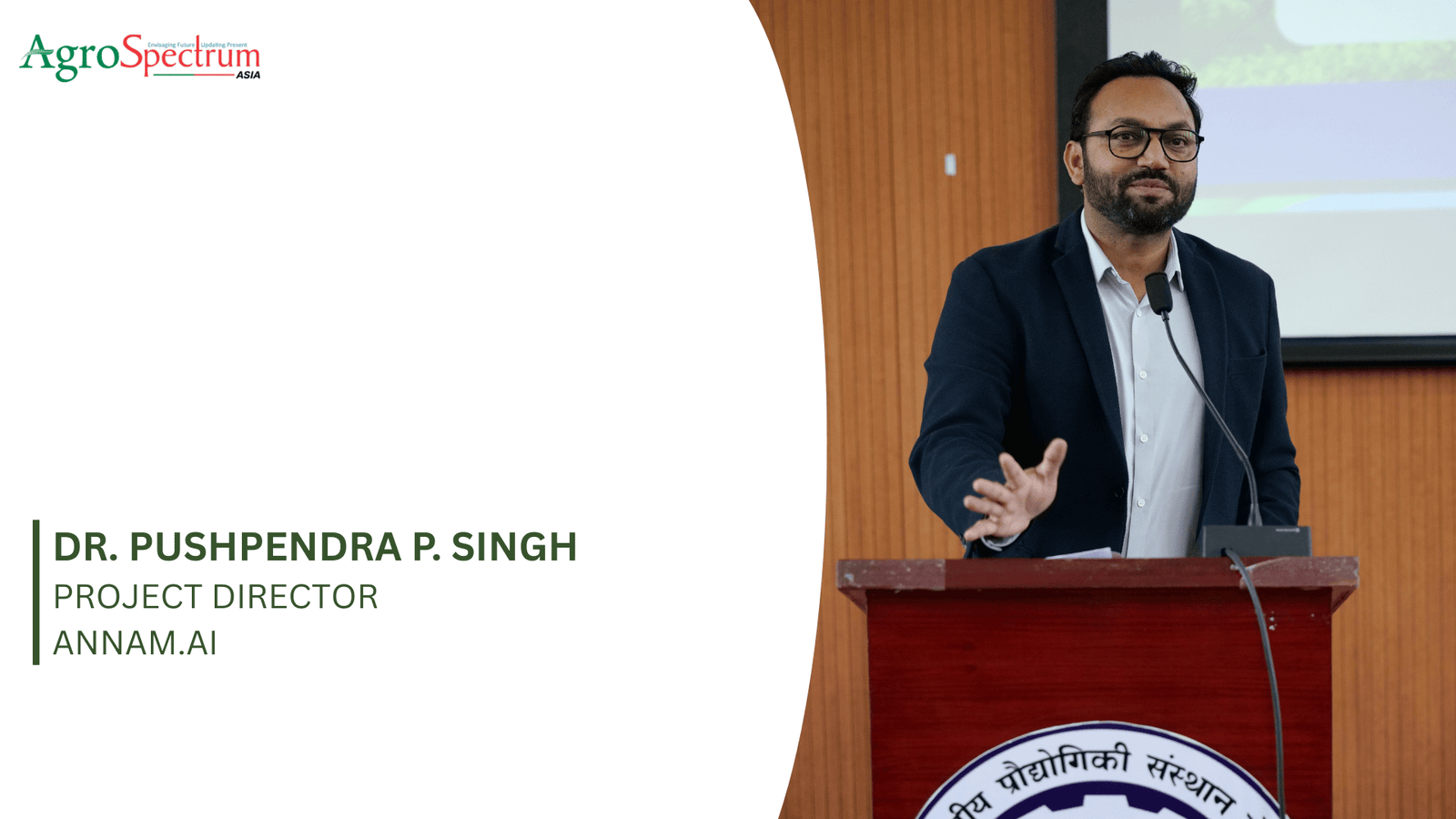
Artificial intelligence is moving beyond experimentation and emerging as a strategic layer for agricultural decision-making. In this exclusive conversation with Dr. Pushpendra P. Singh, Project Director, ANNAM.AI, AgroSpectrum explores how the ANNAM.AI–Syngenta collaboration aims to bridge the persistent gap between promising agri-tech pilots and large-scale farmer adoption. The discussion examines whether AI can deliver measurable improvements in profitability, climate resilience and resource efficiency for India's millions of smallholder farmers while safeguarding data ownership and digital sovereignty. Dr. Singh also outlines his vision of ANNAM.AI as a foundational agricultural intelligence infrastructure capable of integrating satellite data, digital twins, sensors and multilingual advisory systems at national scale.
Looking ahead, he explains how AI could gradually evolve from predictive analytics to semi-autonomous farm operations under robust regulatory safeguards. The interview further explores why India's uniquely complex agricultural landscape could become the proving ground for scalable AI solutions across the Global South. As agriculture enters an era where intelligence may become as valuable as seeds, water and fertilizers, this conversation offers an insightful perspective on the opportunities and challenges shaping the sector's next transformation.
From AI Pilots to Farm-Scale Impact
India has seen numerous agri-tech pilots struggle to achieve meaningful scale. What differentiates the ANNAM.AI–Syngenta collaboration from previous digital agriculture initiatives, and how do you plan to translate AI innovation into measurable outcomes for millions of farmers rather than isolated demonstrations?
India has run over 400+ digital agriculture pilots, but fewer than 5 per cent reached meaningful scale. ANNAM.AI is built for population‑scale impact from Day 1. We use nation‑scale datasets, Digital Twins, IoT networks, and multilingual advisory systems rather than isolated tools. The platform already processes millions of soil, weather, and pest datapoints. With Syngenta’s reach across 1 million+ farmers, we are designing measurable outcomes, water savings, reduced input costs, and yield stability, rather than demonstration plots. This collaboration is structured for scaling, not showcasing.
The Economics of AI in Agriculture
AI models can generate sophisticated insights, but adoption ultimately depends on farmer economics. How will this partnership ensure that AI-driven recommendations directly improve profitability, reduce input costs, or mitigate production risks for smallholder farmers?
ANNAM.AI focuses on direct economic gains. Field pilots show 20–28 per cent water savings, 15–20 per cent fertilizer reduction, and 30-40 per cent fewer pesticide sprays. Early warnings reduce yield losses by 5–12 per cent. Every advisory is tied to local economics, electricity cost for irrigation, fertilizer price bands, and pest thresholds. AI becomes viable only when it improves net returns, and that is the core design of ANNAM.AI.
Building India's Agricultural Intelligence Infrastructure
Many countries are investing heavily in digital public infrastructure. Do you view ANNAM.AI as an agricultural equivalent—a foundational intelligence layer for Indian farming—and what would success look like over the next decade?
Yes. ANNAM.AI is designed as India’s Agricultural Intelligence Layer, much like how UPI became the backbone of digital payments. It integrates sensors, satellite feeds, crop models, and multilingual advisory. Success over the next decade means 100 million farmers receiving AI‑enabled advisories, nationwide micro‑climate coverage, state‑level Digital Twins, and 20 per cent national reduction in input use. India needs a backbone for agricultural decision‑making. ANNAM.AI aims to be that backbone.
Climate Change as an AI Challenge
With heat stress, pest migration, and extreme weather becoming increasingly unpredictable, can AI realistically stay ahead of climate volatility, or are we reaching the limits of predictive agriculture? How does this partnership intend to address that challenge?
Climate unpredictability is rising, Punjab saw 10+ extreme heat days in 2024, and pest migration shifted 200–300 km in several states. AI cannot eliminate uncertainty, but it can reduce reaction time from weeks to hours. ANNAM.AI uses ensemble weather models, computer‑vision pest detection, and Digital Twins to simulate crop response under extreme conditions. The goal is resilience, not perfection, helping farmers act early enough to avoid losses.
Data Sovereignty and Ownership
As AI systems increasingly rely on farm-level data, questions around ownership, governance, and commercialization become critical. Who ultimately owns the data generated through these platforms, and how do you balance innovation with farmer data rights and digital sovereignty?
Farmers own their data. ANNAM.AI follows three principles: farmer‑first ownership, state‑level stewardship aligned with AgriStack, and transparent consent logs. Commercial use requires explicit consent and anonymization. Innovation must never compromise farmer rights. ANNAM.AI is designed to be sovereign, secure, and farmer‑centric.
Beyond Prediction: Towards Autonomous Decision-Making?
Most agricultural AI today focuses on prediction and advisory services. Do you foresee a future where AI systems move toward autonomous decision-making in crop management, and what safeguards would be necessary before reaching that stage?
The world is moving toward autonomous irrigation, fertigation, and robotic spraying. India will follow a staged pathway: prediction → recommendation → semi‑autonomous actions → full autonomy. Before autonomy, we need fail‑safe protocols, human override, regulatory standards, and liability frameworks. Autonomy is possible—but only with trust and robust validation.
The Next Green Revolution: Biological or Digital?
India’s first Green Revolution was driven by genetics, irrigation, and inputs. Could the next agricultural transformation be driven primarily by intelligence—data, AI, and predictive systems—or will digital tools remain complementary to biological innovation?
It will be biological + digital. Genetics will continue to drive yield potential, but AI will drive yield realization. Digital tools can reduce input waste by 20–40 per cent, improve yield stability by 10–15 per cent, and enable climate‑smart diversification. The next revolution will be intelligence‑led, not input‑heavy.
Measuring Return on Innovation
For a global company like Syngenta, what metrics will determine whether this collaboration has succeeded? Will success be measured through yield gains, climate resilience, farmer adoption, sustainability outcomes, or entirely new indicators of agricultural performance?
Key metrics include:
Yield stability: +10–15 per cent
Input efficiency: 20–40 per cent reduction
Farmer profitability: measurable net‑return increase
Adoption: millions of weekly active users
Climate resilience: reduced losses during extreme events
Sustainability: improved soil health, water savings. We also expect new indicators, decision accuracy, risk‑aversion behavior, and digital trust.
Global Relevance of the India Model
India presents one of the world's most complex agricultural environments, with fragmented landholdings, diverse agro-climatic zones, and over 600 million people dependent on agriculture. If ANNAM.AIsucceeds here, could it become a blueprint for AI-enabled agriculture across the Global South, and what lessons might other countries draw from this model?
Absolutely. India has 86 per cent smallholders, 15 agro‑climatic zones, and 600+ million people dependent on agriculture, one of the world’s most complex environments. If ANNAM.AI succeeds here, it will serve as a model for Africa, Southeast Asia, and Latin America. The key lesson is that scalable agricultural AI must be affordable, multilingual, offline‑capable, and farmer‑centric. India can lead the world in AI‑enabled smallholder agriculture.
--- Suchetana Choudhury (suchetana.choudhuri@agrospectrumindia.com)