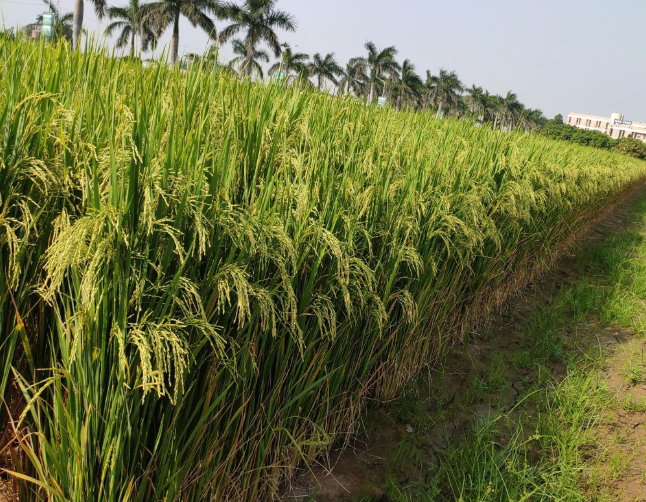
A new salt- and alkali-tolerant rice variety developed in China has set a national yield record for seawater rice, recording a maximum measured output of 13,033.05 kg per hectare in Xinjiang’s Kashgar region. The yield was recorded on October 9 at an experimental demonstration base in Pahataikeli Township, Kashgar City. An expert panel conducted on-site measurements on plots classified as moderately to heavily salinised and alkalised, where Haidao No. 11 demonstrated its ability to withstand challenging soil conditions while delivering high productivity.
The result marks a milestone for the Zhongnong seawater rice team, which has spent eight years developing the variety through a breeding strategy focused on matching crop genetics to local soil conditions.
Combining salt-tolerant varieties with soil improvement
The team's approach goes beyond developing rice that can tolerate saline-alkaline conditions. It combines variety improvement with gradual soil rehabilitation. Under the model, salt- and alkali-tolerant varieties are selected to suit the characteristics of local land, while rice cultivation practices, including flooding irrigation and leaching, are used to progressively reduce soil salinity. This integrated approach is designed to address two constraints simultaneously: improving crop adaptability to saline soils and making the land more suitable for sustained agricultural production.
The latest yield result suggests that the model could support more productive use of land traditionally considered difficult to cultivate. However, its wider applicability will depend on local soil conditions, water availability and the performance of the variety across different production environments.
Kashgar demonstration expands farmer income opportunities
The commercial and livelihood impact of seawater rice cultivation is becoming more visible in Kashgar. The area under the crop in the region has reached 866.67 hectares, making it Xinjiang's largest concentrated contiguous demonstration area for seawater rice. The initiative has also increased annual income for 2,549 farming households in Pahataikeli Township by an estimated $1.04 million to $1.19 million (RMB 7 million to RMB 8 million), according to the information released by the project team.
Beyond Xinjiang, Zhongnong Haidao has expanded seawater rice cultivation across 33 saline-alkaline regions in 12 provinces, autonomous regions and municipalities in China. The cumulative area covered has reached approximately 33,333 hectares.
Next focus: Two harvests a year on saline-alkaline land
The team is now exploring a production model that would enable farmers to harvest both wheat and rice annually on saline-alkaline land. The proposed wheat-rice rotation could improve land-use intensity and create additional production opportunities in areas where soil salinity has constrained conventional agriculture. The longer-term objective is to establish a national demonstration area for the comprehensive utilisation of saline-alkaline land.
China's latest seawater rice achievement highlights the potential of combining crop breeding with soil-management practices to expand agricultural production beyond conventional arable land. The next challenge will be to establish whether the yield gains and farmer-income benefits can be replicated at scale while maintaining sustainable use of water and soil resources.