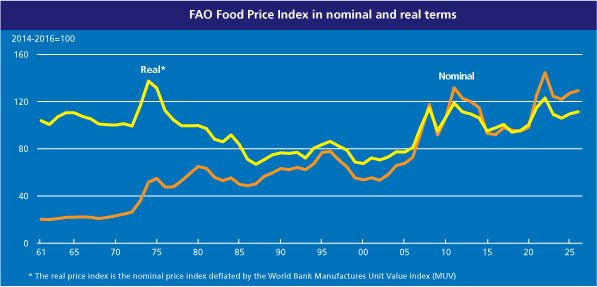
Global food prices moved higher in August as a combination of weather disruptions, resilient demand and mounting concerns over production pushed several major agricultural commodities into firmer territory. The FAO Food Price Index (FFPI) averaged 133.3 points in August 2026, rising 2.5 points, or 1.9 per cent, from its revised July level, according to the Food and Agriculture Organization of the United Nations. All five commodity groups tracked by the index recorded increases during the month, although the scale of the gains varied significantly.
The index was 2.5 per cent higher than a year earlier, but remained 16.8 per cent below its March 2022 peak. The latest increase nevertheless signals a food market becoming increasingly sensitive to climate conditions, production disruptions and shifts in global trade. The sharpest movement came from sugar, while cereals also recorded substantial gains. Vegetable oils extended their upward trend, dairy prices rebounded and meat markets strengthened overall despite divergent movements between beef and other proteins.
Sugar becomes the biggest source of price pressure
The FAO Sugar Price Index averaged 106.4 points in August, rising 11.3 points, or 11.9 per cent, from July. It was the strongest increase among the five commodity groups and pushed the index to its highest level since June 2025. The rally was driven primarily by growing concerns over the global sugar supply outlook for the 2026/27 season. In the European Union, persistent hot and dry conditions have prompted downward revisions to sugar beet yield expectations, while planted area is already expected to decline from the previous season. El Niño-related weather conditions are also weighing on production prospects across important sugar-producing countries in Asia.
Brazil is adding to the pressure. Lower sugar production expectations in the country's key Center-South region have further tightened the global outlook. India's announcement allowing duty-free imports of raw sugar provided an additional catalyst for international prices, highlighting how policy decisions in major producing and consuming markets can quickly alter global commodity balances.
Cereal prices reach a two-year high
The FAO Cereal Price Index rose 2.2 per cent in August to 116.3 points, reaching its highest level since May 2024. Prices increased across all major grains, supported by strong demand, weather-related concerns in key producing regions and continuing uncertainty over Black Sea export flows. Global wheat prices rose 2.6 per cent month on month and stood 15 per cent above their level a year earlier. Persistent disruptions to Black Sea export logistics, weaker production prospects in parts of Europe and a weaker US dollar all contributed to the increase.
Hot and dry weather has damaged crop prospects in several European producing regions, tightening expectations for supplies just as disruptions to established export routes continue to influence international trade. Maize prices increased 2.5 per cent from July, with concerns over crop yields in parts of the US Corn Belt compounded by worsening production prospects in the European Union. Prolonged heat and dryness, particularly in France and Poland, have reduced expectations for EU maize yields. Strong demand from the ethanol and feed industries provided further support, while disruptions to Ukrainian export flows added uncertainty.
Concerns over the availability of agricultural inputs following the closure of the Strait of Hormuz also contributed to the firmer maize market. Sorghum prices rose 3.9 per cent and barley prices increased 2.6 per cent, reflecting broader strength across feed-grain markets. Rice prices also moved higher, although more modestly. The FAO All Rice Price Index increased 0.5 per cent, supported by currency movements, sustained purchases from Asian and African importers and expectations of tighter supplies for Indica varieties.
Global cereal production faces its biggest annual decline since 2018
The strengthening cereal market comes as FAO has reduced its outlook for global production. The agency now forecasts 2026 global cereal production at 2.98 billion tonnes, 3.4 million tonnes lower than its July projection. More significantly, the revised figure is 61.1 million tonnes, or 2 per cent, below 2025 production. That would represent the largest annual decline in global cereal output since 2018. Even with the decline, however, the 2026 harvest would still rank as the second-largest cereal harvest on record.
Maize accounts for much of the deterioration. FAO now expects global maize production to reach 1.309 billion tonnes, 0.6 per cent below its June forecast. The largest downward revision comes from the European Union, where prolonged summer heat and dryness across major producing areas have damaged crops and pushed yield expectations below their five-year averages. Smaller downward revisions to production in India and Paraguay have added to the reduction. The declines have been partly offset by stronger expectations for Argentina and Brazil, where improved yields are expected to result in well-above-average maize production.
Wheat offers a more resilient supply picture
Wheat production is presenting a somewhat more positive picture. FAO has raised its forecast for global wheat production in 2026 by 4.2 million tonnes, or 0.5 per cent, to 810.7 million tonnes. Canada and Morocco account for approximately 1.5 million tonnes each of the upward revision, reflecting improved yield expectations. Additional increases in Russia and Ukraine have further lifted the global forecast. Yet the improvement does not erase the broader production decline. Global wheat output would still be 3.8 per cent below last year's level, although the 2026 harvest would remain the second-largest on record. In Europe and the UK, sparse rainfall and high temperatures have prompted downward revisions to production expectations.
Rice production set to decline
FAO has also revised its rice outlook. Global rice production for 2026/27 is now forecast at 553.1 million tonnes on a milled basis, down 1.9 per cent from the revised 2025/26 estimate. The forecast incorporates higher production expectations for Myanmar following revisions to historical output data and strong yield results from Sri Lanka's main crop. These increases have offset some reductions elsewhere, including China, the Philippines and the United States.
Overall, however, reduced producer margins and adverse weather associated with El Niño are expected to weigh on global rice production.
Vegetable oils extend three-month rally
The FAO Vegetable Oil Price Index increased 0.6 per cent in August to 196.9 points, marking its third consecutive monthly gain and its highest level since June 2022. Palm and soybean oil were the principal drivers of the increase, more than offsetting declines in sunflower and rapeseed oils. Palm oil prices continued to rise as strong global import demand coincided with growing concerns about the impact of El Niño-related weather conditions on production in Southeast Asia.
South American soyoil prices also remained firm on strong export demand. US soyoil prices, however, declined moderately amid uncertainty over biofuel policies and their implications for domestic feedstock demand. Sunflower and rapeseed oil prices moved lower as import demand remained subdued and expectations of ample supplies for the 2026/27 season weighed on markets.
Dairy prices rebound after three months of decline
The FAO Dairy Price Index rose 2.3 per cent in August to 119.2 points, its first increase in four months. Despite the monthly recovery, the index remained 21.7 per cent below its level a year earlier. Higher milk powder and cheese prices drove the increase. Skim milk powder prices rose 3 per cent, while whole milk powder prices increased 2.4 per cent. Tighter milk supplies in the European Union, compounded by hot and dry weather in several major producing areas, supported prices. Strong import demand provided additional momentum, particularly for skim milk powder.
Oceania presented a contrasting picture, with increasing seasonal milk production weighing on milk powder prices. Cheese prices increased 2.7 per cent, extending the recovery that began in July. Butter prices were broadly unchanged as stronger European prices were offset by lower quotations in Oceania.
Meat markets move in different directions
The FAO Meat Price Index averaged 127.9 points in August, up 1 per cent from July and close to its level a year earlier. Poultry, pig and ovine meat prices increased, while bovine meat prices declined.
Brazilian poultry export prices recovered amid strong global import demand, supporting international poultry markets. Pig meat prices rose sharply in the European Union, where high temperatures slowed animal growth and reduced the availability of slaughter-ready animals. Ovine meat prices also strengthened, supported by firmer quotations in New Zealand amid limited export supplies and strong international demand.
Beef moved in the opposite direction. Brazilian beef exports slowed as the country's allocation under China's safeguard import quota approached full utilisation, while Australia had already reached quota thresholds in China and South Korea. With exporters competing more aggressively for alternative destinations, prices faced downward pressure.
Global cereal consumption continues to grow
Despite the decline in production, global cereal utilisation is expected to increase during the 2026/27 season. FAO forecasts world cereal utilisation at 2.965 billion tonnes, 4.1 million tonnes higher than the July forecast and 5.5 million tonnes above the 2025/26 level. The increase is being driven primarily by continued expansion in coarse-grain and rice consumption. Feed demand remains strong, including sustained barley use in China and continued utilisation of maize supplies in the United States following its bumper 2025 harvest.
Wheat utilisation, by contrast, is expected to decline from the unusually high levels recorded in 2025/26. The previous year's large harvest encouraged greater use of wheat for animal feed and, to a lesser extent, industrial purposes. Global rice utilisation is forecast at 559 million tonnes in 2026/27, up 0.5 per cent from 2025/26, driven primarily by population-related growth in food consumption.
Cereal stocks are losing some of their cushion
FAO has lowered its forecast for global cereal stocks at the close of the 2026/27 seasons by 10.7 million tonnes, or 1.1 per cent, to 947.2 million tonnes. At this level, global cereal inventories would be only 1.8 million tonnes, or 0.2 per cent, above opening stocks. The global cereal stocks-to-use ratio is expected to decline to 31.6 per cent, compared with 31.9 per cent in the previous season.
While the ratio remains relatively comfortable by historical standards, the direction of travel is significant. Global inventories are no longer expected to build substantially despite continued demand growth. Wheat stocks are forecast to increase slightly, with larger inventories in Russia and Ukraine expected to offset reductions in the European Union. Coarse-grain inventories, however, have been revised down sharply. Ending stocks are now expected to fall by 13.5 million tonnes, or 3.4 per cent, largely because of lower maize and barley inventories.
US maize stocks are expected to decline as strong exports continue, while lower production forecasts have reduced inventory expectations in the European Union and Paraguay. China's continued use of barley for feed is also contributing to lower global barley stocks.
Trade increasingly driven by diversification
FAO has marginally raised its forecast for global cereal trade in 2026/27 to 509.3 million tonnes, an increase of 1.7 million tonnes, or 0.3 per cent, from its July estimate. The adjustment is largely driven by stronger maize trade expectations. The United States is expected to consolidate its position as the world's largest maize exporter, supported by strong global demand and improved export competitiveness. Argentina is also expected to increase maize exports to 39 million tonnes, bringing shipments close to Brazil's level.
Europe is expected to become a stronger importer as substantial production cuts increase its import requirements. At the same time, uncertainty surrounding Black Sea exports remains a major factor shaping global trade. Russia and Ukraine are expected to continue exporting significant volumes, but evolving shipping conditions, logistics risks and limited capacity on alternative routes are encouraging importers to diversify their sourcing. That could have longer-term implications for global grain trade, as buyers increasingly prioritise supply reliability alongside price. Despite the upward revision, global cereal trade is still expected to decline from the record level recorded in 2025/26.
Rice trade remains below record levels
FAO has raised its forecast for global rice trade in 2026 to 60.5 million tonnes, 0.7 million tonnes above its previous estimate. Stronger import expectations from the Philippines have more than offset downward revisions for several West African countries, particularly Senegal. Nevertheless, global rice trade is expected to remain 1.9 per cent below the 2025 record, reflecting expectations of weaker import demand across parts of Asia and Africa.
Weather is becoming a market variable
The August data highlight a broader transformation underway in global food markets. The world is not facing an immediate shortage of cereals. Production remains historically high, inventories are still relatively comfortable and global utilisation continues to expand. But the margin for absorbing shocks is becoming more complicated. Heat and drought are cutting production expectations in parts of Europe. El Niño is emerging as a growing risk for crops and vegetable oils. Trade routes remain vulnerable to geopolitical and logistical disruptions, while demand from food, feed and biofuel industries continues to support consumption.
The result is a food system in which the location, reliability and timing of supply are becoming nearly as important as the total volume produced. August's sharp rise in sugar prices is perhaps the clearest example of how quickly weather expectations can translate into commodity markets. Cereals tell a similar story: even with the second-largest harvest on record, deteriorating conditions in key producing regions and tighter stocks are pushing prices higher. For agricultural markets, the central challenge for 2026/27 may therefore be less about whether the world has enough food in aggregate and more about whether production and trade systems can remain resilient as climate and geopolitical risks increasingly collide.