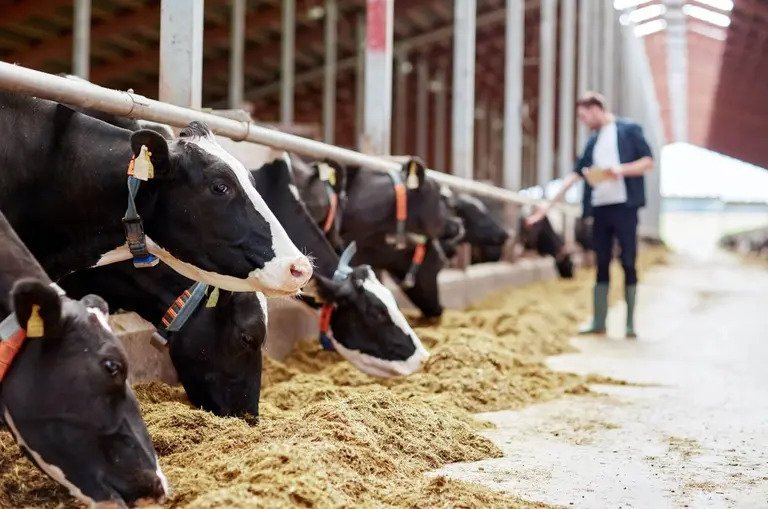
IFF, a global player in flavors, fragrances and health and biosciences, has launched a new phytase enzyme designed for dairy cattle, targeting one of the sector’s biggest cost and productivity challenges: extracting greater nutritional value from existing feed ingredients.
The enzyme is designed to improve nutrient utilisation and feed efficiency by breaking down phytate, a naturally occurring compound found in many feed ingredients that can bind nutrients and limit their availability to animals. The product will initially be launched across the Middle East, Africa and Asia-Pacific markets.
“We believe the future of dairy nutrition is helping cows receive more value from the nutrients in their feed,” said Regina Cortada, vice president, Animal Nutrition & Health, IFF Health & Biosciences. “Our research challenged the long-held assumption that dairy cows fully utilise the phytate contained in feed. We found that phytate breakdown is often incomplete, leaving valuable nutrients unavailable to the animal. This technology was developed to unlock those nutrients and help producers improve feed efficiency, support sustainability goals and increase profitability.”
The launch comes as dairy producers face simultaneous pressure to raise productivity, contain feed costs and reduce the environmental footprint of livestock production. Global milk production is projected to grow by around 2 per cent annually over the coming decade, increasing the focus on technologies that can improve the efficiency with which animals convert feed into milk.
Feed is among the largest costs in dairy production, making nutrient utilisation an increasingly important lever for farm economics. Phytate can bind phosphorus, minerals and other nutrients in feed, limiting their availability to the animal and increasing the need for additional supplementation.
While phytase enzymes have been widely used in poultry and swine nutrition for decades, their application in dairy cattle has historically faced limitations linked to the digestive environment of ruminants. The new enzyme has been developed specifically for this physiology and is designed to remain active where it can break down phytate and release nutrients for absorption.
“Traditional phytase enzymes were not designed to withstand the unique digestive conditions of dairy cattle,” said Ester Vinyeta, innovation director, Animal Nutrition & Health, IFF Health & Biosciences. “This technology was specifically developed for ruminants and is designed to remain active where it can unlock nutrients that would otherwise remain inaccessible. This enables dairy producers to extract more nutritional value from existing feed ingredients while reducing nutrient losses.”
By improving the availability of protein, phosphorus and minerals already present in feed, the enzyme could reduce producers’ reliance on supplemental phosphorus and protected amino acids while also supporting greater flexibility in the use of alternative protein sources. The intended commercial outcome is higher feed efficiency, potentially lower feed costs and reduced nitrogen and phosphorus excretion.
The enzyme can be incorporated into concentrates, premixes and total mixed rations. Product development included extensive evaluation, with one study showing an approximately 70 per cent reduction in undegraded phytate in the abomasum compared with a control diet.
Additional studies in lactating dairy cows found improvements in phosphorus and phytate digestibility, alongside reductions in nitrogen and phosphorus excretion. The studies also reported higher digestibility of nutrients including crude protein and calcium.
The findings position phytase as a potential new tool in dairy nutrition, where improving the efficiency of existing feed ingredients can have implications extending beyond animal performance. For producers operating under pressure from feed costs, resource constraints and sustainability requirements, the ability to extract more nutrients from the same feed base could become an increasingly important part of dairy production economics.