
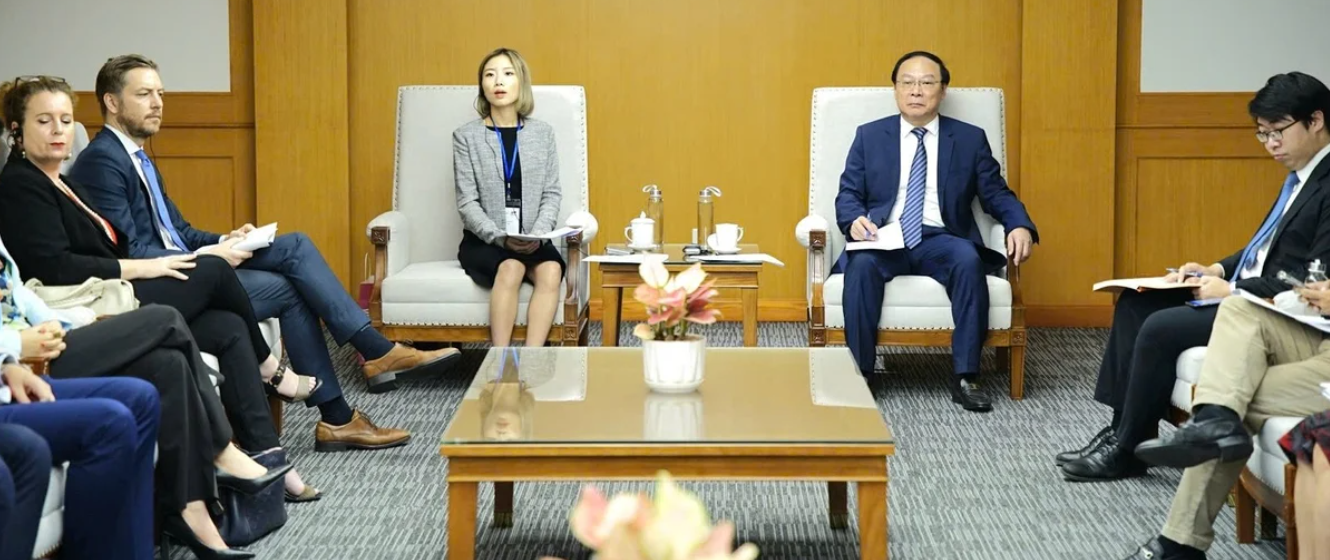
EU-ASEAN Business Council (EU-ABC) and the European Chamber of Commerce in Viet Nam (EuroCham) reviews legal framework, the circular economy, recycling, and agricultural and environmental cooperation
Vietnam’s Deputy Minister of the Ministry of Agriculture and Environment, Le Cong Thanh, held the meeting with a delegation from the EU-ASEAN Business Council (EU-ABC) and the European Chamber of Commerce in Viet Nam (EuroCham). The discussion focused on the legal framework, the circular economy, recycling, and agricultural and environmental cooperation.
At the meeting, Ms. Li Chen, a Member of the EU-ABC Executive Board and Head of Public Affairs for ASEAN at HSBC, introduced the EU-ABC as an organization recognized by the European Commission and the ASEAN Secretariat to represent the European business community operating in Southeast Asia, with EuroCham representing the European business community in Viet Nam.
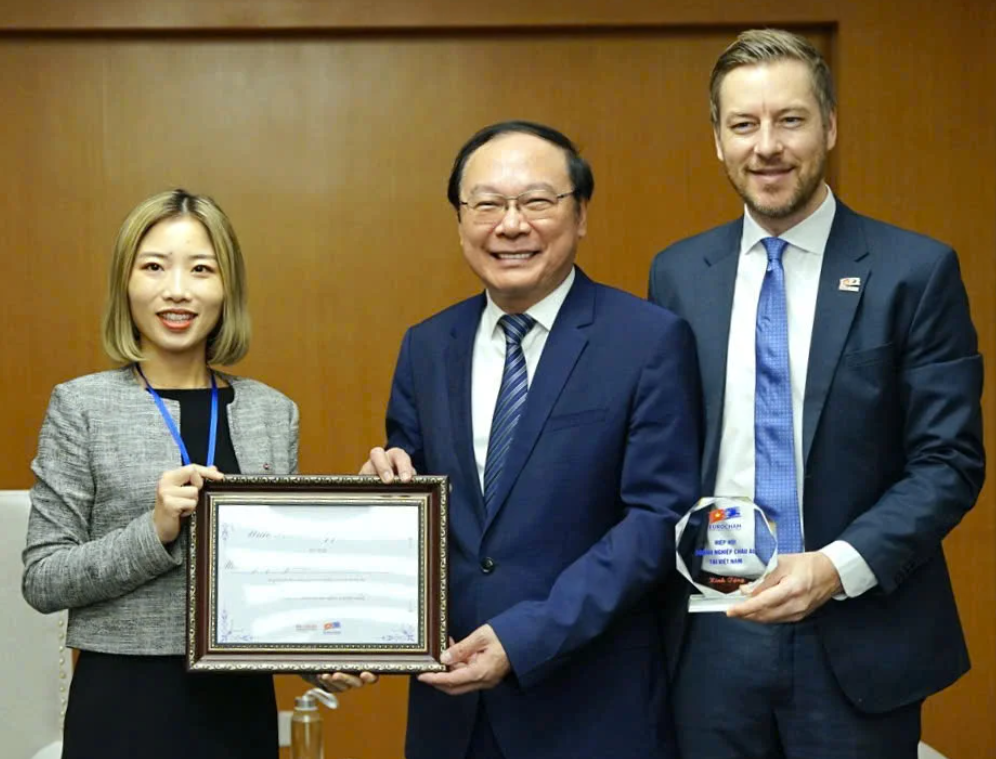
The year 2025 marks the 35th anniversary of diplomatic relations between Viet Nam and the European Union (1990-2025), a significant milestone opening up a period of deeper and more comprehensive cooperation between the two sides. On this occasion, EU-ABC and EuroCham expressed their appreciation towards Vietnamese Ministry of Agriculture and Environment in drafting and amending key bills in 2025, such as the Land Law and the Law Amending and Supplementing a Number of Articles of Laws in the fields of agriculture and environment.
According to Ms. Li Chen, the current legislative refinement process creates an important opportunity to enhance environmental protection and climate change response, while also promoting green transition, smart agriculture development, and increasing added value in agricultural production – areas of particular interest to the European business community, which is ready to accompany and provide support.
European businesses are supporting Vietnam constantly including their recent contributions to disaster prevention and emergency relief, and continued cooperation in remote sensing, spatial data, renewable energy, water treatment, low-emission products, and biomass energy from agricultural by-products.
European Business Mission to Viet Nam
To realize their commitment to cooperate with the Vietnamese Government on these priorities, and to support their members in increasing investment by establishing a platform for constructive dialogue between the Government and businesses, EU-ABC and EuroCham co-organized a High-Level European Business Mission to Viet Nam from November 24 to 27, followed by the Green Economy Forum (GEF) 2025, which will be chaired by EuroCham.
During the working session, representatives of the businesses in the delegation stated that the European business community is committed to long-term partnership with Viet Nam in sustainable development, with the desire to promote the circular economy model and efficient resource utilization.
Deputy Minister Le Cong Thanh affirmed that, the Ministry of Agriculture and Environment continues to develop and amend legal regulations to develop agriculture not merely as a production sector, but as a high value-added commodity production sector capable of meeting the strict requirements of markets, including the European market.
Regarding resource utilization, the Ministry is finalizing policies to ensure that resources such as land, water, minerals, and forests are strictly managed and used efficiently and sustainably, securing development opportunities for future generations. He noted that environmental regulations in recent years have changed significantly toward administrative procedure reform, shifting from pre-inspection to enhanced post-inspection, approaching the advanced management methods applied by the EU. The National Assembly is currently considering amendments to a number of articles in 15 laws related to agriculture and the environment; this is the initial step to address urgent issues, but there will be deeper amendments in the future, including to the environmental laws.
The Deputy Minister emphasized that the comments and recommendations from businesses serve as important questions and suggestions for the policy refinement process, especially concerning the circular economy, recycling, Extended Producer Responsibility (EPR), the carbon market, and carbon credits. The Ministry is researching how to make EPR regulations more favorable and plans to issue a decree soon; it is also considering learning from good European experiences, including regulations on mandatory recycling rates for certain products and packaging.
