
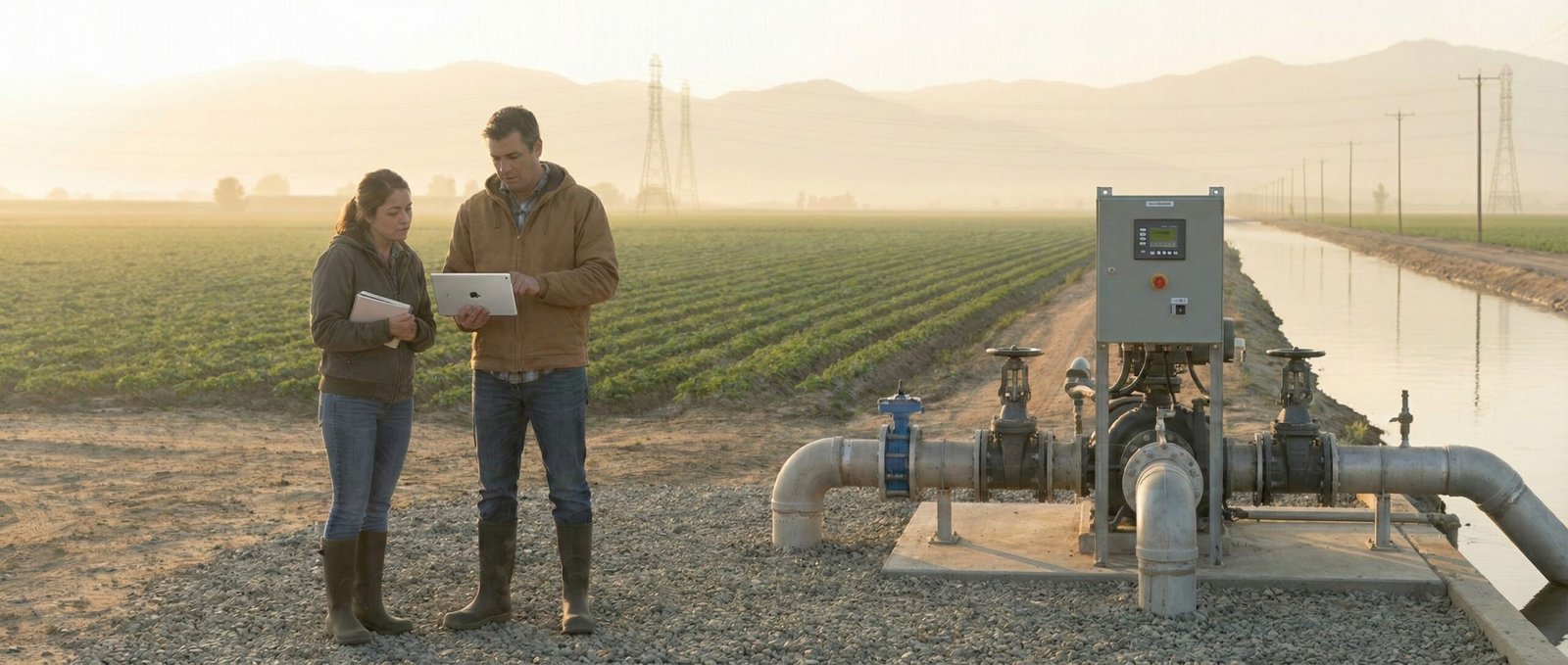
How agricultural load flexibility can compete with peaker plants, batteries, and grid upgrades—at a fraction of the cost

Agricultural flexibility isn’t a temporary workaround—it’s a permanent pillar of the future grid. As renewables increase and variability becomes the norm, the grid needs distributed, dispatchable flexibility everywhere, and farms are uniquely positioned to provide it. Yield’s roadmap expands beyond irrigation into a broader portfolio of farm DERs, orchestrated like a virtual power plant. In an exclusive Agrospectrum interview, Tyler Nuss, CEO of Yield Energy, explains why farmers aren’t just energy users—they’re infrastructure partners in the energy transition.

Agriculture as Grid Infrastructure
You describe agriculture as a new class of grid resource. What would need to change in utility planning, market rules, or regulatory frameworks for agricultural load flexibility to be treated on par with traditional infrastructure like peaker plants or batteries?
Utilities need to formally recognize flexible load as capacity—not just generation. That means valuing demand-side resources based on performance, predictability, and response speed rather than asset type.
Agriculture already represents large, concentrated loads—irrigation alone accounts for roughly 1 per cent of U.S. electricity use. With the right market rules, those loads can deliver grid services faster and at far lower cost than building new infrastructure.
What’s changing now is visibility and control. Platforms like Yield Edge DERMS make agricultural flexibility measurable, dispatchable, and verifiable, allowing it to be planned and relied on just like peaker plants or batteries.
Reliability vs. Variability Risk
Farming operations are inherently seasonal and weather-dependent. How do you ensure the reliability and predictability of agricultural load as a grid resource, particularly during extreme weather events when the grid is most stressed?
Reliability comes from program design and automation that respect farm operations. Farmers only enroll in programs that work for their crop, season, and geography, and participation is automated through equipment they already use.
The results speak for themselves: across thousands of enrolled devices, Yield has delivered an average of 100 per cent performance in demand response dispatches and demonstrated 67 per cent load-shift potential during peak hours.
Extreme weather is exactly when flexible load is most valuable. Our platform coordinates assets so utilities get predictable response, while growers retain full control of which programs they opt-in to.
Scalability Beyond California
California has unique regulatory incentives and grid conditions. What barriers—technical, regulatory, or economic—do you anticipate when scaling this model nationally or internationally, and how central is policy alignment to your growth strategy?
California is a leading market, but the underlying drivers—load growth, electrification, and the need for fast, cost-effective capacity—are global.
The biggest barriers are regulatory recognition and program availability, not technology. Yield Edge is hardware-agnostic and built to integrate with existing farm automation systems, which allows us to scale quickly wherever utilities are ready to engage agriculture.
Policy alignment accelerates adoption, but our strategy is focused on proving performance. When utilities see consistent results, programs follow.
Comparative Economics of Flexibility
You position agricultural load flexibility as cheaper and faster than new storage or grid upgrades. How do the economics compare on a per-megawatt basis over time, especially once transaction, integration, and farmer participation costs are fully accounted for?
Agricultural flexibility avoids the largest cost drivers of traditional infrastructure: long development timelines and capital-intensive buildouts.
Because Yield integrates with equipment farmers already own, deployment costs are low and timelines are measured in months, not years. Utilities gain capacity at a fraction of the cost of new generation or transmission, while growers earn $20–30k annually through demand response or save 10–20 per cent on energy bills through dynamic rates.
That combination—low cost, fast deployment, and dual-sided value—is what makes agricultural flexibility economically compelling over time.
Farmer Incentives and Risk Allocation
How are operational and financial risks shared between Yield Energy, utilities, and growers—particularly if grid dispatch conflicts with critical farm activities or if utility programs change over time?
Growers are always in control. Participation is voluntary, program-based, and aligned with operational realities. We don’t enroll farmers in programs that could disrupt their operations.
Yield handles program design, enrollment, and performance management, while utilities pay for flexible capacity via our DERMS platform. If a grower needs to opt out due to operational constraints, they can do so.
This structure ensures risk is shared appropriately and that growers benefit financially without taking on undue operational risk.
Data, Control, and Cybersecurity
As you aggregate and control thousands of on-farm devices, how do you address concerns around data ownership, cybersecurity, and operational control—especially for growers wary of external interference in farm systems?
We’re very deliberate about this: growers own their data, we don’t sell it, and only the minimum required information is shared for program participation and verification. The platform is built with strong cybersecurity controls, secure integrations with trusted AgTech partners, and continuous monitoring. Most importantly, growers define the operating guardrails and always retain override control—if anything is uncertain, the system defaults back to normal farm operations.
Market Design and Equity
Do you see a risk that flexibility markets disproportionately reward large, capital-intensive farms while leaving smaller growers behind, and how does Yield Energy design its platform to ensure broad participation across farm sizes?
Agriculture’s strength lies in aggregation. Yield enables farms of all sizes to participate by pooling flexible load into unified resources that meet utility thresholds.
Because participation leverages existing equipment, smaller growers can access the same programs without new capital investment. Our goal is to make flexibility revenue and savings accessible across the agricultural spectrum—not just to the largest operations.
Long-Term Grid Transition
Is agricultural flexibility a transitional solution to bridge current grid constraints, or do you see it as a permanent pillar of a decarbonized grid—and how does that vision influence your product roadmap and partnerships?
Agricultural flexibility isn’t a stopgap—it’s a permanent pillar of the future grid. As renewables grow and electrification accelerates, the grid needs fast, distributed, dispatchable flexibility everywhere, and agriculture is one of the largest and most controllable load categories that can provide it through VPP-style orchestration without disrupting operations. That belief drives our roadmap to expand beyond irrigation into a broader farm DER portfolio (cold storage, charging, solar, batteries, generation) and to deepen hardware-agnostic partnerships with AgTech automation platforms so growers can participate seamlessly at scale.
— Suchetana Choudhury (suchetana.choudhuri@agrospectrumindia.com)
