
Malaysia’s Leadership in Climate Action: Advancing Inclusive and Credible Net-Zero Pathways
As the world convened in Belém, Brazil, for the 30th United Nations Climate Change Conference (COP30), Malaysia stepped forward to showcase its leadership, progress, and partnerships on the global stage.
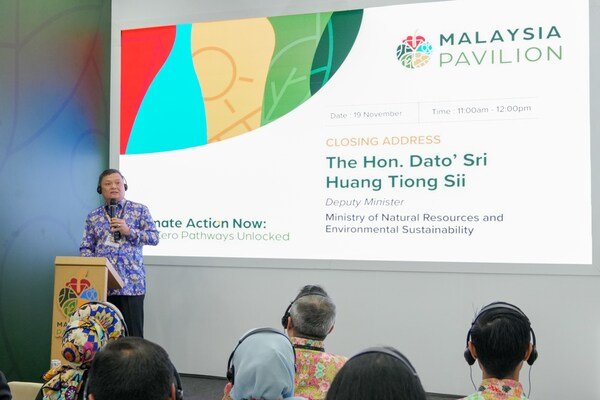
Anchored by the Ministry of Natural Resources and Environmental Sustainability (NRES), the Malaysia Pavilion at COP30 highlighted the nation’s commitment to advancing credible and inclusive net-zero pathways.
Over six days, the Pavilion hosted 17 sessions featuring 78 speakers from government, industry, academia, and civil society, drawing over 580 participants both in person and online, including 319 international delegates.
Building South-South Alliances for Nature and Net Zero
The Pavilion opened with a high-level dialogue titled “Global Mutirão in Practice: Brazil’s Presidency and Malaysia’s Ambition,” co-hosted by PEMANDU Associates and EloGroup. This session explored the alignment between Brazil’s Belém Action Agenda and Malaysia’s climate ambitions, as outlined in the National Climate Change Policy 2.0, the forthcoming Climate Change Bill, and the 2050 Net Zero target. Both nations emphasized the importance of South-South leadership and knowledge exchange to address shared challenges in climate governance. The dialogue highlighted Malaysia’s efforts to strengthen regional cooperation and elevate examples of South-South collaboration, enabling countries to adapt strategies effectively to local contexts.
Safeguarding Our Ecosystems: Science, Faith, and Finance United for the Environment
The “Science Panel for Borneo: Safeguarding Borneo’s Biodiversity for a Sustainable Future” session, led by the UN Sustainable Development Solutions Network (UN SDSN), brought together representatives from global scientific panels to exchange insights on advancing nature-based solutions. These discussions underscored the need to view forests as regenerative assets rather than mere resources for extraction. The Malaysia Forest Fund (MFF) emphasized financing mechanisms that value ecosystem services beyond carbon, calling for a shift in mindset to recognize forests as long-term sustainable revenue generators. Additionally, Lembaga Zakat Selangor showcased how faith-based initiatives could bridge spirituality and sustainability through agro-economy and disaster recovery efforts.
Adaptation in Action: Smart Cities, Industries, and Communities Driving Resilience
Urban resilience and technological innovation took center stage in the session “AI for Urban Resilience: Connecting Technology, Cities, and People,” led by URBANICE Malaysia. Experts from the International Climate Development Institute (ICDI), Universiti Malaya, and other organizations demonstrated how Artificial Intelligence (AI) enhanced city planning, early warning systems, and inclusive development. The session stressed the importance of bridging the gap between AI and local communities, ensuring that technology complemented human understanding and empowered communities rather than leaving them behind. A people-centered approach was highlighted as essential for effective urban resilience.
Anchoring Resilience: Tourism, Energy, and Supply Chains for a Nature-Positive Future
Discussions on resilience explored how sustainable tourism and responsible industry could balance growth with biodiversity protection. In a keynote address, Datuk Nor Yahati binti Awang emphasized that communities must be at the heart of nature-positive tourism. Indigenous and local communities, she noted, were not mere stakeholders but essential partners in equitable and sustainable tourism. The session also showcased initiatives like the Langkawi UNESCO Global Geopark and the Malim Gunung Perhutanan Initiative, which prioritized conservation and community well-being. Sarawak State further highlighted its policy commitments to becoming the “Battery of ASEAN” while preserving one of the world’s oldest rainforests.
Synergy in Sustainability: Integrating Innovation and Nature to Power a Sustainable Future
Tenaga Nasional Berhad (TNB) led discussions on accelerating Malaysia’s energy transition, presenting progress under the National Energy Transition Roadmap (NETR). Ir. Mahathir Nor Ismail, TNB’s Chief Distribution Network Officer, emphasized the importance of a resilient and flexible national grid to support higher integration of renewable energy. TNB’s collaboration with regional partners, including the Laos-Thailand-Malaysia-Singapore Power Integration Project (LTMS-PIP), was highlighted as a model for cross-border power exchange. These efforts reflected ASEAN’s readiness to move from planning to implementation, signaling confidence in the region’s sustainable energy future.
Connecting Green Markets: Finance, Equity, and Driving a Just Transition
The final sessions of the week focused on finance and trade as drivers of inclusive climate action. The “Carbon Pricing Unpacked” discussion brought together leaders from Malaysia, the UK, Singapore, and Australia to explore how carbon pricing could accelerate decarbonization while ensuring equitable growth. Another session, “Accelerating Sustainable and Climate Resilience in Health Systems,” emphasized the need for a “zero regrets” approach to adapting healthcare to climate change. Malaysia’s initiatives, including the National Adaptation Plan (MyNAP) and Green Hospital Initiatives, were showcased alongside global frameworks like the WHO-led ATACH.
A Unified Vision for Climate Action
The Malaysia Pavilion at COP30 underscored the nation’s commitment to a market-driven yet people-centered transition to net zero. By mobilizing finance, safeguarding equity, and fostering collaboration across borders, Malaysia positioned itself as a leader in regional and global climate action. With key national and international stakeholders, including Tenaga Nasional Berhad (TNB), the UN Sustainable Development Solutions Network (UN SDSN), and Maybank, the Pavilion served as a platform for showcasing Malaysia’s progress and partnerships. Spearheaded by the Ministry of Natural Resources and Environmental Sustainability (NRES) and implemented by the Malaysian Green Technology and Climate Change Corporation (MGTC), the Pavilion reflected Malaysia’s unity, resilience, and shared determination to strengthen regional cooperation on climate action.
