
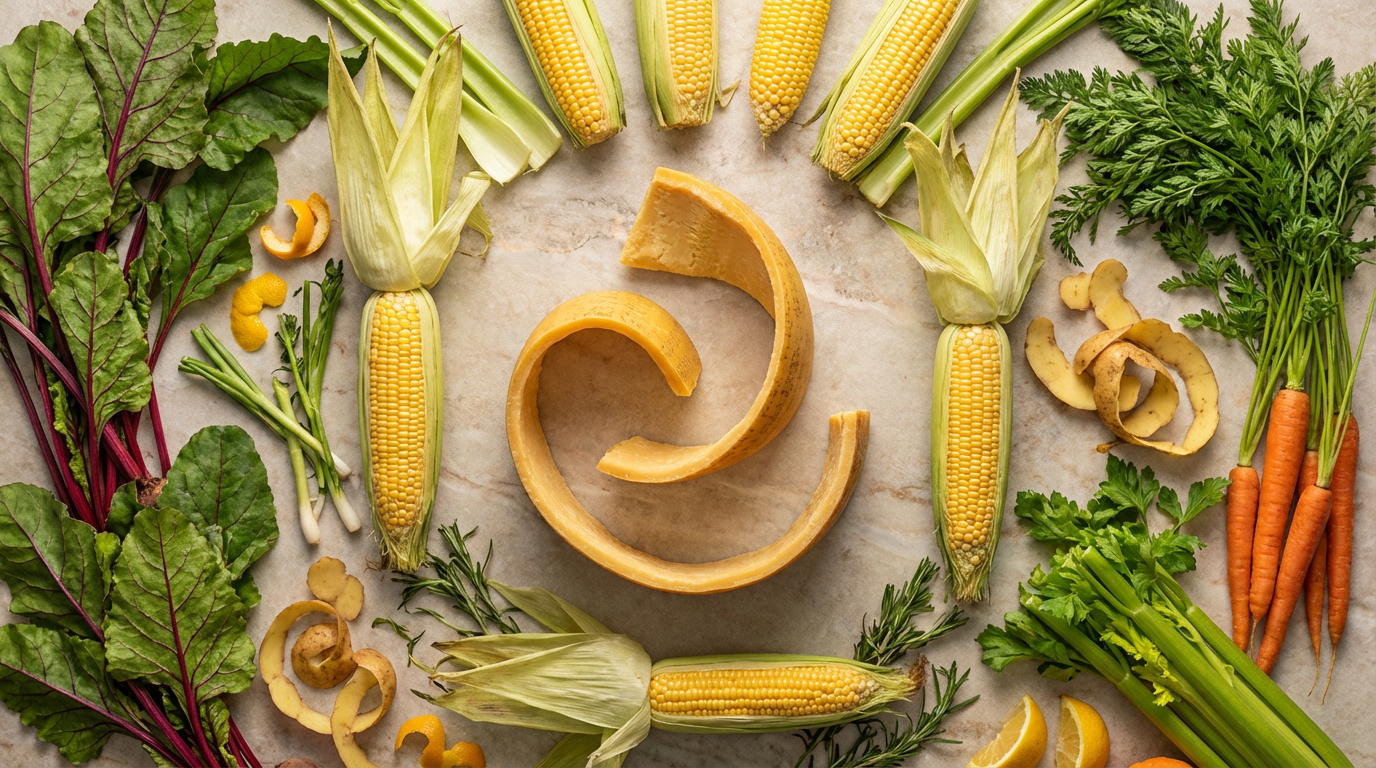
In a world where climate pledges are tightening, supply chains are wobbling under the weight of ecological pressure, and consumers are dissecting the ethics of every bite they take, an unlikely protagonist is stepping into the sustainability spotlight: The humble kitchen scrap. Parmesan rinds, corn cobs, mushroom stems, carrot tops — the culinary castoffs that once met an unceremonious end in the compost bin — are now being reimagined as the building blocks of a new gastronomic economy. What was once waste is becoming wealth. What was once dismissed is being elevated. And what was once an afterthought is rapidly becoming a frontline strategy in the global conversation on food, flavor, and resource intelligence.

This renaissance is not driven by sentimentality or nostalgia. It is driven by taste, economics, and a growing impatience with the inefficiencies embedded in modern cooking. Zero-waste cuisine has existed for centuries, largely as a quiet wisdom passed down through home kitchens and grandmother logic. Michelin-starred chefs are designing entire tasting menus around “secondary” ingredients, proving that carrot peels and leek tops are every bit as capable of delivering complexity as their more photogenic counterparts. Food multinationals are investing in upcycled ingredient pipelines, turning citrus peels into premium extracts and vegetable stems into functional flavor bases.
The thesis animating this movement is elegantly subversive: Flavor has no hierarchy. A corn cob is not lesser than a kernel; a Parmesan rind is not inferior to the wedge it encases. Flavor is democratic, distributed, and often hiding in the places we were taught to ignore.
What began as a sustainability whisper has grown into a culinary roar. The rise of zero-waste cooking is no longer a trend; it is a structural realignment, a philosophical pivot, and a sensory revolution. It is reminding us — with the force of both data and deliciousness — that the future of food may lie not in new ingredients, but in old ones we simply overlooked.
The Economic Rationale: Why Scraps Make Sense Now
A perfect storm of forces is propelling zero-waste cooking from the fringes of sustainability discourse into the beating heart of mainstream food culture. Global food inflation — no longer a temporary spike but a structural reality — has recalibrated how consumers value every ingredient on the chopping board. Food waste, now estimated to swallow a staggering one-third of all food produced worldwide, is morphing from an ethical embarrassment into a fully fledged economic and regulatory liability.
At the same time, a cultural shift is underway: consumers hungry for authenticity, craftsmanship, and ingredient transparency are gravitating toward practices that feel both honest and ingenious. Zero-waste cooking sits precisely at that intersection.
“Banana peels are one of my favorite undercover ingredients — a brilliant plant-based ‘meat’ if you treat them right. Wash them well, slice or shred, then sauté with onions and garlic until they soften and take on that gorgeous golden edge. Hit them with tomato paste, spices, and a splash of broth, and they turn silky, savory, and shockingly satisfying. Parmesan rinds? That’s pure umami currency. I drop them into stocks for depth, or shave them thin and microwave them into crispy, salty wafers that disappear in seconds.
Corn cobs work harder than most people realize. Simmer them with a little sugar and water and you’ve got a beautiful, naturally sweet corn syrup for cocktails or dessert glazes — and the spent cobs add a subtle, smoky dimension when tossed into the grill. Also please don’t ever throw away onion skins, garlic peels, or herb stems. Blend them into a paste, sauté in fat, season well — that becomes the foundation, the soul, the quiet bass note that makes any meat dish sing.”
— Toni Marie ElKhouri, Owner and Executive Chef of Cedars Café ; Award winning chef that specializes in sustainable & low waste northern Lebanese & Mediterranean cuisine

The economic opportunity hidden in scraps is immense — bordering on untapped gold. Take Parmigiano-Reggiano, a global icon with more than 4 million wheels produced each year. About 8 to 12 percent of every wheel is rind, a hard, rugged outer layer brimming with concentrated umami, aromatic oils, and structural integrity. That means tens of thousands of tonnes of culinary potential quietly shaving away at dairy factories — a resource so flavorful that chefs guard it like bullion, yet one that rarely makes its way into home kitchens.
Or consider corn. With over 1.2 billion metric tons produced globally, corn is one of the world’s most powerful agricultural engines. The cob alone accounts for roughly 15 percent of the plant’s biomass. And yet, the cob — an ingredient capable of yielding silk-textured broths and sweet, velvety infusions — is almost entirely absent from the mainstream culinary economy.
Even at the microeconomic level of the household, the numbers are startling. Studies consistently show that families discard between 15 and 25 percent of the edible food they bring home. Not because it has spoiled, but because confusion, habit, and aesthetic bias lead us to misjudge what is truly usable. Much of what lands in the bin is not trash but flavor — dormant, disguised, and waiting to be activated.
This is why zero-waste cooking is evolving beyond sustainability rhetoric. It is fast becoming an economic strategy with measurable impact. Households that rethink scraps can cut grocery costs meaningfully. Restaurants leveraging stems, peels, and trimmings can slash overheads without compromising — indeed, often enhancing — culinary quality. Food companies that upcycle rinds, pulps, and peels into premium ingredients are unlocking entirely new revenue verticals in a market hungry for both thrift and flavor.
We are no longer dealing with a trend of ethical goodwill. We are watching the architecture of a new food economy take shape — one built on the radical premise that nothing natural is ever truly waste until we fail to imagine its value.
The Flavor Frontier: What Gourmet Chefs Always Knew
For decades, the world’s leading chefs have guarded a quiet secret — one that feels almost radical in an era obsessed with perfect produce aesthetics and Instagram-ready plating. Scraps are not waste. Scraps are strategy. They are flavor reservoirs hiding in plain sight. The modern zero-waste gourmet revolution didn’t emerge from environmentalism alone. It emerged from taste — from the recognition that the most intense, concentrated flavor compounds are rarely found in the polished, photogenic cuts supermarkets train us to buy. Instead, they’re wrapped inside the rinds, the cobs, the stems, the peels — the overlooked parts that rarely make it past the cutting board.

The truth is, chefs have always known this, and they’ve been quietly orchestrating culinary magic from what most of us casually discard. Parmesan rinds, corn cobs, vegetable stems, mushroom stems, citrus peels — these are far from mere scraps. They are the hidden alchemy of flavor, the secret chords that transform simple ingredients into symphonies of taste. They carry depth, texture, and aroma that no shortcut, no processed powder, no pre-grated convenience can ever replicate.
In professional kitchens, every simmer, every braise, every careful infusion is a deliberate act of culinary physics. Broths bloom with the slow-release glutamates of cheese rinds. Chowders gain silkiness from corn cob starches. Sauces and pestos build scaffolding from vegetable stems. Mushroom stems provide the earthy bass notes that elevate the simplest dishes into indulgent, forest-floor luxury. Citrus peels, when charred or candied, infuse brightness and perfume that linger long after the plate is cleared.
Leftovers become legend, byproducts transform into treasures, and the kitchen becomes a laboratory of relentless, joyous experimentation. It is an orchestration of taste, a celebration of the overlooked, and a manifesto for turning every ingredient, however humble, into gold. For those who understand it, nothing is wasted; everything is potential, waiting to reveal its hidden brilliance trying to tell us for years. Modern cookbooks rarely capture the messy, improvisational brilliance of real kitchens, but from Kyoto to Copenhagen, the greatest culinary minds have lived by an unspoken principle: Waste is a cultural invention, not a culinary truth.

Massimo Bottura — the rebellious Italian maestro behind Osteria Francescana and the Food for Soul movement — stands at the forefront of this philosophy. Bottura famously transformed stale bread into a silky, caramelized dessert now considered a contemporary masterpiece. He turned Parmigiano rinds into the now-legendary “Parmigiano acqua,” a deceptively simple infusion that produces astonishing depth. Chefs from New York to São Paulo imitate it today. Bottura’s work is built on a profound insight: flavor is not a luxury. Waste is.
Look closely, and you’ll see the zero-waste gourmet movement is not a trend at all. It is a return to culinary science — to extraction, infusion, fermentation, and dehydration, the ancient technologies that sustained civilizations long before refrigeration and industrial processing arrived. Extraction calls for drawing intensity from bones, shells, peels, and pits. Infusion relies on oils, tannins, and aromatics slowly releasing into liquids. Fermentation transforms scraps into acids, fizz, and umami.

Dehydration preserves while amplifying flavor. These techniques show up everywhere: French grandmothers simmering onion skins for broth, Korean halmeonis making kimchi brines from vegetable stubs, Japanese chefs shaving dried fish bones for dashi, Indian households sun-drying citrus peels for digestive powders. Today, chefs market these techniques as sustainability. Historically, they were simply good cooking.
Home cooks are rediscovering what chefs never forgot. The rise of zero-waste gourmet cooking isn’t driven solely by climate consciousness, although that matters. It is driven by economic logic and flavor efficiency. Food prices are rising globally, consumers are cooking more at home, gourmet techniques have been democratized by social media, and people want healthier, more flavorful meals without expensive ingredients. Scraps offer all of this, at zero additional cost. A single Parmesan rind can elevate a simple broth into a restaurant-level experience. A corn cob can transform a summer soup into a velvety, Michelin-grade velouté. Mushroom stems, long ignored, can outperform truffle shavings in pure umami satisfaction. These are not compromises. They are enhancements.
This is why the future of zero-waste cooking is not about guilt. It is about flavor. Scraps are not a moral choice; they are a flavor choice. They are not punishment; they are opportunity. They are not leftovers; they are leverage. What Bottura, Barber, and countless quiet geniuses in professional kitchens around the world have proven is simple: the world does not need more ingredients. It needs more imagination. And the most underutilized raw material in the global food system is sitting right in front of us — not in the gleaming produce aisles, but in the bowls and bins we’ve been taught to discard.
Welcome to the flavor frontier. It’s time to cook the way chefs always have.
The Zero-Waste Consumer: A New Demographic Emerges
A new kind of consumer is reshaping the modern food economy — one who reads labels as closely as financial statements, who sees culinary creativity as a form of personal branding, and who treats kitchen scraps not as trash but as raw material. This demographic is young, eco-literate, digitally native, and increasingly influential. And their rise signals a profound shift in how value is constructed in the food ecosystem.

What has changed is not just environmental awareness, but cultural perception. For decades, frugality was associated with necessity. Today, it has been elevated into a lifestyle choice — a fusion of economic rationality, culinary aspiration, and ethical coherence. Social media has acted as the accelerant: platforms like TikTok, Instagram, and YouTube have collapsed the distance between professional chefs and home cooks. A single “upcycle your scraps” video can accumulate millions of views overnight, reframing what once looked like thrift as artistry. Turning carrot tops into pesto or corn cobs into velouté isn’t just resourceful — it’s cool, performative, and narratively rich. It signals intelligence, sustainability, and competence all at once.

Three underlying forces drive this demographic’s growth, though none operates in isolation. The first is economic pressure. In a world where grocery bills inch upward faster than wages, consumers have turned cost-efficiency into a form of empowerment. The ability to stretch ingredients without compromising quality feels less like compromise and more like strategic mastery. Saving money has become aspirational — a way to display control, creativity, and financial literacy.
The second force is gourmet ambition. The internet has democratized access to culinary techniques once trapped behind the stainless-steel doors of elite restaurants. Video tutorials reveal how Michelin-level chefs coax extraordinary flavor from overlooked scraps. Suddenly, transforming stems, rinds, peels, or bones into gourmet dishes is not only possible but celebrated. This creates a cultural shift: waste reduction is no longer an act of deprivation, but a mark of sophistication. The zero-waste kitchen becomes a stage for ingenuity, where the cook becomes a kind of flavor alchemist. Scraps become a new frontier for experimentation, a way to express one’s palate, identity, and aesthetics.
Finally, there is the ethical undertow. Food waste now appears not just financially reckless but morally outdated. With climate anxieties rising and documentaries illuminating the environmental cost of discarded produce, consumers increasingly view wastefulness as an ethical failure — a breach of personal responsibility. Using scraps allows them to uphold their values without sacrificing pleasure. It delivers what modern consumers want most: sustainability without pain, ethics without compromise, responsibility without austerity. Zero-waste cooking, in this sense, becomes a guilt-free path to indulgence.

This shift has not gone unnoticed by the food industry. Retailers, always sensitive to emerging micro-cultures, are beginning to treat scraps as a product category rather than a liability. In upscale grocery chains, bundles of vegetable stems are marketed specifically for broths and pestos. Artisanal producers have introduced rind-based flavor kits that mirror chef techniques, turning what once sat in waste bins into premium SKUs. Upcycled sauces made from tomato skins or carrot pulp now occupy the same shelves as craft condiments. Even dehydrated citrus peel seasonings — once the domain of grandmother pantries — have been reborn as gourmet cocktail rimmers and dessert garnishes.
What began in Michelin kitchens is quietly becoming a mainstream retail strategy. Scraps are crossing the chasm from necessity to desirability, from background noise to hero ingredient. And as consumers embrace the idea that flavor can come from anywhere — not just the glossy, camera-ready parts of produce — brands are discovering a rare convergence of profit, sustainability, and cultural momentum.
In the evolution of food trends, few shifts are as structurally significant as this one. The zero-waste consumer represents not just a new market segment, but a new mindset — one in which creativity, economy, and ethics align so seamlessly that the boundaries between them dissolve. This demographic is not merely responding to a trend. They are building a new culinary culture, one rind, stem, cob, and peel at a time.
A Future Where “Scrap” Becomes a Culinary Relic
The global food system is undergoing profound reinvention. Climate volatility, soil degradation, supply chain disruptions, and unpredictable harvests are forcing consumers and companies to rethink resource efficiency. At the same time, diners demand deeper umami, brighter aromatics, layered textures, and compelling culinary narratives. Zero-waste cooking sits at the intersection of these pressures, where sustainability and flavor reinforce each other.
“People are more mindful than ever about food waste — and for good reason. With global conversations around food disparity and real-time awareness of how much we throw away, there’s finally a collective shift happening. Add rising grocery costs to the mix, and home cooks are learning to stretch every ingredient to its fullest potential.
Parmesan rinds, for example, are absolute magic. Drop them into soups or a simmering pot of tomato sauce and they melt their umami right into the dish. Onion skins, carrot peelings, herb stems, chicken bones — these so-called ‘discards’ make some of the most flavorful stocks you’ll ever taste. Then there are the everyday heroes: fried rice, omelets, casseroles — dishes purpose-built to transform scraps and leftovers into something comforting and complete.
Look across the culinary world and you’ll see this philosophy deeply rooted in Korean, Japanese, and Chinese cooking especially. Nothing is wasted. Every trim has a purpose. Every scrap has a role. That mindset is as economical as it is delicious — a true chef’s way of respecting the ingredient.”
— Chef Katie Vine, the culinary mind behind Dinners Done Quick

The concept of “waste” is losing relevance. Parmesan rinds are now marketed as concentrated umami cores. Corn cobs serve as natural broth starters, their starches adding sweetness and texture. Vegetable stems function as flavor anchors. Citrus peels provide aromatic lift and bitter-sweet complexity. Mushroom stems deliver earthy, savory intensity. What was once scrap is becoming a premium ingredient category, echoing the rise of cascara and whey — byproducts turned commodities.

The shift is philosophical as much as commercial. Zero-waste cooking succeeds not through virtue but through flavor, control, and mastery. Using scraps is an act of culinary intelligence. Deeper broths, richer oils, and cleaner pantries make sustainability a byproduct of technique, not an obligation. When flavor leads, behavior change becomes seamless.
As AI optimizes household patterns, fermentation expands possibilities, and upcycling scales industrially, the idea of a “scrap” may disappear. Every peel, stem, core, leaf, rind, and husk will hold deliberate culinary value. Future cookbooks will map potential, not waste.
The kitchen, once one of the most wasteful spaces, is becoming a model of circular design. Ingredients destined for trash will drive new flavors, textures, and innovations. The question will no longer be how to use scraps, but what extraordinary flavors have been ignored, and what else are we still discarding?
— Suchetana Choudhury (suchetana.choudhuri@agrospectrumindia.com)
