
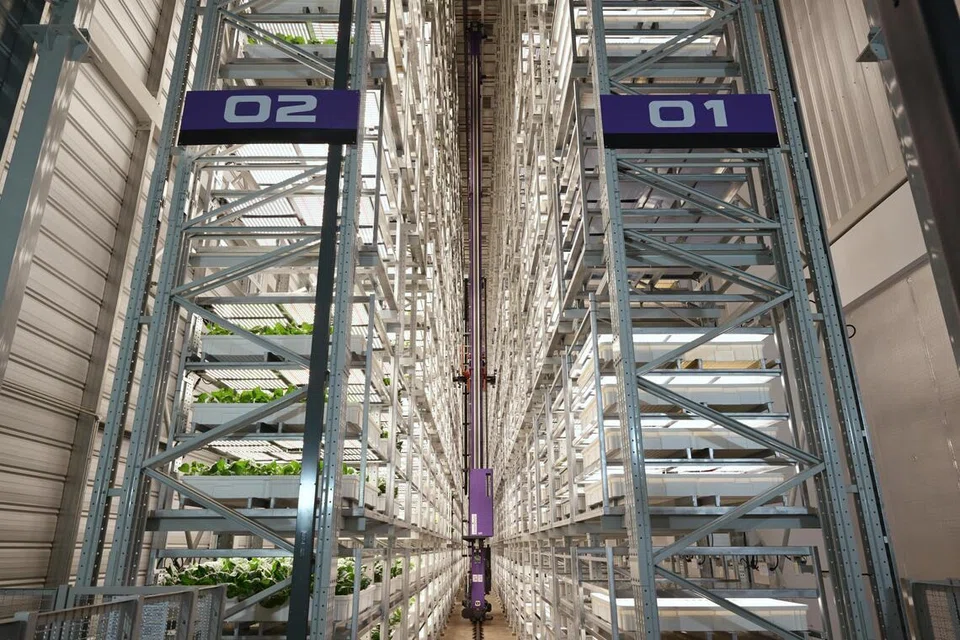
Greenphyto, to redefines vertical farming with innovation and resilience using AI, robotics and automation to produce 2,000 tonnes of greens annually at full capacity.
Singapore unveils Greenphyto, the world’s tallest indoor vertical farm, standing over 23 meters tall and showcasing a 14-year journey of ambition and technological advancement. Greenphyto located in Jurong West industrial area redefines vertical farming with agricultural innovation and resilience.
The fully automated hydroponic farm, powered by artificial intelligence (AI) and advanced robotics, represents a bold step in Singapore’s agri-tech landscape. Despite challenges faced by other high-tech farms, Greenphyto is determined to thrive, leveraging cutting-edge technology and a focus on quality to carve out its niche in the competitive market.
The farm also cultivates Japanese chye sim, baby spinach, arugula, and other greens. A 200g pack of kailan retails for $3.95, while a 100g pack of Mambo Lettuce costs $3.20. At full capacity, the $80 million, five-storey facility spanning 2 hectares can produce 2,000 tonnes of greens annually. Greenphyto’s success is underpinned by 69 patents that drive its innovations in crop optimization and cost reduction.
Founder Ms. Susan Chong emphasized the farm’s commitment to using technology as an enabler for producing high-quality, cost-efficient vegetables. She highlights the farm’s focus on delivering value through its products rather than merely showcasing advanced systems. Energy efficiency has been a critical area of improvement.

High energy costs have long plagued indoor farms, but Greenphyto has reduced its energy consumption by 30% through research and development. Collaborating with a vendor, the farm designed LED lights that use less power and implemented a system to adjust lighting levels based on the needs of individual crops, avoiding wasteful energy use.
The farm’s core infrastructure consists of five unmanned chambers, each housing two 118-meter-long hydroponic towers that soar to 23.3 meters. Unlike conventional systems, Greenphyto’s towers are inspired by supply chain warehouse designs from Ms. Chong’s earlier career. Stacked with over 500 racks and illuminated by LED lights, the towers use nutrient-rich trays tailored to each crop’s growth stage. This stacking innovation enabled the towers to exceed typical height limits. In addition to vegetable production, Greenphyto has diversified its revenue streams. The farm has established a sales office in Malaysia to explore export opportunities and an office in the Netherlands to market its novel farming system globally.
Furthermore, the farm’s AI software, which monitors crop health, predicts yields, and provides actionable insights, is being positioned as a standalone product. Greenphyto plans to offer this AI solution to other farms and industries, including food and beverage and supply chain sectors. Farm staff receive daily email alerts from the AI system about potential crop issues, such as yellowing leaves, along with suggested root causes. This allows managers to make informed decisions about harvesting schedules or adjusting chamber parameters.
The AI capabilities were developed with support from the Infocomm Media Development Authority’s Digital Leaders Programme, which also facilitated the hiring of data engineers and software developers. Greenphyto is now preparing to launch a technology spin-off, Arber.ai, to provide consultancy services for other farms and small and medium-sized enterprises looking to adopt digital solutions. This initiative underscores the farm’s broader vision of driving innovation beyond its own operations.
The farm has also received support from the Singapore Food Agency’s Agri-food Cluster Transformation Fund, which aids local farms in adopting technologies to boost productivity. Senior Minister of State for Sustainability and the Environment Zaqy Mohamad, speaking at the launch, noted that Greenphyto’s focus on energy efficiency, automation, and technology export positions it well for success. However, he emphasized that fostering demand for local produce is equally critical. Greenphyto’s journey has not been without context.
Greenphyto’s founder approach combines resilience with a focus on innovation and adaptability. Singapore’s shift away from its “30 by 30” local farming goal in late 2025, replaced by new targets for fiber and protein production by 2035, has also reshaped the landscape for agri-tech ventures. Greenphyto’s ability to align with these evolving priorities while maintaining a strong focus on quality and efficiency sets it apart. As Greenphyto looks toward the future, its blend of local production, global ambitions, and technological spin-offs positions it as a model for sustainable agri-tech. With its AI-driven systems and commitment to quality, the farm is not just growing vegetables—it is cultivating a new standard for what vertical farming can achieve in Singapore and beyond.
