
Focus on green nano‑fertilizers and plant‑immunity enhancers to improve crop productivity
NTU’s School of Biological Sciences (NTU SBS) has signed a Memorandum of Understanding with Golden Agri International (GAI) and the SMART Research Institute (SMARTRI), facilitated by the Singapore Agri‑Food Innovation Lab (SAIL), to explore collaborative research in sustainable agricultural practices.
The partnership will focus on green nano‑fertilizers and plant‑immunity enhancers to improve crop productivity; molecular and structural regulation of oil biosynthesis and seed loading for efficient, sustainable vegetable‑oil production; plant–pathogen interactions and VOC‑based early diagnostics for pest and disease management; photosynthetic optimisation and carbon fixation to enhance yields while reducing environmental impact; and functional and comparative genomics for long‑term trait discovery in oil palm using non‑GMO approaches. The parties will take a systems (CoLab) approach to shape exploratory and applied projects, including the establishment of interdisciplinary research interfaces with other NTU entities.
NTU Team Awarded SSHR Seed Grant for Study on Digital Agriculture in Singapore and Southeast Asia
NTU Food Research Systems (NTU‑FRS) is pleased to share that the project “Digital Agriculture Technology Adoption Drivers in Singapore and Southeast Asia” (Award #2025‑CoHASS‑003) has been awarded the NTU Social Sciences and Humanities Research (SSHR) Seed Grant.
Led by Dr Jose Ma. Luis Montesclaros (RSIS) as Principal Investigator, with Prof Mely Caballero‑Anthony (RSIS) as Co‑Investigator, the project will examine how digital agriculture can strengthen food security outcomes in Singapore and the broader Southeast Asian region. Initial fieldwork in Singapore will form the foundation for developing a full SSHR‑TG proposal in 2028, with the intention to expand participation across the community in this interdisciplinary effort.
The team brings together expertise across NTU, including Dr Sherwin Chua (WKWSCI) as Lead Collaborator, and collaborators Prof Ng Kee Woei (MSE), Dr Munusamy Vijayan (CRADLE), and Mr Kayven Tan (RSIS). The project also benefits from regional partnership through Dr Gerlie Tatlonghari of the Southeast Asian Regional Centre for Graduate Study and Research in Agriculture (SEARCA‑CADRE), helping to connect future ASEAN country participants to the research.
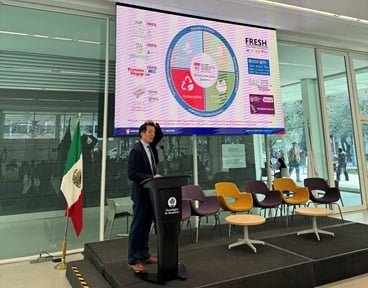
Prof William Chen, Cluster Lead with NTU Food Research Systems (NTU‑FRS), was invited to speak at the Second International Symposium on Food Security and Nutrition, held on 23–24 February 2026 at Tecnológico de Monterrey in Monterrey, Nuevo León, Mexico. The event drew over 150 in‑person attendees and more than 200 virtual participants, according to the organisers.
The symposium brought together leading researchers, industry representatives, and policymakers to discuss current challenges and emerging solutions in food security and nutrition from interdisciplinary and global perspectives, with a focus on science‑ and technology‑driven approaches. Prof Chen delivered a talk titled “Enhancing Food Security through Technology Innovations and Partnerships: A Singapore Perspective,” contributing insights on how innovation ecosystems can strengthen resilience and accelerate practical impact across food systems.
Organised by the Food Security and Nutrition Research Group of the School of Engineering and Sciences at Tecnológico de Monterrey, the symposium also included a dedicated working session on strategic actions for the Food Security and Nutrition Alliance – an initiative that seeks to articulate scientific research, technological innovation, and public policy design to transform food systems toward more sustainable, healthy, and equitable models, generating synergy among several international institutions to work from a united front on food security solutions.
Ahead of the symposium, a NTU delegation led by the Deputy President and Provost Prof Christian Wolfrum visited Tecnológico de Monterrey in early February 2026, further strengthening institutional ties and collaboration pathways.
