
Cargill increases its investment in low-carbon innovation in the bulk shipping sector
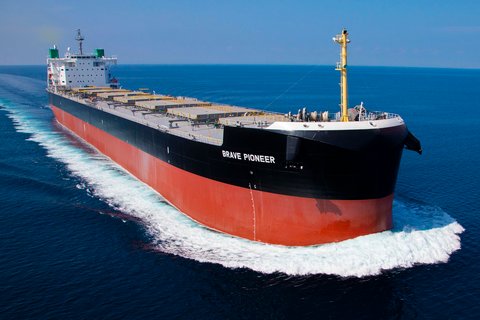
Cargill today announced the maiden voyage of the Brave Pioneer, the first of its five green methanol dual-fuel dry bulk carriers. As Cargill collaborates with customers and partners to develop future-proof solutions for itself and the industry as a whole, the Brave Pioneer’s maiden voyage represents another significant milestone in Cargill’s broader decarbonization process—a process centered on innovation, testing, and experience.
Built by Tsuneishi Shipbuilding Co., Ltd. and owned by Mitsui & Co. Ltd., the Brave Pioneer is equipped with a dual-fuel system that can use both conventional marine fuels and green methanol, a low-carbon alternative. Compared to conventional fuels, the use of green methanol is expected to reduce carbon dioxide emissions by up to 70%.
The vessel departed from the Philippines today, will refuel with green methanol in Singapore, then head to Western Australia before continuing its journey to Europe. With the Brave Pioneer’s maiden voyage, Cargill will conduct a series of operational tests aimed at assessing methanol refueling readiness, exploring how to track and verify environmental attributes through carbon accounting systems, and understanding market demand for low-carbon freight services.
Jan Dieleman, President of Cargill’s Maritime Shipping Business, stated, “Global shipping decarbonization requires a synergistic effort from multiple technologies and bold steps before the entire ecosystem is ready. The application of technologies such as green methanol or wind-assisted propulsion still faces uncertainties. However, as industry leaders, we have a responsibility to test these innovative technologies in actual voyages, share our experiences and results, and help build systems and standards that facilitate the widespread adoption of these technologies.”
Laying the foundation for a new type of low-carbon fleet
The commissioning of the Brave Pioneer lays the foundation for four more vessels to join the Cargill fleet in the coming years. These additions will further strengthen Cargill’s multi-pronged decarbonization strategy, which includes wind-assisted propulsion, navigation optimization technologies, energy efficiency retrofits, and the exploration of alternative fuels such as biofuels and ethanol.
Each step is an important part of the company’s broader efforts to integrate sustainability into the global ocean supply chain, while supporting customers seeking practical, low-carbon freight solutions.
Dieleman continued, “We understand that the path to low-carbon shipping requires a variety of solutions, and green methanol is one of them. Our new fleet emphasizes flexibility and adaptability. These vessels can currently achieve best-in-class operational standards using conventional fuels, while allowing us the flexibility to switch to more environmentally friendly fuels as the supply of green fuels improves. This is a practical way to ensure the future development of maritime transport.”
As one of the world’s largest dry bulk charterers, Cargill’s move sends a strong signal of demand to the market and extends an open invitation to other players in the shipping industry to work together to move toward sustainable shipping.
This move will help Cargill further reduce emissions from its supply chain, while investing in and testing viable innovative technologies to drive the global food system toward greater sustainability. With the gradual expansion of renewable energy fuel supply, ships using green methanol are expected to play a significant role in reducing shipping emissions over the next decade.
