

Strengthening Research Collaboration on the Phitsanulok Alternate Wetting and Drying (AWD) Project to Accelerate Science-Based Carbon Credit Generation
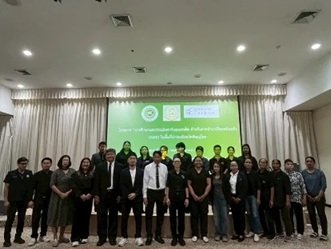
Green Carbon Co., Ltd., which operates a nature-based carbon credit creation and sales business, has signed a memorandum of understanding (MOU) with Naresuan University (NU), a national university in Thailand, to promote a greenhouse gas reduction project that utilizes intermittent irrigation (AWD: Alternate Wetting and Drying) (*1) in rice paddies in Phitsanulok Province, Thailand. Strengthening scientific credibility and laying a foundation for scale-up are the objectives of the MOU.
Through this collaboration, we aim to strengthen the system for measuring, analyzing, and evaluating GHG (greenhouse gas) emissions and establish a high-quality agricultural carbon credit creation model based on scientific evidence.
Naresuan University, a leading national institution in Phitsanulok Province renowned for its research in agriculture and environmental science, has entered into an MOU with Green Carbon to advance collaboration with the following goals:
- Precise measurement of GHG emissions in AWD rice paddies
- Scientific evaluation of emission reduction effects
- Development of a data infrastructure to support the international credit system
- Establishment of a research and demonstration model for large-scale deployment.
This partnership will enhance the ongoing AWD project with academic support, aiming to produce high-quality agricultural carbon credits suitable for the international market.
AWD project in Thailand enters implementation phase
Rice cultivation is one of the world’s major sources of agricultural methane emissions and is positioned as a priority area for reduction efforts in decarbonizing agriculture.
Green Carbon has designated Thailand as one of its priority regions and has been promoting a greenhouse gas (GHG) reduction project using intermittent irrigation (AWD) in rice paddies. In particular, in Phitsanulok Province, the company is collaborating with local government agencies and agricultural stakeholders to implement a field demonstration project for AWD.
The results of a survey on the effects of introducing AWD in the region have confirmed the following multiple environmental and economic benefits.
- Average reduction of methane emissions by approximately 49%
- Emissions reduction of approximately 2.97tCO₂e per hectare per season
- Reducing water usage
- Increased yields and farm income
Based on these results, the establishment of a highly accurate MRV (Monitoring, Reporting and Verification) system that can comply with the international carbon credit system is a key to future large-scale deployment. Naresuan University is a major national university based in Phitsanulok Province, with a strong track record of research in the fields of agriculture and environmental science.
Based on this MOU, Green Carbon and NU will promote research collaboration with the following objectives:
- Precise measurement of GHG emissions in AWD rice paddies
- Scientific evaluation of emission reduction effects
- Developing a data infrastructure to support the international credit system
- Establishment of a research and demonstration model for large-scale deployment
This will strengthen the already implemented AWD project with academic backing and aim to create high-quality agricultural carbon credits that can be used in the international market.
Intermittent irrigation (AWD) is a method in which water is added to rice paddies every few days and then allowed to dry naturally, based on the water level in the paddy field. Compared to continuous water addition, intermittent irrigation (AWD) reduces water usage and contributes to the conservation of water resources.
