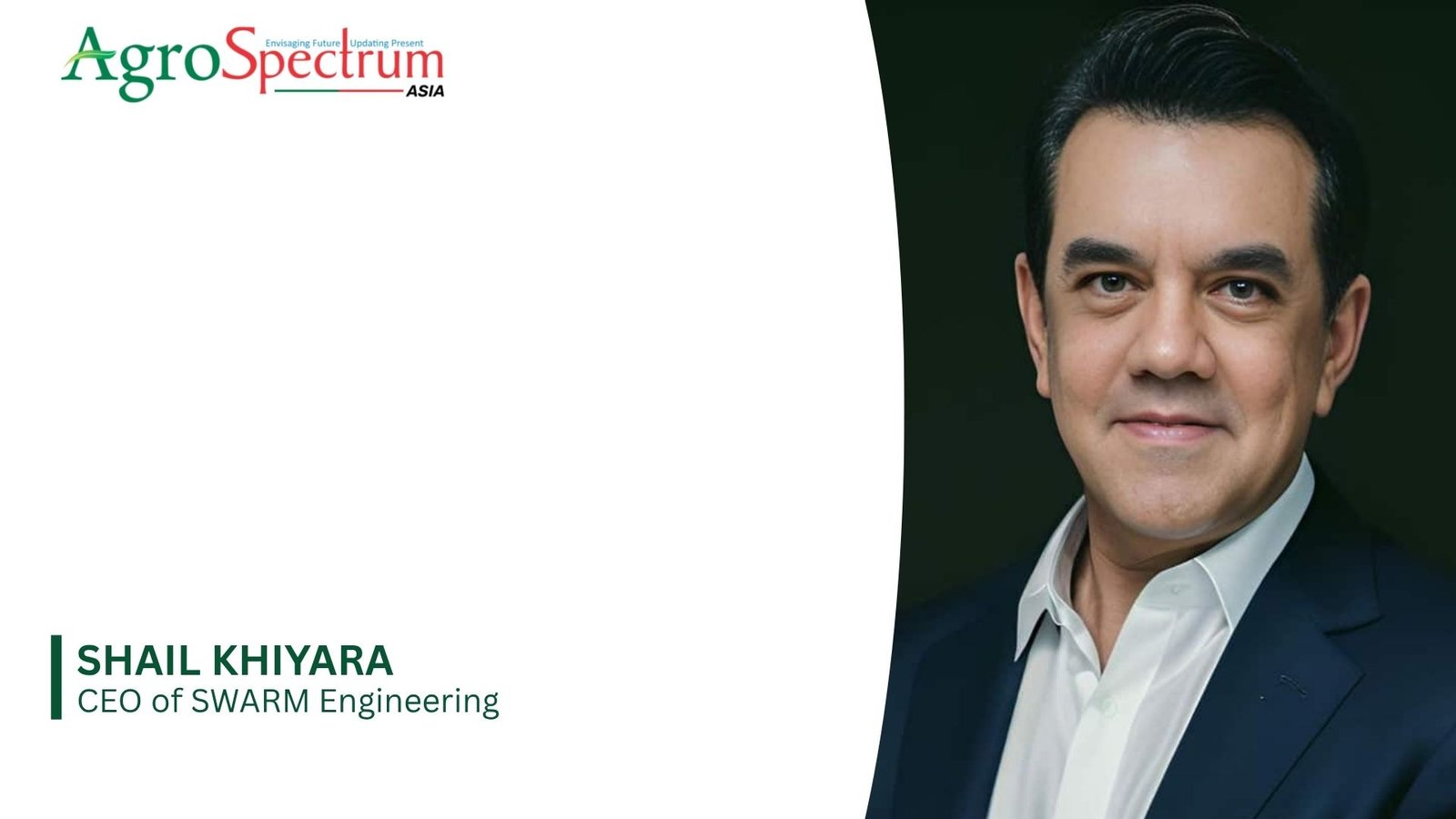
In an exclusive interview with AgroSpectrum, Shail Khiyara, CEO of SWARM Engineering, argues that the real threat posed by a potential disruption in the Strait of Hormuz is not any single shock, but the simultaneous collision of fertilizer shortages, energy price spikes, freight disruptions and shifting export demand that can overwhelm conventional planning systems.
Khiyara contends that agrifood and manufacturing companies are entering an era where geopolitical volatility is no longer an exception but the operating environment, rendering traditional supply-chain models built on historical data increasingly obsolete. He makes the case that the next competitive frontier is not access to data, scale or capital, but decision-making speed and quality, with "decision latency" emerging as a hidden cost that erodes margins and resilience. As geopolitical risks intensify, Khiyara believes decision intelligence—rather than generative AI—will become the defining technology category for operators seeking to navigate uncertainty and turn disruption into competitive advantage.
The Strait of Hormuz remains one of the world's most critical geopolitical chokepoints. From an operational decision-making perspective, how exposed are today's agrifood and manufacturing supply chains to a major disruption in the region, and do companies fully understand that risk?
The exposure is real but it is often misunderstood. The most direct impact of a Hormuz disruption on agrifood is not the food imports, but the fertilizer. That said there are areas without fresh water like the UAE that does survive on food imports. Urea and ammonia move through Gulf ports and a disruption reprices input costs for grain and row crop producers almost immediately. The second impact is energy. Oil price spikes hit transportation, cold chain, and food processing operations simultaneously.
The third is export demand. The Gulf is a major destination for U.S. and Australian wheat exports to Middle East and North Africa markets. When those lanes constrict, global grain pricing shifts and North American and South American producers feel it in demand and margin. Do companies understand that risk? Most do not. They understand it in isolation, fertilizer costs go up, freight goes up. What they do not understand is how those shocks interact simultaneously across their operation and compound into a decision crisis that their planning tools were never built to handle.
The risk is not that companies do not have the data. It is that they do not understand how the shocks interact. When fertilizer, energy, and export demand move simultaneously, the planning system does not just slow down. It breaks.
For decades, supply-chain planning has largely been built around historical data and predictable trade flows. In an era of geopolitical shocks—from the Strait of Hormuz to the Red Sea—has the traditional planning model fundamentally broken down?
The traditional planning model was built on two assumptions that no longer hold. First, that disruptions are exceptions. Second, that you have days to respond. Historical data and predictable trade flows gave planners a stable foundation to work from. Adjust last year's plan for this year's forecast and you were mostly right. That model worked when the exceptions were rare enough to manage manually.
What has changed is the frequency and simultaneity of disruption. Tariffs, Hormuz, Red Sea, climate events, labor volatility. These are no longer exceptions. They are the operating environment. And they do not arrive one at a time. They arrive together, each one interacting with the others in ways that historical data cannot predict and manual planning cannot resolve fast enough. The traditional model has not just broken down. It has become a liability. Every day an organization relies on it is a day it is making decisions with tools built for a world that no longer exists.
Many executives talk about resilience, but resilience often comes at the expense of efficiency. How can AI help companies navigate that trade-off when energy prices, freight costs, and sourcing risks can change overnight because of geopolitical events?
The resilience versus efficiency trade-off is real but it is often framed incorrectly. Most organizations treat it as a binary choice, meaning build buffer inventory and sacrifice efficiency, or run lean and accept vulnerability. AI changes that framing entirely.
I have spent my career inside operational environments where that trade-off was not theoretical. It was measured in contract penalties, lost production, and margin that disappeared before the quarter closed. The operators who navigated it best were never the ones who chose one over the other. They were the ones who could see both simultaneously and move faster than the situation could deteriorate. The trade-off exists in most organizations today because planning systems cannot evaluate resilience and efficiency simultaneously across thousands of variables in real time. They optimize for one at the expense of the other because they cannot hold both at once.
Decision intelligence changes that.
When a system can run hundreds of scenarios simultaneously across your entire operation, it finds the options that protect efficiency and build resilience at the same time. And with no extra buffer stock everywhere. The right inventory, in the right place, for the right risk. The companies that figure this out will not have to choose between resilience and efficiency. In a world where disruption is the operating environment, that choice is a false one. The real question is whether your planning architecture can hold both simultaneously. Decision intelligence can. Legacy tools cannot. And the gap between those two realities is now measured in margin.
The risk is not that companies do not have the data. It is that they do not understand how the shocks interact. When fertilizer, energy, and export demand move simultaneously, the planning system does not just slow down. It breaks.
A closure or disruption of the Strait of Hormuz would likely trigger ripple effects across fuel markets, transportation networks, fertilizer supplies, and food production costs. Which sectors within agrifood and manufacturing do you believe are most vulnerable, and why?
The most vulnerable sectors are those where the Hormuz impact chains are longest and fastest. Grain and oilseed production is most directly exposed through fertilizer. Urea and ammonia price spikes hit input costs immediately and ripple through the entire food value chain from farm to processor to consumer. Protein production, poultry, pork, and aquaculture, is doubly exposed. Feed costs spike through the fertilizer and grain channel. Energy costs hit processing and cold chain simultaneously. And, customer commitments made 60 days earlier can become margin-negative overnight.
Food manufacturing and processing is exposed through energy costs, packaging materials, and transportation. A plant running 3 shifts suddenly faces a cost structure that the pricing model cannot absorb. The common thread across all of them is simultaneity. It is not one shock. It is several hitting at once, each one amplifying the others, in organizations that are still planning sequentially.
One of SWARM's core propositions is scenario modelling. If a major Hormuz-related disruption occurred tomorrow, how quickly could AI-driven systems generate actionable alternatives compared to conventional planning processes that may take days or weeks?
The contrast is stark and it is measurable. When a Hormuz disruption hits, a conventional planning team splits the problem. Supply works the fertilizer and input cost problem. Logistics works the freight problem. Commercial works the customer commitments. Three teams, three spreadsheets, three versions of reality that will not reconcile until Thursday. By then the market has moved again.
With SWARM, the system takes in the new information immediately and evaluates hundreds of options across your entire operation at once. Everything simultaneously. Within minutes the operations team has a ranked set of options showing the financial impact of each path forward, with clear assumptions they can review and act on immediately. The difference is not incremental, it's structural. When disruption moves by the hour, the gap between minutes and days is the difference between managing the situation and being managed by it.
Supply-chain disruptions often expose a hidden problem: organizations have data, but lack decision agility. Is the real competitive advantage today no longer access to information, but the ability to make high-quality decisions faster than competitors?
Yes. And this is the most underappreciated insight in enterprise AI right now.
Every organization has data and most organizations have too much of it. The problem has never been access to information, but rather the gap between having information and making a high quality decision with it, fast enough to matter. That gap is what we call decision latency. And in agrifood and manufacturing today, decision latency is the single most expensive line item that does not appear on any income statement. It shows up as margin erosion, missed commitments, excess inventory, and suboptimal pricing. Quietly, every quarter, before anyone connects it to the speed of the decision that caused it.
The organizations that will define the next decade of agrifood and manufacturing are not necessarily the ones with the most data, the most capital, or the largest operations. They are the ones that have closed the gap between when disruption happens and when a high quality decision can be made. That gap is measurable. And it is closable. That is the real competitive advantage and it is available right now to any organization willing to build for it.
Agrifood supply chains are increasingly being shaped by factors outside agriculture itself—energy security, shipping routes, trade restrictions, and geopolitical alliances. Does this require a completely new operating model for food companies, and how can AI support that transition?
Yes it does. And the change is more fundamental than most food companies realize. The old model was built around the planning cycle. You gathered data, built a plan, executed against it, and adjusted next month. That worked when the world moved slowly enough for a monthly plan to stay valid.
Geopolitical volatility has compressed that cadence to hours. A tariff announcement, a shipping lane closure, an energy price spike. These do not wait for your planning cycle. They arrive in the middle of it and invalidate assumptions you made 48 hours ago. The new model requires three things most food companies do not yet have. Systems that take in live data as conditions change. The ability to evaluate hundreds of options across the entire operation at once rather than function by function. And outputs the team can act on immediately rather than recommendations that take days to validate before anyone commits.
AI does not just support that transition. For most organizations it is the only way to make it real. The companies that make this shift will not just survive geopolitical volatility. They will use it as a competitive weapon while their competitors are still rebuilding spreadsheets.
We've seen enormous investor enthusiasm around generative AI, yet companies facing geopolitical volatility often need optimization rather than content generation. Do events like the uncertainty around the Strait of Hormuz strengthen the case for decision intelligence as the next major AI category?
Events like these play a huge role. Timing matters.
The first wave of enterprise AI investment went into generative AI, large language models, content generation, and conversational interfaces. Those tools are genuinely useful for certain tasks. But they were not built for the problem that operations leaders in agrifood and manufacturing face every day. A generative AI model can draft a report about a supply chain disruption. It cannot tell you which customer commitments to protect, which logistics lanes to activate, and where your margin exposure sits, all simultaneously, in minutes, with auditable assumptions.
Geopolitical volatility is accelerating the recognition that the most valuable AI application in the physical economy is not content generation. It is decision optimization. The ability to evaluate thousands of operational scenarios simultaneously and surface the options that best protect margin, fulfill commitments, and manage risk in real time. That is decision intelligence. And events like Hormuz, the Red Sea disruptions, and tariff volatility are making the case for it faster than any marketing campaign could.
Every operations leader who has watched their planning team spend three days rebuilding a spreadsheet while the market moved understands intuitively why this category exists. The question is no longer whether decision intelligence is valuable. It is which organizations will build for it first. Hormuz did not create the case for decision intelligence. It revealed it.
Looking ahead, if geopolitical volatility becomes a permanent feature of global commerce rather than an occasional disruption, what will separate the winners from the losers in agrifood and manufacturing over the next decade: scale, data, capital—or decision-making capability?
Not scale, data or capital. Decision making capability and speed.
Scale can be a liability in a volatile environment if the organization cannot make decisions fast enough to adapt it. Data is abundant and increasingly cheap. Capital is available to any organization with a compelling thesis. None of those things are the constraint. The constraint is decision latency.
The gap between when the environment changes and when a high-quality response can be made and executed. That gap is where margin disappears, where customer relationships erode, and where competitors who move faster gain ground that is very hard to recover. The organizations that will define agrifood and manufacturing over the next decade are the ones that treat decision making capability as a strategic asset, not an operational afterthought. The ones that invest in systems that understand how their industry actually works, not generic tools adapted after the fact. The ones that can act on what they know before the window closes.
The operators who win are not the ones with the most data. They are the ones who can act on it before the window closes. That has always been true. What has changed is that the window is now measured in hours, not days. And the tools to close that gap exist today. SWARM was built for that moment - the focus on the operator. We are in the Operator’s decade.
--- Suchetana Choudhury (suchetana.choudhuri@agrospectrumindia.com)