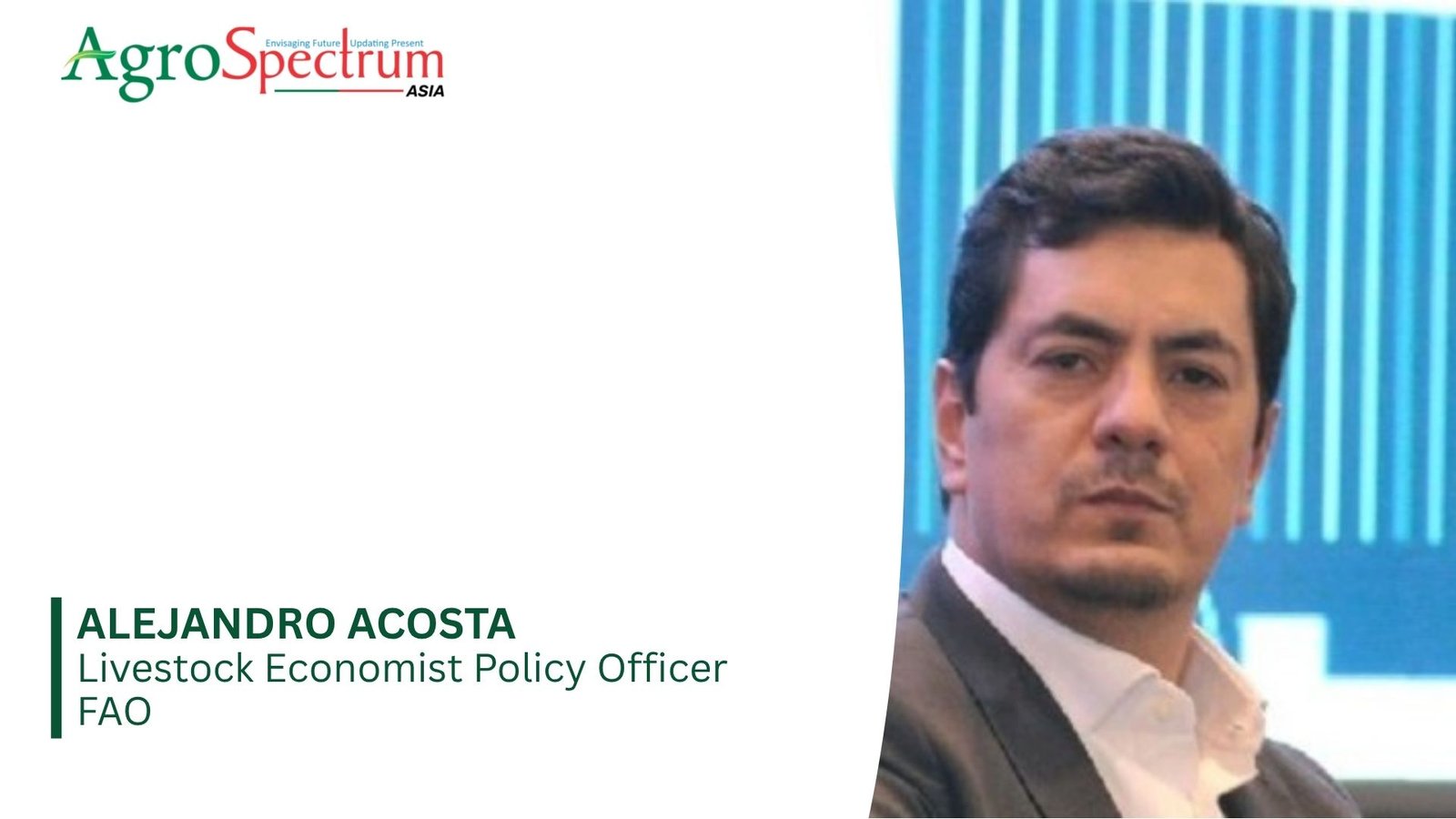
In an exclusive interview with AgroSpectrum, Alejandro Acosta, Livestock Economist and Policy Officer, FAO, cautioned that the projected rise in livestock antimicrobial use by 2040 could accelerate antimicrobial resistance (AMR), undermining animal health, farm profitability, food security and public health. Acosta emphasized that while reducing antimicrobial use delivers significant long-term economic benefits, the transition carries short-term costs that require targeted policy support, incentives and investment. He argued that preserving antimicrobial effectiveness should be treated as a global public good, given that the benefits extend far beyond individual farms and national borders. The FAO’s latest analysis suggests that improving productivity through better veterinary services, vaccination, biosecurity and husbandry practices offers the most effective pathway to reducing antimicrobial dependence without compromising livestock production.
How does FAO’s latest assessment change the economic argument around antimicrobial use in livestock, particularly for policymakers balancing productivity and sustainability?
Previous studies often presented antimicrobial use (AMU) reduction as a win-win proposition, assuming that lower use would automatically translate into economic gains. Our assessment suggests the reality is more nuanced. While reducing AMU delivers substantial economic, animal health and public health benefits in the long run, the transition is not costless, and the short-term economics can be challenging.
In the early years, producers may face adjustment costs as they invest in improved biosecurity, vaccination, veterinary services and alternative disease prevention strategies. As a result, the immediate cost of action can be higher than the cost of maintaining existing practices. However, over time, the economic consequences of rising antimicrobial resistance (AMR) become significantly greater. The key policy challenge is therefore not whether to act, but how to support farmers through the transition so productivity, profitability and sustainability can advance together.
With antimicrobial use in livestock projected to rise significantly by 2040, what are the biggest risks to food security, farm profitability and public health if current trends continue?
Under the business-as-usual scenario, the projected increase in antimicrobial use (AMU) is not driven by higher use intensity, but by the expansion of livestock biomass required to meet growing global demand for animal-source foods. In other words, if AMU intensity remains broadly unchanged and productivity gains are insufficient to offset demand growth, total antimicrobial use will rise mechanically as livestock production expands.
The main concern is that this trend could accelerate antimicrobial resistance (AMR). As resistance increases, treatments become less effective, animal diseases become harder to control, and producers face higher mortality rates, rising production costs and lower profitability. What may initially appear as a manageable production strategy can gradually undermine the economic efficiency of livestock systems.
The implications extend beyond individual farms. In the long term, higher AMR could reduce global livestock production compared with scenarios where resistance is better controlled, affecting the availability and affordability of animal-source foods. This has direct consequences for food security, particularly as global demand for meat, milk and eggs continues to grow.
From a public health perspective, the risks are equally significant. AMR is a One Health challenge that affects animals, humans and the environment simultaneously. If current trends continue, the long-term economic and societal costs of resistance could far outweigh the short-term benefits associated with continued reliance on antimicrobials, making preventive action increasingly important.
The report suggests that the long-term costs of antimicrobial resistance far outweigh the short-term productivity gains from antimicrobial growth promoters. What evidence supports this conclusion?
We first quantify the short-term productivity value of antimicrobial growth promoters (AGPs), and then compare it with the long-term economic losses associated with rising antimicrobial resistance (AMR). AGPs can provide measurable gains in growth performance and feed efficiency, which explains why they continue to be used in many livestock systems, particularly where disease pressure is high and access to alternatives remains limited.
However, our analysis shows that these short-term benefits are significantly outweighed by the long-term economic consequences of increasing resistance. By 2040, cumulative livestock production losses under a high-AMR scenario are projected to reach approximately $ 318 billion, compared with about $ 53 billion under a severe AGP phase-out scenario.
The key point is that while AGPs may deliver immediate productivity gains, AMR gradually erodes the effectiveness of antimicrobial treatments, making animal diseases harder and more expensive to control. Over time, this can lead to higher mortality, reduced productivity, increased production costs and lower farm profitability. The report therefore demonstrates that the economic risks of inaction are substantially greater than the costs associated with reducing reliance on growth-promoting antimicrobials and investing in preventive animal health measures.
Why does FAO believe antimicrobial effectiveness should be treated as a global public good, and what would that mean in practical policy terms?
The costs of reducing antimicrobial use (AMU) are often local and immediate, while the benefits of preserving antimicrobial effectiveness are global and long-term. This creates a misalignment of incentives, where farmers and countries bear the transition costs today, while the benefits are shared widely and materialize over time.
For example, producers may need to invest in biosecurity, vaccination, improved husbandry, veterinary services and other preventive measures to reduce antimicrobial dependence. These investments require resources upfront, while the benefits of slowing antimicrobial resistance extend far beyond individual farms or national borders.
This is why FAO considers antimicrobial effectiveness a global public good. Preserving it benefits animal health, food security, public health and the sustainability of agrifood systems worldwide. In practical policy terms, this means stewardship cannot rely solely on regulations or restrictions. It requires coordinated investments, economic incentives and transition support that help farmers adopt better practices without compromising productivity or profitability.
The report highlights the need for stronger veterinary services, improved surveillance and diagnostics, wider access to alternatives, sustainable financing mechanisms and market incentives that reward responsible antimicrobial use. Ultimately, preserving antimicrobial effectiveness requires collective action because the benefits are shared globally, while the costs of transition are often borne locally.
What kinds of investments and incentives are needed to help farmers transition away from routine antimicrobial use without compromising productivity?