
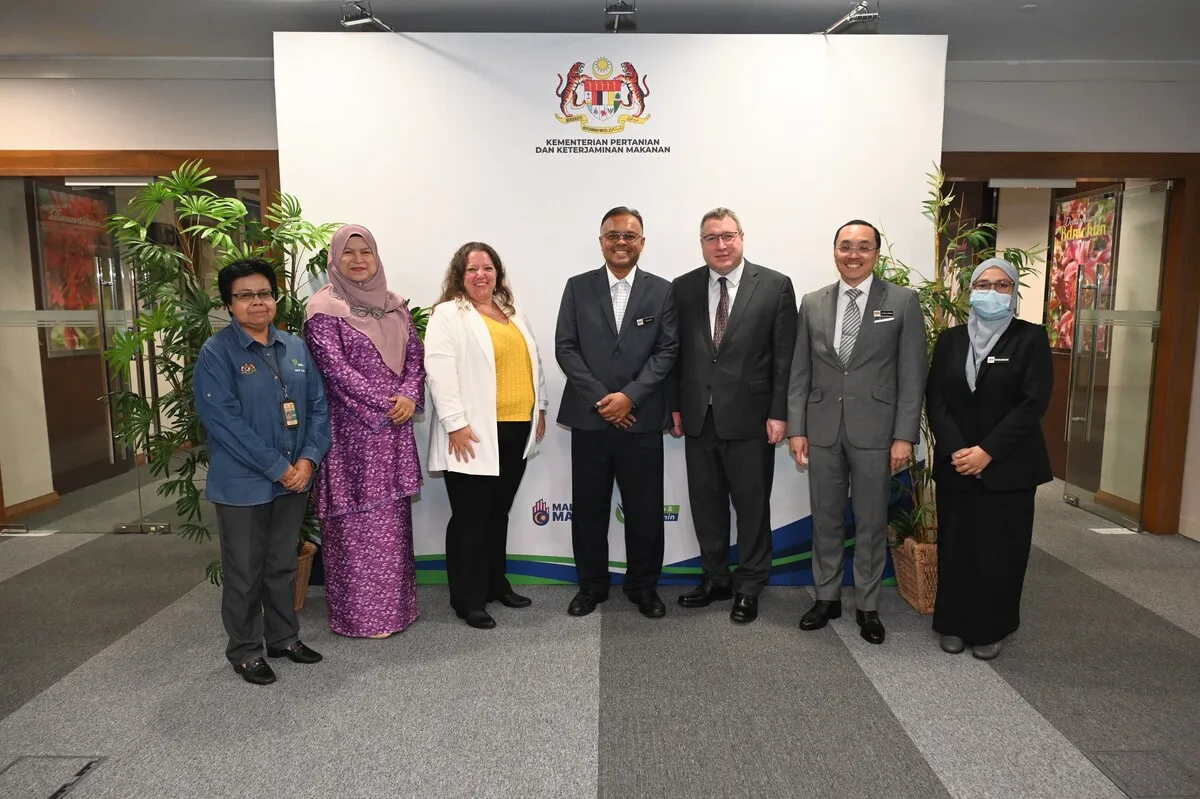
Strengthen bilateral cooperation in agriculture and food security
Malaysia will send a delegation to the United States to inspect and benchmark its food safety and agricultural control systems, a move linked to commitments under the Malaysia-US Agreement on Reciprocal Trade (ART).
The Ministry of Agriculture and Food Security (KPKM) said the planned working visit will involve officials from the ministry, the Department of Veterinary Services (DVS), and the Department of Agriculture (DOA), following a courtesy call by David Gamble, deputy chief of mission at the US Embassy to Malaysia, on KPKM secretary-general Isham Ishak at Wisma Tani last Monday.
The ministry said Gamble’s visit to its headquarters in Putrajaya was part of efforts to strengthen bilateral cooperation in agriculture and food security.
“In this regard, KPKM, in collaboration with DVS and DOA, is expected to undertake a working visit to the US in the near future for the purpose of benchmarking that country’s food safety and agricultural health control systems, in line with the commitments outlined under the ART,” the ministry said in a statement last Monday.
KPKM said both sides shared views on enhancing agricultural trade cooperation “aimed at strengthening trade performance and increasing mutual confidence in the food and agricultural regulatory systems of both countries”.
The ministry also said Malaysia had expressed interest in exploring cooperation in areas including grain corn production for animal feed, agricultural mechanisation and automation through modern technologies, and the development of round cabbage cultivation in lowland areas.
Malaysia also welcomed investment from the US in agriculture and food security, including in Internet of Things (IoT) technology and improvements to seed varieties.
The US Embassy in Kuala Lumpur, described the meeting as reaffirming America’s position as a global leader in agricultural innovation and food safety.
“We are proud to see the continued recognition of the US as a global leader in agricultural innovation and excellence,” the embassy said, adding that KPKM had “reaffirmed its commitment to expanding its strategic partnership with the US”.
The embassy said the collaboration highlighted the US “as a gold standard in several key areas”, including agri-technology leadership through IoT integration, advanced mechanisation and automation, expansion in corn production for animal feed, and climate-resilient seed varieties.
It also said that a Malaysian delegation will soon visit the US to benchmark food health and agricultural control systems, describing the visit as “a testament to the rigor and reliability of American food safety protocols”.
The US embassy noted that bilateral agricultural trade had exceeded RM14.68 billion as of September 2025, and said the US remained “a vital partner in driving the national agrofood transformation and modernisation agenda”.
The planned visit comes amid ongoing debate over the implications of ART for Malaysia’s food safety, biosecurity, and halal oversight frameworks.
Under ART, Malaysia has committed to recognising US sanitary and phytosanitary systems and certification processes for meat, poultry, dairy, and other agricultural products, reducing the need for Malaysia-specific facility approvals.
Critics have raised concerns that recognising foreign regulatory systems could limit Malaysia’s ability to independently impose safeguards or swiftly restrict imports during disease outbreaks, particularly as ART also requires Malaysia to shift from nationwide import bans to zone-based disease control measures aligned with international standards.
Questions have also been raised over halal governance following previous industry admissions from US poultry groups that not all US producers may be able to meet Malaysia’s halal requirements. ART obliges Malaysia to accept halal certificates issued by US certifiers recognised by the Department of Islamic Development Malaysia (Jakim).
KPKM’s January 5 statement did not provide details on the scope, timing, or outcomes expected from the planned US visit, nor whether findings from the benchmarking exercise would be made public.
The ministry also did not state whether the Ministry of Health (MOH) would be involved in the inspection, despite food safety being a public health issue.
