
(VAN) Viet Nam FST-WG shared 2025 activities and reaffirmed the commitment to strengthening coordination, resources for agri-food systems transformation
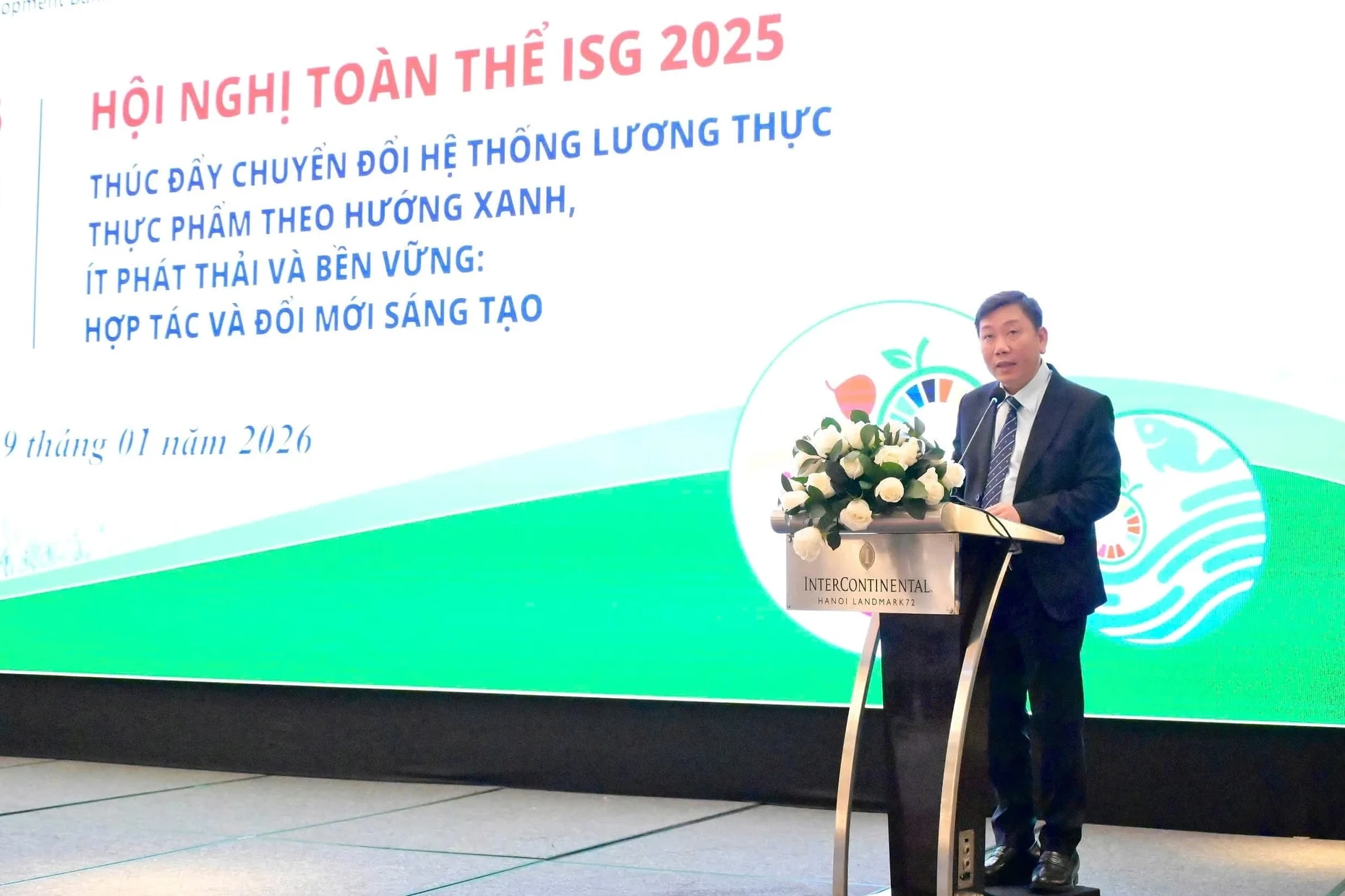
On January 9, the Ministry of Agriculture and Environment, in coordination with the Food and Agriculture Organization of the United Nations ( FAO ) in Vietnam and the Asian Development Bank (ADB), organized the ISG Plenary Meeting Advancing the food systems transformation toward green, low-emission, and sustainability: Partnership and innovation.
In his opening remarks, Nguyen Do Anh Tuan, Director General of the International Cooperation Department (MAE), emphasized that the food systems transformation has gradually been embraced and is becoming increasingly widespread from the perspective of the agri-food ecosystem.
According to him, 2025 has affirmed the prominent role of ecological agriculture in adapting to and mitigating the impacts of climate change, as reflected in Vietnam’s NDC 3.0, the One Million Hectares Project, and the compilation of local models nationally. In addition, efforts are being stepped up to promote public – private partnerships and mobilize financial resources for ecological agriculture.
Vietnam has been revising and improving its policies and legal frameworks to align with new requirements of the green transition and low-emission production. Successful ecological models at the local level build on many outcomes achieved through cooperation with international organizations and will require stronger connectivity, sharing, consolidation, and transfer of these results into national-scale models, he noted.
Director General Nguyen Do Anh Tuan expressed his hope that international partners will continue to engage and coordinate in implementing green, low-emission initiatives, such as the Low-Emission Crop Production Project and other sectoral programs of the Ministry.
During the 2021-2025 period, Vietnam implemented more than 200 ecological agriculture models with support from international organizations such as FAO and UNDP. Mr. Tuan noted that in 2026, the nutrition and consumer behavior cluster will be a key focus, aiming to strengthen food safety assurance, traceability, and sustainable consumption.
According to updates from Associate Professor Dr. Tran Minh Tien, Deputy Director of the Viet Nam Academy of Agricultural Sciences (VAAS), in 2025 the Food Systems Transformation Partnership Group focuses on surveying and assessing the implementation of the National Action Plan on Food Systems Transformation (FST-NAP), reviewing task assignments in the new context, and developing a draft detailed implementation plan (FST-PIP).
Looking ahead, Associate Professor Dr. Tran Minh Tien said priorities will include effectively mobilizing financial resources and technical assistance for the Ministry’s flagship programs and projects, aligned with green growth objectives, food safety assurance, disaster risk prevention and mitigation, and the promotion of science and technology application and digital transformation; while continuing to implement solutions to reduce food loss and waste across the entire value chain.
Representing the international organizations, Mr. Nguyen Song Ha, Assistant FAO Representative in Viet Nam, affirmed that strategies and action plans for food system transformation need to be mainstreamed into flagship programs and integrated regional planning, ensuring harmonization of regulations and standards.
FAO emphasized the role of green finance, agricultural insurance, and carbon markets in the new phase, while encouraging the collection, sharing, and scaling up of proven ecology and nature-based agricultural models in Vietnam, such as flood-season fish farming, rice – lotus systems, rice – shrimp systems, mangrove–shrimp farming, and agroforestry.
ISG 2025 meeting also shared and introduced outcomes from COP30 and recent policy developments related to the transformation of agri-food systems. Proposed initiatives and potential areas of cooperation on low-emission and sustainable production, responsible and sustainable consumption, ISG governance and operational orientation, as well as cooperation and innovation to advance green, low-emission food system transformation.
The ISG Plenary Meeting serves as a high-level forum between the Ministry of Agriculture and Environment and its partners to share research findings, showcase model implementation, and align resource support with national priorities in agriculture and rural development, thereby advancing the transformation of food systems toward greater transparency, accountability, and sustainability.
At the conference, FAO also launched the International Year of Women Farmer 2026, highlighting the vital role of women in building inclusive and sustainable food systems.
