
2026 Innovation Challenge_ Five Countries: 11 Innovators_Singapore on 12–13 May
Future Fit Asia, a decade-long advocate for understanding the interconnected solutions to Food, Health, and Planet challenges, proudly unveils the 11 startups chosen for its 2026 Innovation Challenge. This milestone event, part of the 10th edition of their flagship conference, will take center stage at the Goodwood Park Hotel in Singapore on 12–13 May, showcasing the next wave of transformative innovation.
This year’s conference is structured around three distinct thematic sessions that share a unifying thread, emphasizing the interconnected nature of the solutions Future Fit Asia has championed over the past decade.
- Toxicity is a subject often overlooked, underestimated or quietly avoided. We confront it directly, examining its impact across food systems, environments, and health.
- Planetary Health asks a broader question: how do we protect and restore the natural systems that sustain all life, while supporting biodiversity and enabling healthy aging through our food and agricultural systems?
- Food, Nutrition and Wellness challenge the long-held assumption that better health must come at a high cost, reframing the conversation around healthy longevity and exploring innovations beyond GLP-1—from gut health and metabolic science to data-driven approaches reshaping food and retail.
Early and Growth-Stage Startups from Five Countries: 11 Innovators
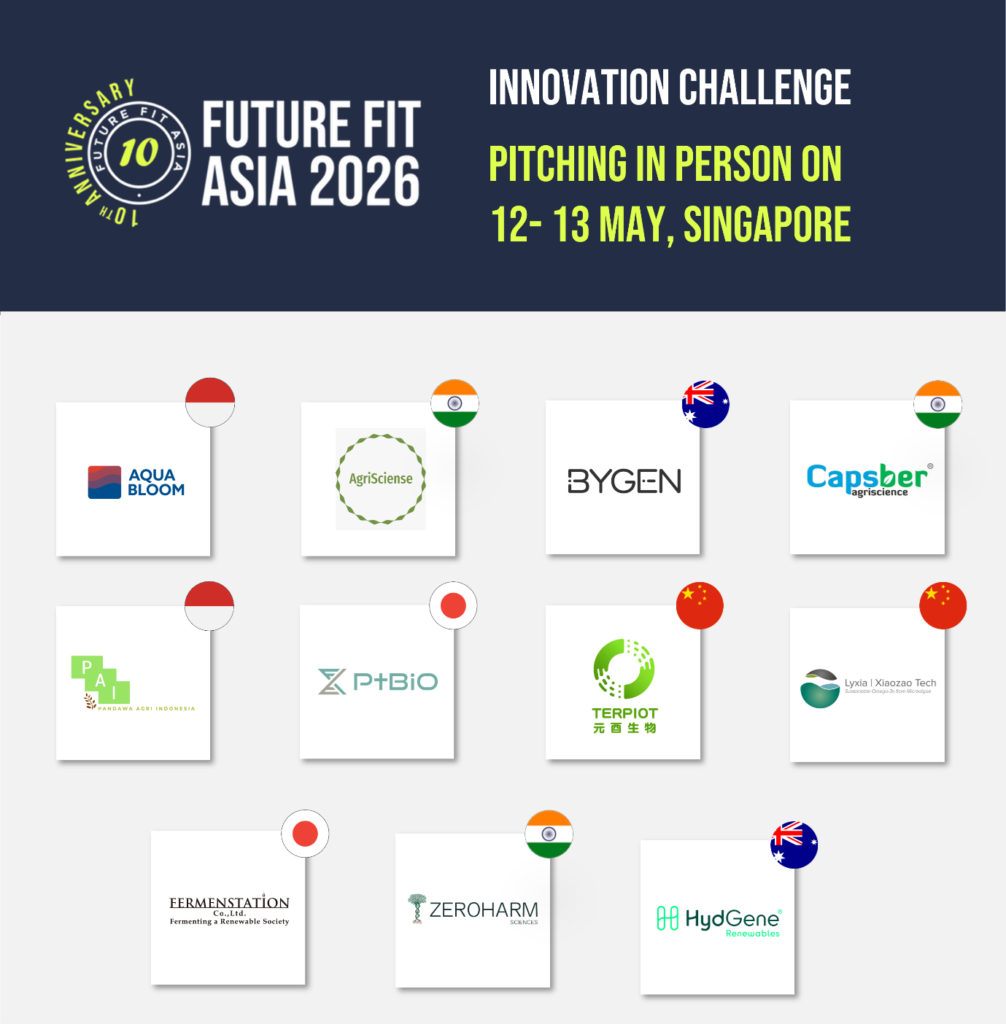
For the first time, Future Fit Asia is welcoming both early and growth-stage startups to its Innovation Challenge, featuring 11 handpicked innovators spanning fields like Ayurveda and AI. These startups will pitch in person on 12-13 May 2026 in Singapore, marking a milestone in the organization’s decade-long mission to address interconnected Food, Health, and Planet challenges.
AgriSciense (India) is redefining agroforestry through real-time farm-level sensing and analytics that enable early, precise pest intervention, reducing ecological and carbon footprints while preserving cost neutrality for growers.
Aquabloom (Indonesia) converts Indonesian tropical seaweed into high-performance biostimulants and feed additives, delivering 20-30% yield improvements across 27 crops and 46 field trials, with 30x ROI for farmers per growing cycle.
Bygen (Australia) is commercialising its novel Low-Temperature Activation (LTA) technology, producing activated carbon at 50% lower cost and with 20 times fewer carbon emissions than conventional methods, helping clean air, water, and soil.
Capsber Agriscience (India) is an ag-biotech company developing microbial and bioactive technologies to detoxify agriculture and reduce dependence on chemical herbicides. Its biological weedicide platform selectively suppresses invasive weeds while preserving soil health and crop productivity.
Fermenstation (Japan) develops high-functionality ingredients from underutilised biomass using data-driven, multi-microbe fermentation, building circular, bio-based supply chains for the future of food.
HydGene Renewables (Australia) uses a biological catalyst to convert agricultural residues and waste into green hydrogen and locally-produced nitrogen fertiliser at lower cost, offering a resilient alternative to volatile global fertiliser supply chains. Its technology is proven at scale and backed by the Australian Government.
Pandawa Agri Indonesia (Indonesia) develops science-based agricultural solutions that reduce pesticide use by up to 50% while maintaining crop productivity, enabling plantations and smallholders across Southeast Asia to transition toward lower-toxicity and lower-emission farming systems.
PtBio Inc. (Japan) integrates proprietary genome editing with AI-driven data analysis to develop breakthrough food solutions including allergen-reduced eggs, helping shift the global food system toward a more inclusive “Food for All” society.
Terpiot Guangzhou Biotechnology (China) leverages AI-driven synthetic biology to engineer microbial cell factories that replace polluting synthesis and land-intensive plant extraction, delivering bio-alternatives across personal care, food ingredients, and non-toxic pest and vector control.
Xiaozao Tech (China) focuses on Nannochloropsis microalgae cultivation and high-value active ingredients for food, supplements, and personal care, offering sustainable, non-animal sourced alternatives across health and nutrition applications.
Zeroharm Sciences (India) develops 100% plant-based nutraceuticals using advanced nano-formulation technology, combining principles of Ayurveda with modern science to deliver targeted health solutions across immunity, gut health, and women’s wellness. The company serves over 800,000 customers across India, the US, UK, and UAE.
