
New early-season forecasts point to likely declining global cereal harvests and trade in the year ahead
The benchmark measure for world food commodity prices remained broadly stable in May, as declines in vegetable oil quotations offset increases in those for cereals and sugar, according to new data released Friday by the Food and Agriculture Organization of the United Nations (FAO).
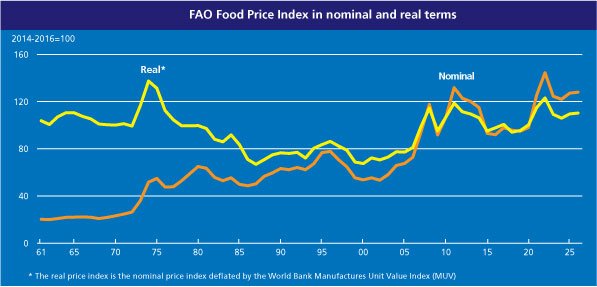
The FAO Food Price Index, which tracks monthly changes in the international prices of a basket of globally-traded food commodities, averaged 130.8 points in May 2026, down 0.2 percent from its revised April level and 2.9 percent higher than its year-earlier level.
“While global food commodity markets have remained broadly resilient, rising cereal prices underscore vulnerability to weather-related risks and disruptions in energy and input markets. Continued uncertainty affecting key trade routes, including the Strait of Hormuz, could reduce fertilizer use and place additional pressure on food prices, highlighting the need for coordinated international action,” said Boubaker Ben-Belhassen, Director of FAO’s Markets and Trade division.
The FAO Cereal Price Index increased by 2.6 percent from April and was nearly 5.0 percent higher than a year ago, reflecting higher prices across all major cereals amid higher fuel and fertilizer costs globally and weather-related pressures. World wheat prices rose 3.4 percent on the month – and 7.8 percent from their year-earlier level – supported by smaller expected harvests in major exporters, including the United States of America, where winter wheat crop conditions are among the least favourable in decades. U.S. Hard Red Winter wheat prices in May 2026 were 28 percent higher than in May 2025. Maize prices rose 1.9 percent – 3.9 percent annualized – on the back of stronger import demand in key markets, tighter availability in Brazil and the United States and firmer energy prices that boosted ethanol-related demand. The FAO All-Rice Price Index increased by 2.7 percent from the previous month as weather concerns and higher crude oil and derived product prices underpinned quotations in some leading Asian exporting countries.
The FAO Vegetable Oil Price Index, by contrast, declined by 4.6 percent from April, its first monthly decline in 2026. International palm oil prices declined due to expectations of weaker global import demand and uncertainty in crude oil markets, while world soyoil price trends were mixed, with seasonal increases in exportable supplies pulling prices down in South America even as firm biofuel demand supported values in North America. Rapeseed and sunflower oil prices rose on tight supply conditions.
The FAO Meat Price Index inched up 0.1 percent. World bovine meat prices rose on the back of robust import demand, particularly from China and the United States of America, while pig meat prices declined, mainly due to lower prices in the European Union amid abundant supplies and subdued import demand.
The FAO Dairy Price Index declined by 0.5 percent from the previous month, led down by international butter prices. Cheese prices were mostly stable while skim milk powder prices increased. Whole milk powder prices showed mixed developments.
The FAO Sugar Price Index rose by 7.5 percent in May, pushed up by data indicating a lower share of Brazil’s sugarcane output being allocated to sugar production, raising expectations of greater diversion to ethanol, as well as concerns that El Niño conditions could adversely affect production in India and Thailand in the year ahead.
World cereal output and trade projected to decline in year ahead
World cereal production in the 2026/27 season is expected to drop by 2 percent year on year to 2 982 million tonnes, led by declining wheat harvests, according to FAO’s latest Cereal Supply and Demand Brief, also released Friday.
The expected decline follows a 6.1 percent increase in 2025/26 to a record 3 043 million tonnes, with the marketing season coming to an end. This robust growth led to an estimated 9.5 percent increase in global cereals stocks.
World cereal utilization is forecast to increase by 0.6 percent in 2026/2027, slowing down from the 2.7 percent pace recorded in the previous season. Based on current forecasts, world cereal stocks are predicted to contract slightly, by 0.3 percent, due mostly to lower anticipated rice inventories, leaving the global cereal stock-to-use ratio, at 31.7 percent, close to its earlier level.
After expanding by 4.8 percent in 2025/26, global cereal trade is predicted to decline by 0.3 percent to 507.2 million tonnes in the year ahead, as expected lower wheat and barley traded volumes more than offset foreseen increases in maize and rice shipments.
For a more detailed analysis of global cereal markets, see the forthcoming issue of Food Outlook, which will be released on 18 June 2026.
The Agricultural Market Information System (AMIS), hosted by FAO, also published its monthly Market Monitor on Friday. In addition to the regular market updates, the report offers insights into how the global bulk freight landscape is being reshaped by the tensions in the Strait of Hormuz and reviews how some countries are responding to higher energy and fertilizer costs.
