
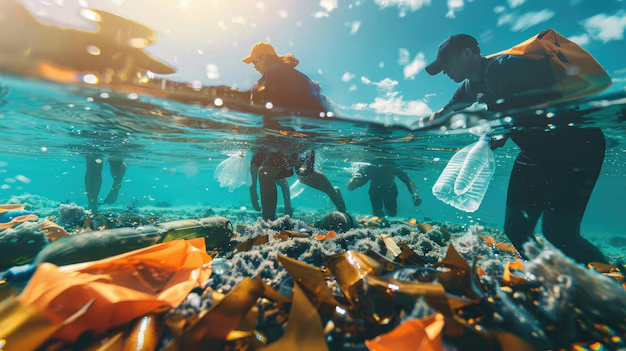
Partnership prioritizes legal frameworks, technology transfer, and integrated data systems to protect marine ecosystems
Viet Nam is stepping up its collaboration with Germany’s development agency GIZ to address marine plastic pollution and accelerate the transition toward a sustainable blue economy, signaling a more integrated approach to ocean governance and economic development. The renewed partnership, outlined during high-level discussions between the Viet Nam Administration of Seas and Islands (VASI) and GIZ, sets priorities for 2026 and a longer-term framework through 2030.
At the center of the cooperation is a dual focus on strengthening regulatory systems and deploying practical, scalable solutions to reduce marine plastic waste. Viet Nam is currently refining its legal architecture governing marine and island resources, including revisions to the Law on Marine and Island Resources and Environment, expected to be submitted in October 2026. The process also includes a review of Resolution 36-NQ/TW, which will inform a new long-term national marine strategy.
Building on previous collaboration, both sides have identified key priority areas for the next phase, including institutional strengthening, improved marine resource management, and the development of integrated data systems to support evidence-based policymaking. The partnership also aims to expand technology transfer and mobilize financial resources to support innovation in ocean sustainability.
A cornerstone of the cooperation is the “Reduce, Reuse, Recycle to Protect the Marine Environment and Coral Reefs” (3RproMar) initiative, which has completed its first phase and is undergoing final evaluation. The program has played a critical role in piloting solutions to reduce marine plastic waste across the region, including Viet Nam, while promoting circular economy practices.
The upcoming second phase of 3RproMar will place greater emphasis on implementation, linking plastic waste reduction strategies with broader economic models that prioritize resource efficiency and sustainability. The initiative is expected to contribute to the protection of marine ecosystems while supporting the growth of industries aligned with the blue economy, such as sustainable fisheries, eco-tourism, and marine-based renewable resources.
Beyond environmental outcomes, the partnership is positioned to enhance Viet Nam’s regional influence, particularly within ASEAN frameworks focused on sustainable ocean governance. Technical assistance and capacity-building efforts planned for the 2026–2030 period will support the country’s ability to manage marine resources more effectively while aligning with international best practices.
As global attention intensifies on ocean health and plastic pollution, the Viet Nam–GIZ collaboration reflects a broader shift toward integrated solutions that balance conservation with economic development. By combining policy reform, technological innovation, and regional cooperation, the initiative aims to position Viet Nam as a key player in shaping the future of sustainable maritime economies in Asia-Pacific.
