
Circularity offers airlines a low-cost path to mandated fuel volumes and a new revenue stream for farmers
Circularity Fuels announced it has completed the world’s first end-to-end conversion of raw agricultural biogas into sustainable aviation fuel (SAF).
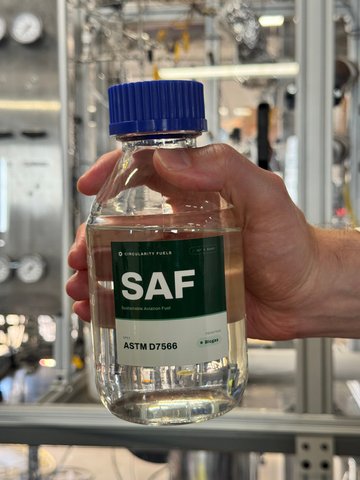
Over a six-month pilot run on biogas drawn straight from a California dairy farm’s manure digester, Circularity produced drop-in jet fuel meeting ASTM D7566 Annex A1 specifications. The pilot puts commercial SAF within reach at <$100,000 per barrel-per-day of installed capacity at commercial scale, about one-fifth the capital cost of SAF plants currently under construction in Europe. The reduction in plant cost will make Circularity’s biogas-derived SAF cost-competitive with fossil jet fuel.
Jet fuel supply has come under growing pressure. International geopolitics has destabilised crude oil markets, and prices for airlines and fliers keep climbing. SAF offers a domestically produced alternative, but today’s global SAF production still meets less than 1 per cent of demand. SAF production today is dominated by used cooking oil, which suffers from limited scale and doesn’t mitigate energy security risks, given that the majority of used cooking oil is imported from China. Advanced SAF proponents have touted e-Fuels as the solution, but rising power prices make power-to-liquid approaches economically challenging.
Agricultural biogas is one of the lowest-cost feedstocks available for SAF because almost all of it goes to waste. The world’s waste biogas resource is also vast, large enough to supply the entire global jet fuel market. The pilot host, a dairy of more than 5,000 head near Madera, California, currently vents nearly all of its biogas to the atmosphere despite sitting in the heart of the country’s largest dairy region. Circularity’s system lets operators like this one monetise that methane on-site, without the cost of removing carbon dioxide.
Over thousands of operating hours, Circularity’s two-reactor system ran on raw biogas (about 65 per cent methane and 35 per cent CO₂) drawn straight from the dairy’s digester and produced finished jet fuel. The stack pairs the electrified Ouro bi-reforming reactor with the compact Aion Fischer-Tropsch synthesis reactor. Both are modular, low-cost, skid-mounted reactors, so the system is sized for the small, distributed scales at which biogas is actually produced.
