
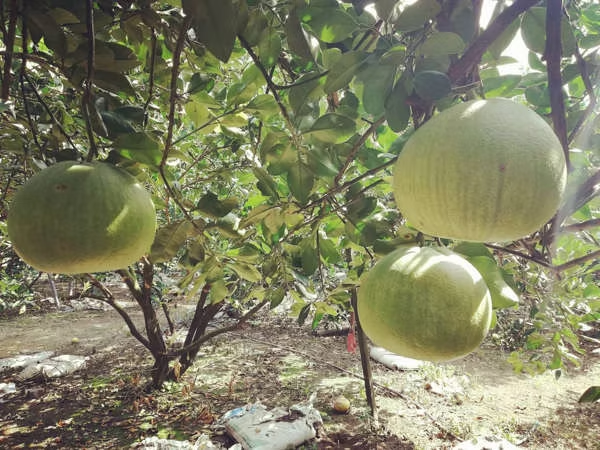
From planting-area codes to GlobalGAP compliance, the company is helping transform Vinh Long’s green-skinned pomelo sector into a globally competitive export ecosystem
As international markets raise the bar on food safety, traceability and production transparency, Vietnam’s pomelo industry is undergoing a fundamental recalibration. Leading that transition is Chanh Thu Fruit Import-Export Group, which is intensifying its collaboration with cooperatives and growers in Vinh Long to build export-oriented pomelo production systems capable of meeting the increasingly exacting standards of global trade.
The initiative underscores a broader shift taking place across Vietnam’s fruit sector. Market access is no longer determined solely by production volumes or product quality; it increasingly depends on a grower’s ability to document every stage of cultivation, maintain rigorous compliance records and operate within traceable supply chains that satisfy importing nations.
For Vinh Long, one of the Mekong Delta’s most important pomelo-producing provinces, the opportunity is significant. Home to more than 18,500 hectares of pomelo cultivation, including nearly 13,800 hectares of the highly prized green-skinned variety, the province possesses the scale to become a major export hub. Yet unlocking that potential requires a transition from traditional cultivation models to professionally managed production ecosystems aligned with international protocols.
To accelerate this transition, Chanh Thu has partnered with the United Nations Industrial Development Organization (UNIDO) and local agricultural stakeholders to strengthen export readiness among growers. Through a series of technical programmes and field demonstrations, farmers are being introduced to modern cultivation practices, pest-management protocols, residue-control measures and traceability systems that have become indispensable for accessing premium overseas markets.
The focus extends beyond agronomy. Equally important is the establishment and maintenance of planting-area codes and packing-house codes, which have emerged as the cornerstone of official agricultural exports. These systems enable importing countries to verify product origins, monitor compliance and ensure supply-chain integrity—requirements that are increasingly non-negotiable in global fruit trade.
What was once viewed as administrative complexity is now becoming an economic necessity. Export markets, particularly China, are moving decisively toward protocol-driven trade, requiring producers and exporters to demonstrate compliance across the entire value chain rather than merely at the point of shipment.
For growers, the implications are profound. Practices such as cultivation record-keeping, fruit bagging, integrated pest management and regulated pesticide application are no longer optional enhancements but prerequisites for market participation. Farmers who successfully adapt stand to benefit from stronger price realization, more stable market access and reduced exposure to trading disruptions.
The transformation is also being reinforced through scientific support. Agricultural researchers and technical specialists are working closely with cooperatives to improve fruit quality, enhance orchard management and ensure compliance with export-market requirements. Field-level demonstrations on disease control, safe cultivation practices and fruit-protection techniques are helping translate technical knowledge into practical outcomes.
The emphasis on traceability comes at a pivotal moment for Vietnam’s horticultural exports. As importing countries tighten food-safety regulations and demand greater transparency from suppliers, exporters are increasingly expected to provide comprehensive documentation covering cultivation practices, production inputs and post-harvest handling procedures.
Chanh Thu’s investment in export infrastructure reflects this new reality. The company has developed an integrated network of production regions and certified packing facilities capable of supplying fruit to some of the world’s most demanding markets, including the United States, the European Union, Japan, Australia, South Korea and China. Supported by internationally recognised food-safety certifications, the infrastructure provides a platform through which growers can participate more effectively in global value chains.
The company’s strategy reflects a growing recognition that the future of agricultural competitiveness will depend less on expanding acreage and more on strengthening quality systems, supply-chain governance and market compliance capabilities.
At the farm level, early adopters are already demonstrating the commercial advantages of this approach. Producers operating under international standards such as GlobalGAP and participating in coded growing regions are reporting greater confidence in market access and stronger resilience against the volatility that often characterises informal trading channels.
The evolution of Vietnam’s pomelo industry therefore represents more than a story of export expansion. It reflects the emergence of a new agricultural paradigm in which data, traceability, certification and collaboration carry as much importance as cultivation itself.
As global consumers and regulators continue to demand greater accountability from food supply chains, the ability to connect orchard-level practices with international market expectations will increasingly determine which agricultural sectors thrive. Through its cooperative partnerships and export-focused production model, Chanh Thu is positioning Vietnam’s green-skinned pomelo industry to compete not merely on volume, but on credibility, consistency and compliance—attributes that are rapidly becoming the true currency of global agricultural trade.
