
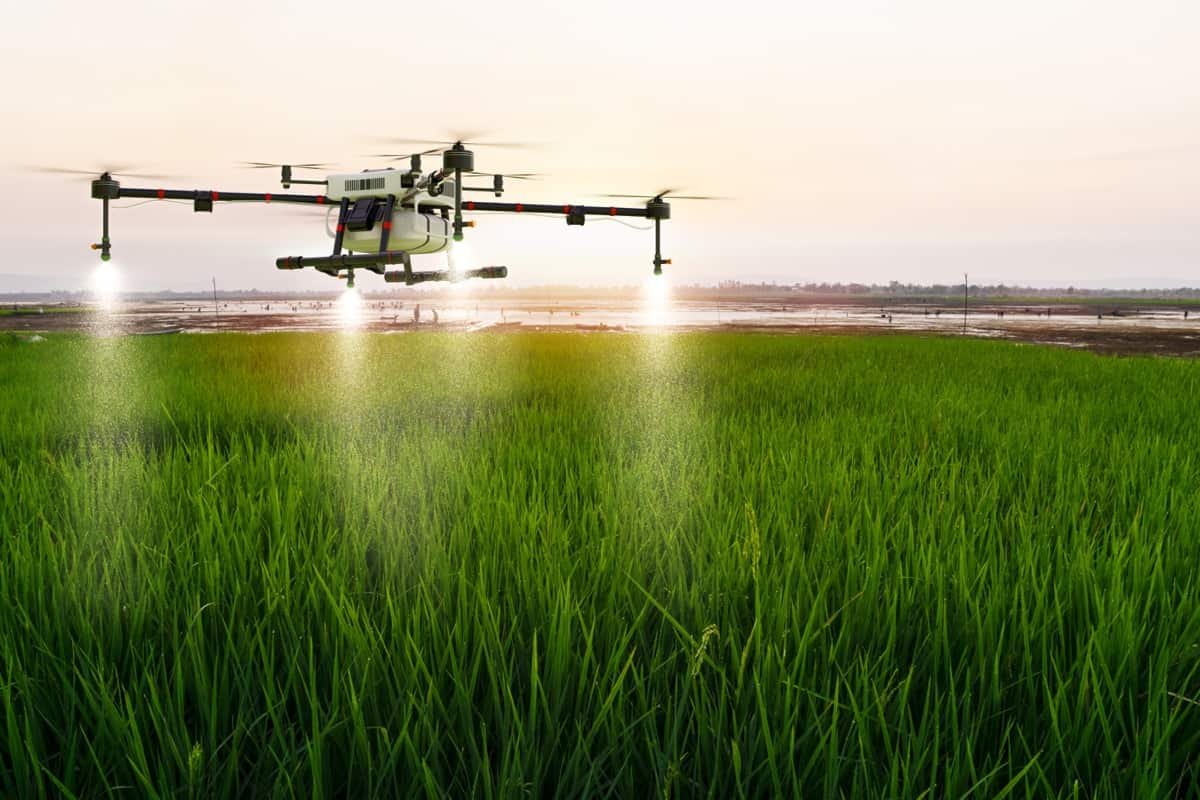
As climate volatility, water constraints and rising production costs intensify pressure on padi cultivation, Bernas is expanding smart farming technologies to improve productivity, optimise resource use and strengthen national food security
Malaysia’s rice sector is entering a new phase of technological transformation as Bernas expands the deployment of drones, satellite monitoring systems, smart soil sensors and artificial intelligence-driven agronomy platforms in an effort to enhance padi productivity and reinforce the country’s long-term food security architecture.
The initiative reflects a broader shift taking place across global agriculture, where the ability to anticipate challenges before they become visible is increasingly emerging as a decisive competitive advantage. In modern farming systems, the difference between a productive harvest and a disappointing season often lies not in the severity of a problem, but in how early it is identified and addressed.
For rice cultivation, where margins are often narrow and productivity gains hard-earned, the capacity to detect crop stress, nutrient imbalances, soil degradation or water management issues at an early stage can have significant implications for yields, farm profitability and national food availability.
Traditionally, many agronomic challenges have only been identified once visible symptoms begin to appear in the field. By that stage, crop damage is frequently underway, limiting intervention options and increasing the likelihood of yield losses. Precision agriculture technologies are now changing that equation by enabling continuous monitoring of crop and soil conditions with unprecedented accuracy.
At the centre of Bernas’ strategy is the growing adoption of multispectral imaging technologies delivered through drones and satellite platforms. These systems provide a detailed view of crop performance, enabling the identification of subtle variations in plant health that are often imperceptible to the human eye. By detecting early indicators of nutrient deficiencies, moisture stress, disease pressure and field variability, farmers are able to undertake corrective action before production losses escalate.
Complementing aerial surveillance technologies are advanced soil monitoring systems that provide real-time insights into critical parameters such as nutrient availability, soil fertility status and organic matter content. The resulting data allows fertiliser application and field management decisions to be guided by actual agronomic requirements rather than predetermined schedules or generalised assumptions.
The outcome is a more precise allocation of resources, reduced input wastage and improved operational efficiency at the farm level—an increasingly important consideration as production costs continue to rise across agricultural systems worldwide.
The urgency of such interventions is underscored by the mounting challenges confronting Malaysia’s rice industry. Climate variability, changing rainfall patterns, water management constraints and escalating input expenses are placing unprecedented pressure on domestic padi production.
Recent developments in Kedah, Malaysia’s most important rice-producing region, illustrate the scale of the challenge. Delays in planting activity linked to operational costs and water availability concerns raised questions about potential impacts on the nation’s rice self-sufficiency objectives, highlighting the vulnerability of conventional production systems to environmental and economic disruptions.
Although planting activities have since resumed across much of the affected area, the episode reinforced a broader reality: future agricultural resilience will depend not only on expanding cultivation but on producing more efficiently within increasingly constrained resource environments.
Against this backdrop, Bernas is positioning technology as a strategic enabler of productivity rather than merely a supplementary tool. Through its SMART Sawah Berskala Besar programme, the organisation is advancing a model of agriculture in which data, predictive intelligence and precision management become integral components of farm decision-making.
The transformation extends beyond hardware deployment. Increasingly, digital agriculture is creating opportunities to analyse crop performance trends, evaluate input effectiveness, forecast production outcomes and optimise management strategies using advanced data analytics and artificial intelligence.
By integrating agronomic expertise with digital intelligence, Bernas aims to provide farmers with more timely, localised and actionable recommendations, enabling them to respond more effectively to changing field conditions and emerging risks.
The significance of this evolution extends beyond Malaysia’s borders. Around the world, food systems are confronting an increasingly complex convergence of challenges, including climate-related disruptions, supply-chain vulnerabilities, resource scarcity and geopolitical uncertainties that have amplified concerns over food security and agricultural sustainability.
In such an environment, productivity gains are no longer solely a function of expanding acreage or increasing input application. They increasingly depend on the ability to maximise efficiency, minimise avoidable losses and make informed decisions supported by real-time information.
The growing adoption of precision agriculture technologies reflects a recognition that the future of farming will be defined as much by intelligence and data as by land and labour. Farmers who can access predictive insights and manage variability more effectively are likely to be better positioned to navigate uncertainty while maintaining productivity.
For Malaysia’s rice sector, the implications are particularly significant. As the country seeks to strengthen domestic food production capabilities while reducing vulnerability to external shocks, investments in digital agriculture offer a pathway toward greater resilience and self-reliance.
Bernas’ expanding technology-driven approach signals a broader reimagining of how padi farming can evolve in an era of climatic unpredictability and resource constraints. By combining drone surveillance, satellite imagery, soil intelligence and AI-powered agronomy, the company is contributing to the development of a more adaptive and data-centric agricultural ecosystem.
Ultimately, the challenge facing modern agriculture is not simply to produce more food, but to do so with greater precision, efficiency and sustainability. As digital technologies become increasingly embedded in farming systems, the future of food security may depend less on the scale of cultivation and more on the quality of decisions made long before challenges become visible in the field.
— Nur Firdaus Yusof , Head Agronomist at Bernas Farm Management
