
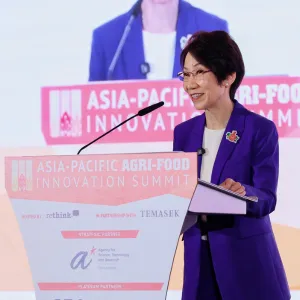
Singapore International Agri-Food Week: Asia-Pacific Agri-Food Innovation Summit
Singapore has always prioritized food security, and since 2019, we have made significant strides in strengthening our local production. Locally produced hen shell eggs and beansprouts now account for over 30% and 50% of our consumption, respectively.
Singapore’s farms have become more productive, with vegetable, seafood, and egg production increasing by 10%, 17%, and 50%, respectively, from 2019 to 2024. However, our agri-food sector has faced challenges such as supply chain disruptions, rising costs, and a tougher financing environment. Despite these hurdles, some farms have thrived by embracing innovation and technology.
Singapore has also explored alternative proteins, but scaling up has been difficult due to high production costs and limited consumer acceptance globally. Reflecting on these experiences, we have refined our local production strategy to focus on what is feasible and efficient for land-scarce Singapore.
“While we initially aimed to produce 30% of our nutritional needs under the 30-by-30 strategy, we now target more realistic goals: by 2035, our farms will supply 20% of our fibre needs, including fresh vegetables, beansprouts, and mushrooms, and 30% of our protein needs, such as eggs and seafood. These targets align with the strengths of our farming ecosystem and its growth potential. To support our farms, we are taking steps to reduce their production costs. For instance, we are exploring a government-owned, multi-tenanted facility that provides plug-and-play spaces, shared utilities, and controlled environments to lower start-up costs and enhance climate resilience. Additionally, through the Agri-Food Cluster Transformation (ACT) Fund, we have allocated over $40 million to 135 projects, enabling farms to adopt technologies like automated irrigation and climate-resilient systems. Our research efforts, backed by over $300 million under the Singapore Food Story R&D Programme, have led to innovations such as improved fish feeds, disease-resistant vaccines, and higher-yield crops” says Ms Grace Fu.
Strengthening the supply of farming inputs is another priority. The Singapore Food Agency (SFA) launched the National Broodstock Centre and the Hatchery Development and Recognition Programme, which have already recognized four local hatcheries. We plan to expand this programme to include red snapper and collaborate with the industry to enhance the supply of quality eggs and post-larvae for grouper and shrimp. These efforts will improve production yields and disease resistance. To ensure the commercial viability of our growers, we are enhancing demand offtake.
The Singapore Agro-Food Enterprises Federation (SAFEF) has successfully aggregated local produce, with brands like “SG Farmers’ Market” and “The Straits Fish” now available in major supermarkets. Sales of Xiao Bai Cai under the “SG Farmers’ Market” brand have increased sevenfold since its launch in May 2024. SAFEF is also expanding its offerings to include seafood like Asian seabass and shrimp and working with restaurants such as Joy of Fish and Coriander Leaf to feature local produce on their menus. Diversifying our import sources remains a critical pillar of our food security strategy.
Over the years, we have built strong trade networks, enabling us to import food from over 180 countries and regions. We facilitate connections between local importers and overseas suppliers through sourcing trips and accreditation of new sources. To ensure supply resilience, we streamline accreditation processes and explore regional arrangements to mitigate disruptions. For example, during Brazil’s bird flu outbreak in May 2024, we continued importing poultry from unaffected areas, avoiding supply disruptions and price fluctuations. These efforts reflect our commitment to ensuring food security through local production, import diversification, and collaboration with industry and consumers. Together, we will continue to strengthen Singapore’s food resilience for the future.
