
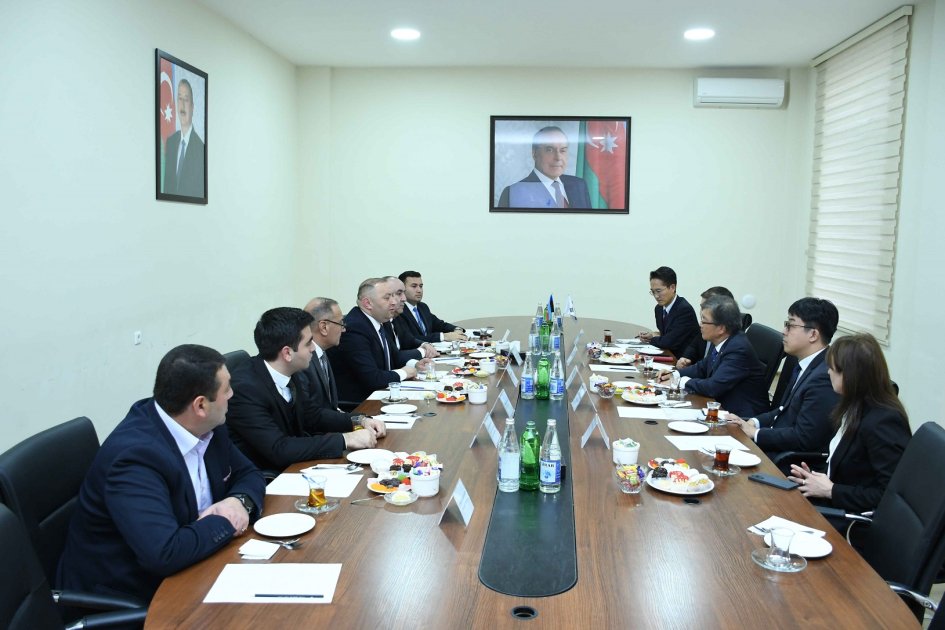
Explored opportunities for cooperation in the fields of agriculture, education, and innovation
Ambassador of the Republic of Korea Kang Kymgu visited the Azerbaijan State Agrarian University (ASAU). The meeting focused on the collaboration between the Government of Azerbaijan and the World Bank in agriculture and irrigation, particularly the preparation and implementation of the “Competitive, Resilient Agriculture and Irrigation Services” (CRAIS) project.
The rector of the university, Zafar Gurbanov, highlighted ASAU’s international cooperation, material and technical resources, and academic potential. He noted that the Republic of Korea has advanced technologies and innovative approaches in the agricultural sector, stressing the importance of establishing relations between universities in this field.

Ambassador Kang Kymgu praised the university’s progress in training agricultural specialists. He expressed readiness to implement joint projects, training programs, and student-teacher exchanges with Korean universities in the future.
The meeting also explored opportunities for cooperation in the fields of agriculture, education, and innovation. The parties emphasized the importance of experience exchange in agricultural education and scientific research. The discussion highlighted the project’s goal to enhance the productivity, sustainability, and competitiveness of Azerbaijan’s agricultural sector, with an emphasis on priority irrigation schemes.
Following the meeting, the guests viewed the university’s modern laboratories, the ASAU-TV Internet studio, open and closed fish farms, and greenhouses.
Azerbaijan’s First Deputy Minister underscored the government’s priorities, including modernizing agriculture, improving irrigation infrastructure, adopting climate-resilient technologies, and strengthening food security.
Holger Kray, the World Bank’s Regional Manager for Agriculture and Food in Europe and Central Asia, commended Azerbaijan’s agricultural progress and noted that the CRAIS project would bolster the sector’s sustainability, support economic activities, and create employment opportunities in rural areas. Both sides also discussed preparations for project implementation, expert involvement, and the acceleration of technical processes, among other mutual interests.
