
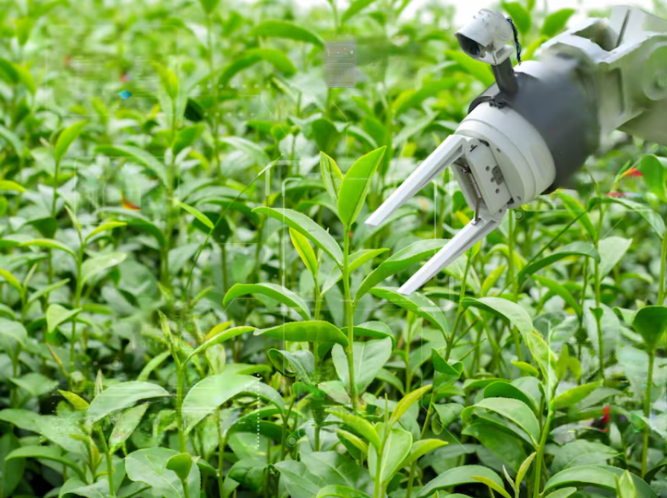
iTerra is developing a non-chemical alternative to herbicides
I-Pulse Co-Founder, Chairman, and CEO Robert Friedland, I-Pulse Co-Founder and Chief Technology Officer, Laurent Frescaline, and iTerra CEO, Romain Leray, are pleased to announce the launch of iTerra, an agricultural technology subsidiary dedicated to non-chemical weed control within I-Pulse, the world leader in pulsed power technologies.
“By controlling weeds with our pulsed electrical power, we will reduce reliance on poisonous chemicals that are being used in global agriculture. It maintains soil health so that the food can be organic and regenerative by protecting the water table.”
iTerra leverages I-Pulse’s proprietary high pulsed power technology to eliminate weeds at the root without harming crops, disrupting soil microbiology, or leaving chemical residues. Using AI-driven detection with accuracy rates of up to 95% in early trials, the system targets each weed individually with controlled, high power pulses lasting just five milliseconds. The treated weeds remain in the soil, where they naturally decompose, helping maintain soil health and supporting long-term crop performance.
I-Pulse Co-Founder, Chairman and CEO Robert Friedland commented: “By controlling weeds with our pulsed electrical power, we will reduce reliance on the load of poisonous chemicals that are being used in global agriculture. It maintains soil health so that the food can be organic and regenerative by protecting the water table.”
iTerra will be overseen by I-Pulse’s leadership team, with iTerra CEO Romain Leray managing day-to-day operations. George Eustice, former UK Secretary of State for Environment, Food & Rural Affairs, and Sarah Mock, U.S. Agriculture Policy Analyst and former Washington Correspondent for RFD-TV, have joined the iTerra team as advisors.
iTerra is collaborating with leading U.S. agricultural universities and USDA research partners UC Davis, Cornell and Rutgers to validate initial positive test results at scale in diverse climates and with different soil types across seasonal changes. Large parcel testing, essential to fully prove commercial viability and scalability, is expected to commence in the second quarter of 2026. Initial research conducted at l’École d’Ingénieurs de Purpan in Toulouse, France, confirmed the company’s results showing that iTerra technology does not disturb soil microbiology and has high weed-control efficiency.
iTerra CEO Romain Leray commented: “This is a completely new approach to weed control. At iTerra, we’re combining two advanced technologies – high pulsed power and AI – to give farmers the ability to produce healthy organic food with absolutely no chemical herbicides involved.”
Farmers worldwide have relied on chemical herbicides to meet the pressures of feeding a rapidly growing population. Yet these products accumulate in soil, water and food chains, raising environmental and health concerns and impacting ecosystems. At the same time, many weed species have developed resistance to common herbicides, forcing growers to increase application rates to maintain effectiveness. With farm margins tightening, few economically viable alternatives available, and herbicide regulations becoming increasingly restrictive, iTerra aims to provide farmers facing mounting pressure with a new more effective, more sustainable solution.
