
Collaboration signals push toward next-gen emissions reporting and climate-smart rice systems
In a significant step toward strengthening climate accountability in agriculture, the International Rice Research Institute (IRRI) and Thailand’s Department of Climate Change and Environment (DCCE) have initiated a strategic dialogue to enhance the country’s greenhouse gas (GHG) inventory and reporting systems in the rice sector. The engagement marks a formal introduction between the two institutions and sets the stage for deeper technical collaboration aimed at aligning project-level emissions data with national reporting frameworks.
Bridging Project Data with National Climate Reporting
At the core of the discussions was the need to harmonize project-based GHG estimation methodologies with Thailand’s national inventory systems, particularly under the Biennial Transparency Report (BTR). The collaboration seeks to ensure consistency, accuracy, and transparency in emissions accounting—critical components as countries intensify efforts to meet global climate commitments.
Leveraging Advanced MRV Tools and Technical Expertise
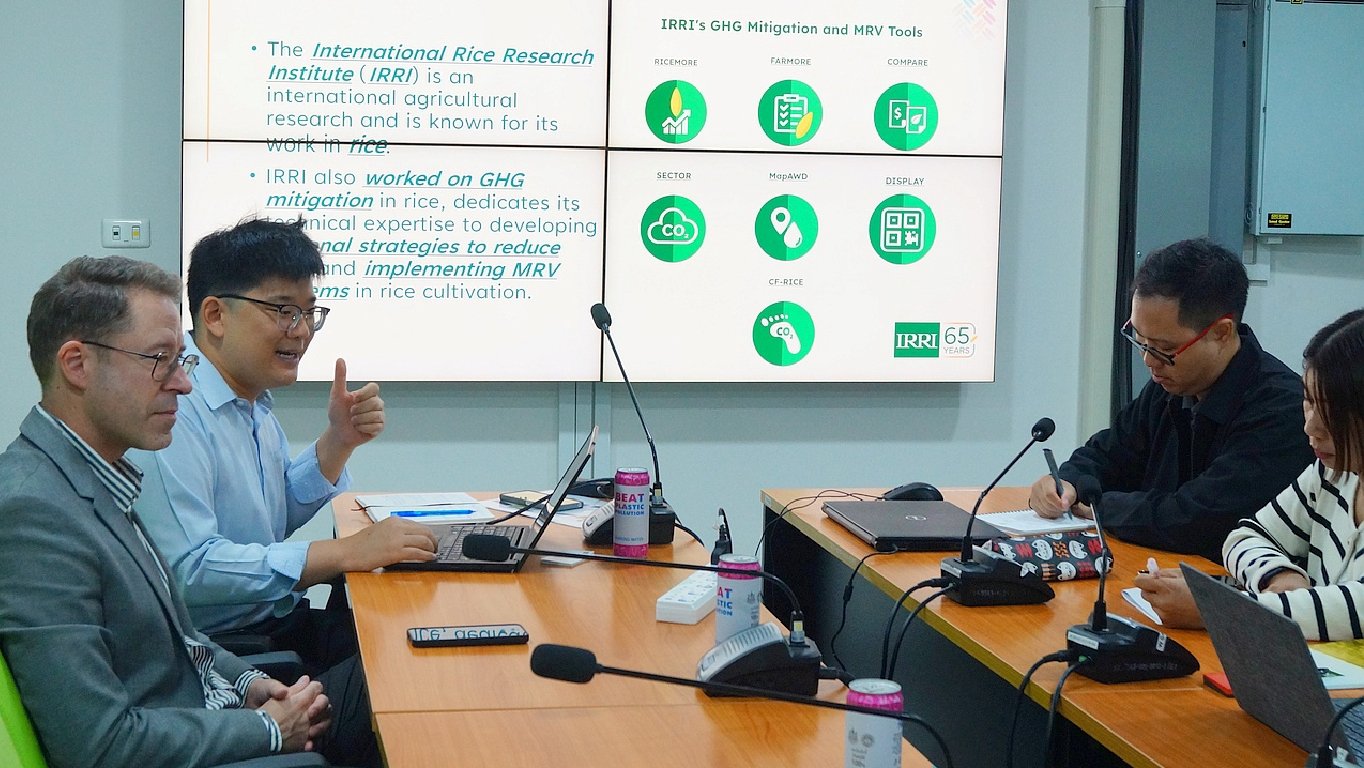
IRRI highlighted its extensive experience in GHG mitigation, Measurement, Reporting, and Verification (MRV) systems, and Nationally Determined Contributions (NDCs) in rice production. The institute introduced a suite of advanced tools—including RiceMoRe, SECTOR, and MapAWD—designed to quantify emissions, monitor mitigation efforts, and support data-driven decision-making in climate-smart agriculture.
Supporting Thailand’s Transition to Advanced Reporting Systems
The dialogue also opened avenues for Thailand to transition toward more sophisticated emissions accounting frameworks, moving from Tier 1 to Tier 2 and eventually Tier 3 reporting systems. Such advancements would significantly improve the precision of emissions estimates, particularly in agriculture, where variability in practices and environments presents unique challenges.
Addressing Long-Standing Barriers in Climate-Smart Agriculture
Both parties acknowledged persistent challenges in scaling sustainable rice practices, including lessons from earlier initiatives such as the Thai Rice NAMA project. IRRI’s technical expertise is expected to play a pivotal role in overcoming these barriers, enabling broader adoption of low-emission farming techniques.
Digital Agriculture and Remote Sensing: The Next Frontier
Looking ahead, the collaboration recognized the transformative potential of satellite-based remote sensing technologies in monitoring agricultural emissions. While still evolving, these tools could enable real-time, large-scale tracking of GHG emissions, positioning Thailand at the forefront of digital climate monitoring in agriculture.
A Strategic Opportunity for Global Leadership
With support from national institutions such as the Rice Department and the Geo-Informatics and Space Technology Development Agency (GISTDA), Thailand is uniquely positioned to pioneer the integration of advanced technologies into agricultural emissions reporting. This partnership could establish the country as a global benchmark in climate-smart rice production and transparent GHG accounting.
Laying the Foundation for Long-Term Collaboration
The engagement underscores a shared commitment between IRRI and DCCE to advance knowledge exchange, refine emissions methodologies, and build robust reporting systems. As climate pressures intensify, such collaborations are set to play a critical role in aligning agricultural productivity with environmental sustainability—charting a path toward resilient, low-emission food systems.
